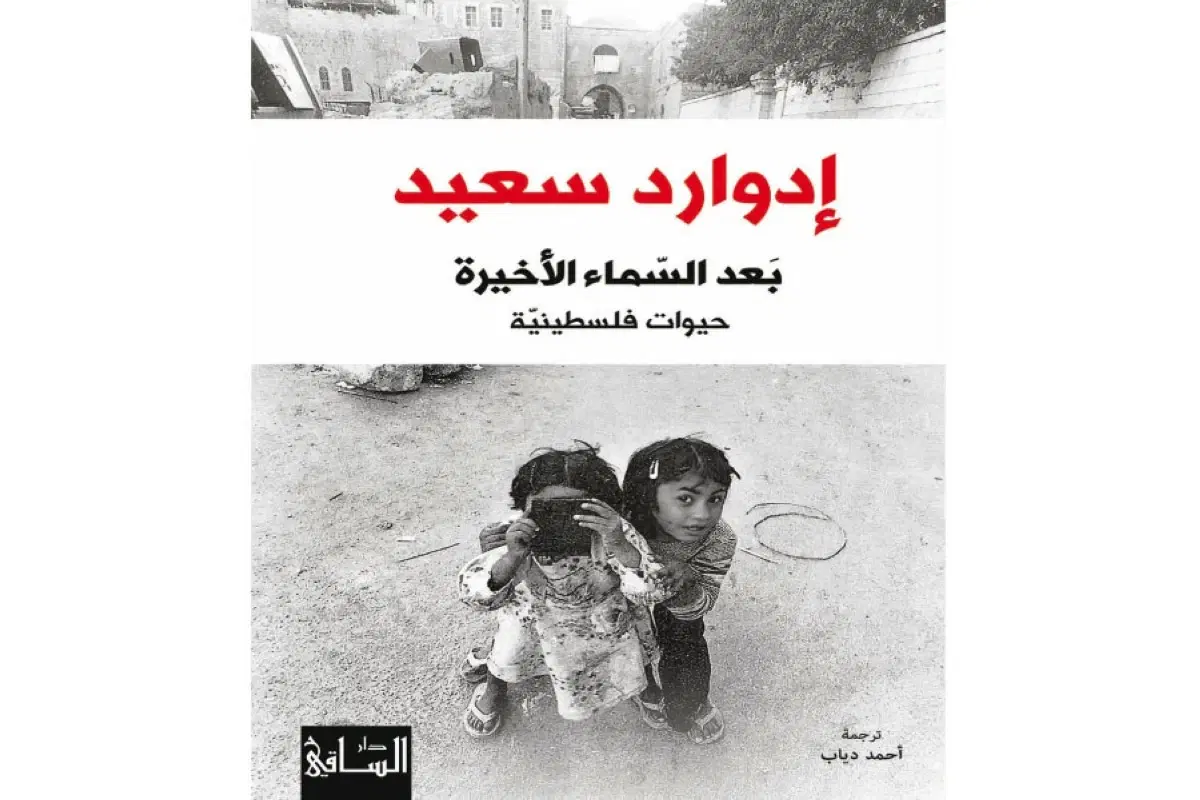
In his book, Edward Said sharply criticized the literature that dealt with the Palestinian; because it carried a discourse charged with controversy, accusation, and condemnation, making it a discourse preoccupied with condemnation more than attempting to understand the Palestinian reality. Within this framework, the Palestinian was reshaped within representations that reduced their complex experience from the image of the exiled refugee to the image of the terrorist, with all the threats and warnings it carried. Thus, identity turned into a ready-made sign, its meaning predetermined, and the plurality of life that Said sought to restore was erased from it.
The book also revealed, in its extension of the critique of representational discourses, a deeper level connected to the structure of narrative itself, as the issue of banning history became a foundational condition for how it appears. The issue did not stop at the erasure of the Palestinian narrative, but went beyond that to produce rare and truncated narratives, lacking continuity regarding stories of origins, home, and nation, as if they were secret and obscured. When this history surfaces, it comes in the form of intermittent fragments, displaced from familiar narrative forms, taking ironic, satirical, or symbolic shapes, making it encrypted and loaded with layers of meaning that are not easily revealed, especially to an external recipient lacking the keys to the context. In this way, oppression allows for the absence of narrative or its expression in a distorted form, which made Palestinian identity formed through fragmentary accumulation rather than a continuous narrative. He says: "Our characteristic mode, then, is not a narrative in which scenes occur sequentially, but rather broken narratives, fragmented structures, and testimonies organized with self-awareness, where the narrative voice continues to stumble over itself, its obligations, and its constraints" (p. 63).
Regarding the chapters of the book, Edward Said began his discussion in "States" with a theoretical framing through which he reveals the dialectical structure that governs the formation of Palestinian identity, where cultures are based on a sharp distinction between the "Self" as a resident origin, and the "Other" as a strange outsider. However, this duality in the Palestinian context does not remain fixed; rather, it is radically inverted; the authentic is redefined as an intruder, which makes the Palestinian condition an existential state conditioned by double alienation: alienation from the geographical place, and alienation in defining the self. This is the crux of the Palestinian dilemma; that is, to find a suitable place in a system that does not allow for your existence.
The Palestinian interior is not absent from Said's mind, as he deconstructed the concept as a semantic structure that combines the geographical extension of the areas located inside Israel and the value transformation of its Palestinian inhabitants, where their status shifted from a position of suspicion and difference in the eyes of the diaspora Palestinians to a position of privilege; as they are the bearers of the experience of actual existence on the land, regardless of what this experience carried of the danger of Israeli occupation restrictions. If the outside is a space of exile, diaspora, and failure, the Palestinian interior for Said did not establish a cohesive unit; it remained governed by secrecy and division, as manifested in the multiplicity of meanings of some central concepts such as the concept of "return."
In the context of deconstructing the concept, Said noted the glaring absence of the Palestinian woman within the narrative structure of the collective experience. As stated in his quote, she is only present as "a link, a connection, a means of passage, or a mere fleeting event" (p. 105). This description is deepened through the experience of his mother, who, during the incident of her passport being torn up by a British official at the Mandate government registration office—to provide a legal place for a Jewish immigrant from Europe—reveals an intense moment where the woman is redefined from an independent entity to a dependent and represented one—a wife and mother—that is, between distributed, non-authentic identities, within an overlapping colonial and social context.
The pain carried by that story, and its persistence in his mother's memory for decades, points to a dual violence: colonial violence that denies the legal identity of the Palestinian woman, and social violence that reaffirms that denial within a patriarchal structure that reformulates the woman's presence within emotional frameworks—mothers, virgins, martyrs—burdening her with symbolic meanings that limit the possibility of speech. We notice that Said's question about the woman's position between being a woman and being a Palestinian does not require prioritizing one dimension over the other, but rather reveals their overlap in producing a situation in which forms of exclusion are multiplied, which is the fate of all Palestinian and Arab women.
The Palestinian did not disappear after the Nakba; rather, their presence increased remarkably within multiple spaces through work and knowledge. However, this "emergence" remained ambiguous; it was accompanied by a constant tension between acknowledging their competence and suspicion of their presence. Said demonstrates this in his reference to Palestinian peasants who represented a crushed immigrant force, uprooted from their traditional agricultural structure, and pushed into an economy that relies more on cities and reshapes their relationship with work and identity. This calls to mind the horizon of Karl Marx; where work becomes a site of alienation as much as it is a means of survival, which explains the Palestinian's preoccupation with reproducing the conditions of their life at the expense of documenting their history and authentic culture. Nevertheless, work for the Palestinian acquired a double meaning; it shifted from an economic activity to a practice of steadfastness (Sumud), and a primary form of daily resistance, through which presence is transformed into a continuous act despite the absence of a political horizon.
The emergence also reflected a new moment of awareness in which Palestinians produced themselves within different environments. Evidence of this was their distinction as teachers, doctors, engineers, businessmen, and intellectuals. That success is nothing but a sign of a collective cohesion formed through work and knowledge, until the Palestinian's reputation for diligence and resourcefulness became closer to a collective narrative circulated by the host societies in exile.