Analysts: The Speech from the Throne establishes a culture of giving, the dignity of the word, and the ethics of disagreement
Amman10 min read
Share
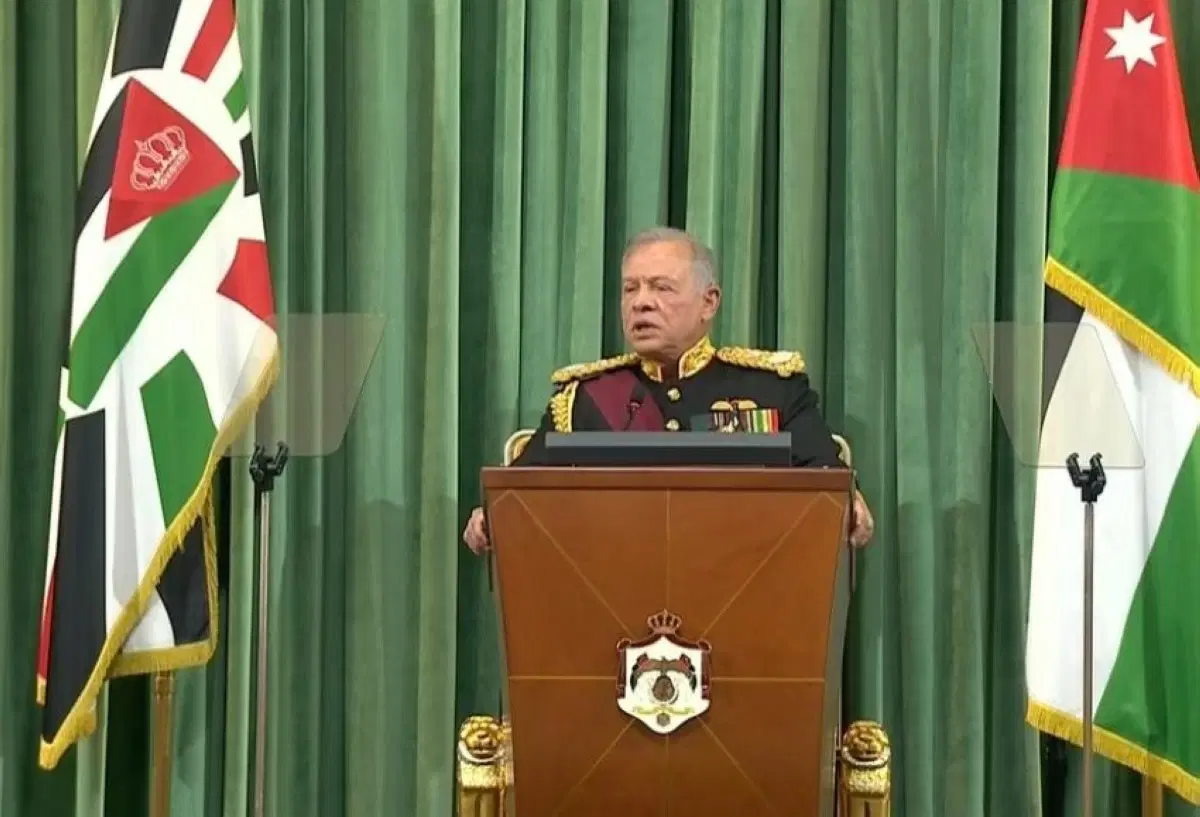
The statement by His Majesty King Abdullah II during his opening, this Monday, of the third ordinary session of the 20th Parliament: "Whoever loves Jordan preserves its beautiful giving, the dignity of the word, and the ethics of disagreement," was not merely rhetorical, but a moral and political constitution that summarizes the philosophy of the Jordanian state in its second centennial, and draws a roadmap for public work under the parliament dome and beyond.
The statement summarized three values at a time when local and regional challenges are growing, and national transformations are accelerating with the launch of political, administrative, and economic modernization paths.
Analysts told the Jordan News Agency (Petra) that "beautiful giving" means invoking the state's memory and the sacrifices of its sons and daughters, reminding us that true citizenship is the preservation of favor and the safeguarding of achievement; that the "dignity of the word" is an affirmation that freedom of expression, guaranteed by the Jordanian Constitution, is neither lawlessness nor defamation, but a responsibility that protects the societal fabric from disinformation and hate speech; while the "ethics of disagreement" comes as a guarantee for the success of the new partisan and parliamentary experience, and as a golden rule for managing political competition within the framework of the higher interest of the state, in a way that strengthens the internal front and preserves Jordan's status as a model of moderation and wisdom in a turbulent region.
Public law professor Dr. Moath Abu Dalhoum confirmed that the royal sentence carries deep connotations emphasizing that love for Jordan must not be limited to mere slogans, but must be transformed into behavior and responsibility borne by everyone, which requires respect for the word, respect for the other, and hard work.
He added that the timing of this message in the Speech from the Throne has significant connotations and carries direct directives to everyone on the necessity of assuming national and moral responsibility, and that political competition must always remain within the framework of the public interest and respect for institutions, the state, values of citizenship, and service to citizens.
Abu Dalhoum explained that these words are translated through a culture of dialogue and respect for the opinion of others, pointing out that the Jordanian Constitution speaks of freedom and the right to expression and opinion based on Article 15 thereof.
He stressed the necessity of moving away from personalization, defamation, insults, and character assassination, and that the parliament should work to exercise oversight and legislation responsibly in a manner that achieves the public interest, and that competition should be through programs to serve citizens far from personal interests.
He indicated that freedom of opinion and expression is a constitutional right but must be linked to responsibility and respect for the rights of others and not exceed the law, and it should not turn into a tool for incitement or hate speech, and it must always remain within the framework of responsibility and for the interest of Jordan.
Abu Dalhoum considered these sentences to represent a national and moral charter that complements the march of political and administrative modernization, and forms a basis for practicing democracy and the rule of law.
He pointed out that modernization and reform do not happen once in the life of nations, but are a continuous process that includes legislation, partisan and political participation in elections, and the entrenchment of a culture that believes in the plurality of opinions, respects the human being, and safeguards their dignity and freedom.
He emphasized the necessity of adhering to activating the internal front and respecting differences in light of the surrounding regional challenges, considering that the unity of the internal front is a source of strength to enhance Jordan's position as a model of moderation, balance, and wisdom amidst a region facing ongoing crises and conflicts.
In turn, the head of the Jordan Press Association, Tariq Al-Momani, said that His Majesty the King has always pushed for the media to be a force for the state, practicing its work professionally and in accordance with ethical rules. He noted more than once that the Constitution guarantees freedom of opinion and expression, and the necessity of highlighting success stories of Jordanians and highlighting the state’s achievements to enhance positives and fight negatives, and here comes the media's responsibility to fight such models and push towards highlighting and strengthening every achievement.
He added that the word in media work carries a great trust and moral and professional weight that goes beyond conveying events to building awareness or destroying stability. This necessitates verifying the accuracy of news and returning to reliable sources, which is not an option but a moral and professional duty, as a scoop does not take precedence over respecting people’s minds, awareness, and feelings, in addition to establishing values and protecting the fabric of society. The word is soft power that strengthens belonging and immunizes society against disinformation and incorrect news, preserves societal peace, and faces crises with wisdom, where the media in such circumstances turns into a fortress of national awareness and moves away from sensationalism and presents the truth as it is without deviation.
Al-Momani pointed out the necessity of humanizing events and respecting human dignity, and that the media should remain a true bridge between the state and the citizen, confirming that there is a journalistic and ethical code of honor that explicitly states respect for disagreement and the other opinion, and rejects hate speech, which is an elementary part of media work. He said if we look at the various media outlets, we find they are far from hate speech; those who practice it are some social media outlets that need a moral charter to regulate their behavior and push towards practicing their work professionally away from incitement, and striving to strengthen common denominators in a way that serves the nation and the citizen and enhances the political process.
For his part, Professor of Sociology at Mu'tah University, Dr. Hussein Al-Mahadin, confirmed that the moral contract referred to by His Majesty the King is the field translation, in thought and behavior, of belonging and achievement in service to the people by everyone in their specialty, and that the process of accumulating achievements of generations and our state crossing its first centennial in a turbulent region is the decisive evidence that the diversity of specialties and the integration of giving are the resort of durability and ascension always.
Al-Mahadin added that the values of loyalty referred to by His Majesty in the Speech from the Throne are a message with multiple addresses and directions for everyone whom our people befriended and for whom they built seedlings without favor, as is our good custom with all brothers and free people upon whom circumstances have been harsh, yet some of them did not preserve the company and love, and this is the way of our leadership and our people together.
He confirmed that the diversity of opinions under the umbrella of the Constitution and under the protection of the law is a national crucible that will work to mature visions and achievements in a participatory national way that represents an extension of the diversity and freedom of conscious expression of opinions and trends towards the issues of the citizen and the nation as part of the flexibility of the intellectual and political building of the Jordanian state.
He indicated that democratic practice is rooted in the conscience and official and civil institutions of the state and expresses the values of citizenship with the diversity of its titles and the nobility of its sustainable goals through the eras of the history of the state of law and institutions, and therefore it is more deserving of being modernized and upgraded by all segments and generations of our active and young Jordanian society.
Al-Mahadin pointed out that the patterns of political socialization were unique to Jordan, starting from the family with its keenness to provide children with the awareness that the basis of things is pluralism, respect for the brother, the neighbor, Arabism, and honoring the guest brother, until our policies and our tolerant dealings in their awareness and nobility became proverbial in the world, and in which Jordanians became a model of success and leading human dialogues in religions, arts, and sciences as a reference we are proud of, and the Amman Message, which has been translated into most of the world's languages, is not far from its distinct connotations.
In turn, former Minister of Government Communications, Dr. Muhannad Al-Mubaidin, stressed that His Majesty the King's words are perfectly clear that those who are rooted in the dictionary of the Jordanian state are those who loved Jordan and gave, sacrificed, and offered generously with their souls, spirits, and years of their lives in the service of Jordan, its leadership, and its people.
He added that the establishment of Jordan was always on a firm covenant between the Hashemites and the Jordanians, titled chivalry and loyalty, and making sacrifices for the sake of Jordan, appreciating the people, respecting their achievements, and being loyal to them, confirming that love for Jordan is not enough alone, but must be coupled with sincerity and work.
Al-Mubaidin explained that what was mentioned in His Majesty the King's words about love for Jordan, and that whoever loves it, Jordan preserves for them beautiful giving, the dignity of the word, and the ethics of disagreement, is in the context of noting that love for Jordan is not without cost, but is among the traits of the noble and chivalrous, and also that expressing opinion and disagreement in views and words is something the state was raised upon in its appreciation of pluralism and the appreciation of the opinions that come from those who loved Jordan and went on the journey of establishing the Emirate and the state over a hundred years and more.
Al-Mubaidin indicated that this is the concept of the contract upon which the state was founded between the Hashemites and the Jordanians as citizens who offered this country during its building journey many achievements, many sacrifices, much blood, and martyrdom for the sake of its elevation.
He pointed out that the message of the Hashemites towards Jordanians was always to preserve their dignity while being gentle in the ethics of disagreement and accepting each other's opinions regardless of how they are, for the sake of the nation's interest. Jordanians may disagree in opinion, but they do not disagree on Jordan, its love, and loyalty to its leadership.
He confirmed that His Majesty the King spoke of kindness to Jordanians regarding their land, preserving it, and preserving the capabilities of their nation and their achievement, and this is what beautiful giving and loyalty mean, which is the rare currency; loyalty to Jordan, loyalty to achievement, loyalty to sacrifices, and loyalty to a long path of the Jordanian building journey over decades and over a century and more.