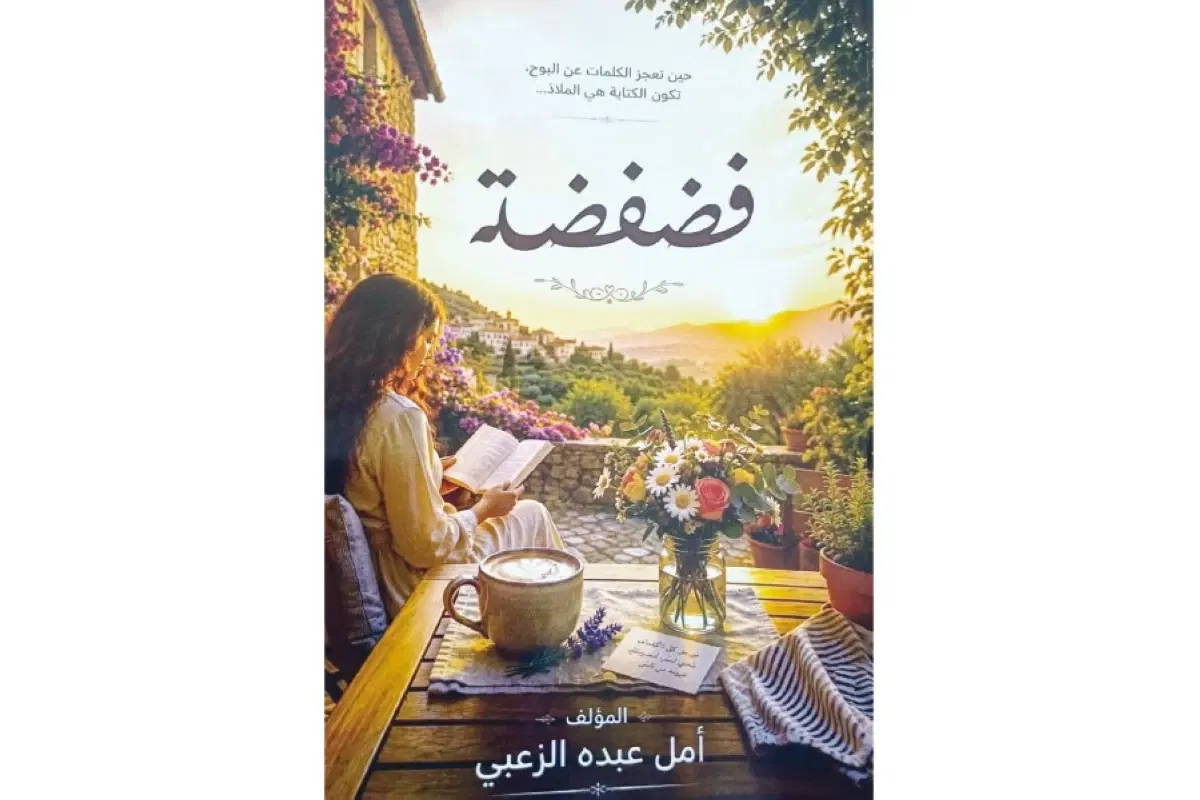
“Not all ventilation is chatter; some of it is documentation of life.” With this spirit, novelist Amal Abdo Al-Zoubi opens the door to her new narrative short story collection, “Fadfada,” recently published by Yafa House for Publishing and Distribution, with support from the Jordanian Writers Association.
Al-Zoubi divided her collection into twenty sub-headings through which the heroine vents: A Dignified Father, The Late King, My Mother, Family, The Enhancing King, Our Queen and Patron of Initiatives, The Crown Prince and Hope of Tomorrow, Young and Old, My Homeland, Sisters, Brothers, Friends, Halves of My Life, Childhood and Youth, Neighbors, Trips to the United Arab Emirates, Trips to Qatar, Trips to Saudi Arabia, Trips to Turkey, and a Trip to Egypt.
In this 135-page medium-sized collection, Al-Zoubi relied on a new style of narrative writing, different from the style of her previous novels and collections, where she made the entire narrative spoken by a single heroine who was never named.
Between “Gaza Sunrise 2030,” which asked about tomorrow, and “Fadfada,” which answers for today, there is a distance of nostalgia, homeland, and memory. About this distance, and about an unnamed heroine speaking for all women, "$" spoke to Al-Zoubi:
The collection includes notable titles such as “The Late King, The Enhancing King, Our Queen and Patron of Initiatives, The Crown Prince and Hope of Tomorrow.” Why did you dedicate this space to the Hashemite leadership in “Fadfada,” which is primarily a social collection?
Because the homeland is not a side heading in our lives; it is the whole story. I am a daughter of this country, and the heroine’s ventilation is not complete without venting about her big house. I dedicated large corners to the Royal Family in my book because the Hashemite family actually owns a large part of every Jordanian’s life, and every Jordanian has a story with them. The late King is our memory and conscience that never fades, the Enhancing King is our security and stability, our Queen is the mother of initiatives and humanity that we see in every home, and the Crown Prince is the hope of tomorrow in whom we see ourselves and our children. I did not dedicate space to them out of courtesy, but wrote about them as an integral part of our social life. I was honored to write about them on behalf of every Jordanian who loves their country and their big family.
Where do you draw inspiration for the events and characters?
I do not invent; I capture. The hero of my stories could be a taxi driver whose sentence I heard, or a woman in a bakery queue, or a small piece of news I read that everyone else passed over. But diverse social relationships—friends and family—are the inspiring and dominant idea for me, so I made the narrative of all the stories through one heroine. She is both real and imaginary at the same time: real because I heard the events from more than one heroine, and imaginary because the entire narrative of the collection was told by one character.
What distinguishes “Fadfada” from your previous short story collections like (Scattered Papers)?
“What distinguishes it is that its narrative style is entirely new for my books. My previous collections were images of life, separate short stories, each story with a different heroine. As for “Fadfada,” it is a calculated risk. It is not a collection of short stories in the traditional sense, but rather closer to a narrative autobiography. One unnamed heroine tells twenty stories, with one voice and one thread connecting them. It is as if you are sitting with one woman venting to you about her whole life. Therefore, it is not just stories, but a biography of one soul divided into twenty ventilations.”
What difficulties did you face, given that it consists of 20 stories with different endings?
The difficulty in a novel is that you have to maintain a long breath, whereas in a short story collection, the difficulty is that you stop the breath and start anew each time. Each story has its own mood, unique flavor, language, hero, and ending. The biggest challenge was that these stories should not resemble each other, that I should not repeat myself, and that I should make the reader—despite the different worlds—feel that there is one thread connecting those stories.”
After the novel “Gaza Sunrise 2030,” did you use real characters?
After the novel (Gaza Sunrise 2030), I learned that the real hero is too great to be trapped in a story. In the novel, I was forced to document a place and a time, whereas in the stories, I was freer. Certainly, there are real souls that passed between the lines, people I met, but I do not convey them as they are; rather, I borrow from them a hidden feeling or a sentence that stuck in my mind. All the heroes of the collection are real in terms of feeling and imaginary in terms of the story, and this is what protects them and protects me. The novel (Gaza Sunrise 2030) was asking about the future, whereas this collection is an attempt to answer the present. Gaza taught me that the big story exists in the small details.
How much time did “Fadfada” require from you?
“The collection was not written in a year or two; it is an accumulation of years. The short story tricks you; you think it is fast because it is short, but in reality, it needs a long fermentation time. Some stories I wrote in a day and spent more than a week refining, and some took me longer.”
“Fadfada” is not the end of a story, but its beginning. After I asked in “Gaza Sunrise 2030” about the future of a homeland, I decided in “Fadfada” to document the present of a human being. It is a mirror for every woman who ever found herself between the story of a dignified father, a mother’s prayer, a King’s memory, and a Crown Prince’s dream, to say in the end: We are all heroes of small stories, but when they are gathered, they become the homeland.