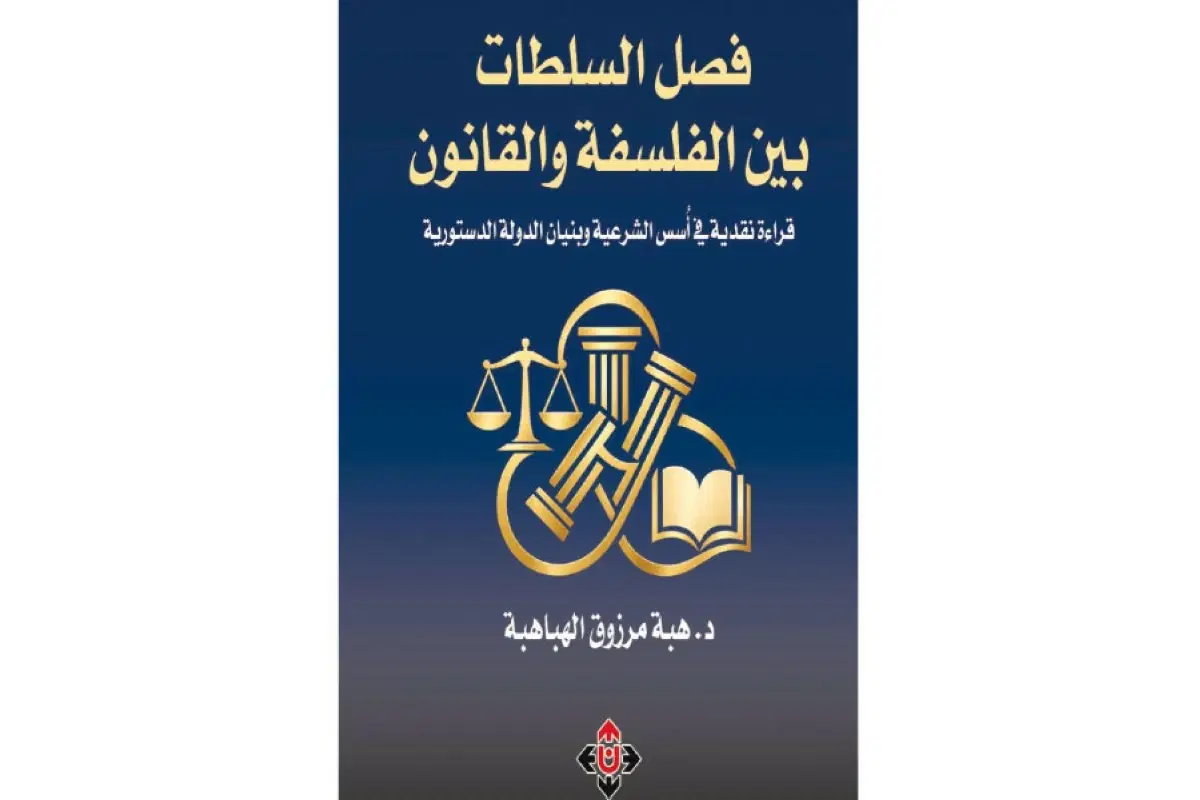
“Separation of Powers between Philosophy and Law”.. A book by researcher Heba Al-Habahbeh
Amman6 min read
Share
The Jordanian legal researcher, Dr. Heba Marzouq Al-Habahbeh, opens an intellectual and legal debate in her book, “Separation of Powers between Philosophy and Law,” regarding one of the most prominent theories founding the modern constitutional state. She traces its philosophical roots and legal transformations, as well as the issues its contemporary applications raise concerning the balance of powers, the legitimacy of legislation, and the protection of rights and freedoms, in an attempt to answer a fundamental question about the ability of political systems to achieve a balance between authority and liberty.
The book, recently published by “Al-Aan Publishers and Distributors” in Amman, provides an analytical and critical approach to the theory of separation of powers and the problems of its application, particularly those related to the overlap between powers, the legitimacy of legislation, and the relationship between law and justice, culminating in the proposal of a “legislative legal code” aimed at strengthening constitutional oversight and control and activating the principle of separation of powers.
The book, with a cover designed by poet and artist Eid Banat, starts by grounding the concepts of natural rights and natural law as a philosophical reference for the legitimacy of law and the restriction of power, before moving to the philosophical debate regarding the origin of the state and sovereignty, and the development of the idea of separation of powers as a constitutional guarantee against tyranny and for achieving balance between the legislative, executive, and judicial branches.
The central problem addressed by the book is the extent to which the theory of separation of powers can function effectively in current political systems, in light of the overlap between law and politics and the resulting effects on the legislative process. Hence, Al-Habahbeh adopts a critical and comparative approach to deconstruct existing theoretical frameworks and analyze various legal and legislative structures, reaching a proposed legislative vision.
The book retraces the intellectual roots of the idea of distributing state functions, starting from Greek philosophy with Plato and Aristotle, all the way to Montesquieu, who crystallized the most famous formulation of the principle of separation of powers: the legislative branch enacts laws, the executive branch enforces them, and the judicial branch administers justice. The research does not stop at this foundation but follows the development of the idea in schools of legal philosophy, as well as utilitarian, realist, and positivist doctrines.
The author believes that the separation of powers should not be understood merely as a functional distribution of state tasks, but as a philosophical and moral necessity to protect liberty and ensure the legitimacy of legislation. According to the book's argument, the concentration of power threatens liberty and drains the law of its content, while a balance between the powers allows for a system more capable of protecting rights and freedoms.
The study expands on examining the gap between theory and practice, pausing at the possibilities of political bias in the legislative process, the influence of interests and alignments in drafting laws, and the resulting imbalance in the legal structure. Therefore, it does not stop at evaluating the principle of separation of powers, but seeks to test its ability to produce effective legal rules in the political and institutional reality.
In this context, the author gives the philosophical dimension a primary place in reading legislation, considering that integrating philosophical and political awareness into legal work is not an intellectual luxury, but a necessity to curb overreach and unfair legislation, and to rebuild a more balanced relationship between the philosophy of legislation and the philosophy of the constitution.
The book moves within four main axes; it begins with “The Theory of Right and Natural Rights,” then moves to “The Theory of the State and Separation of Powers,” then addresses “Separation of Powers as a Framework for Exercising Legislative Authority,” before arriving at the axis of “Re-establishing the Legal System,” where the author proposes integrating a philosophical vision into mechanisms for facing contemporary constitutional and legal challenges.
In her critical approach, Al-Habahbeh draws on a number of philosophical and legal trends and schools, from Montesquieu, Locke, and Rousseau to Marxist thought, and from legal positivism according to Austin and Kelsen to the conceptions that link law with values and justice according to Radbruch and Dworkin, up to Habermas and Rawls. Thus, the book places the principle of separation of powers within a broader debate about the nature of law, its sources of legitimacy, and the limits of authority.
The book concludes that the separation of powers does not achieve its purpose merely by the existence of constitutional texts defining institutional competencies, but requires an effective system of checks, balances, and mutual oversight, as well as an independent judiciary capable of protecting the spirit of the law and fundamental rights. It also calls for making legal legitimacy a continuous dialogical process, not just rigid rules separated from the values of justice.
On the practical side, the author proposes adopting a flexible separation of powers that ensures cooperation without falling into disruptive merging, strengthening judicial independence, activating mutual and social oversight, and re-establishing the law as a moral value and a guarantee of liberty, leading to the formulation of a “legal/constitutional code” that combines philosophical and legal rules for the principle of separation of powers.
The book “Separation of Powers between Philosophy and Law” places constitutional theory in the face of its most pressing question: How can texts that organize power become actual guarantees of liberty and justice? By combining philosophical grounding, legal analysis, and critical theory, Al-Habahbeh opens the discussion on the necessity of rethinking the separation of powers as a living institutional practice, not just a fixed constitutional rule.
It is noted that the author is a legal researcher specializing in legal contracts in both Arabic and English. She graduated from the University of Jordan, Prince Al-Hussein bin Abdullah II School of International Studies, and obtained a Bachelor's degree in Law, then a Master's degree in Human Rights and Human Development, up to her PhD. She possesses extensive practical experience in drafting contracts and legal consulting, in addition to research interests in legal and humanitarian issues, particularly refugee rights and humanitarian legislation, and is distinguished by a critical vision in approaching these issues.