Academics: King’s UN speech warns against ignoring crises and the sustainability of occupation
Amman6 min read
Share
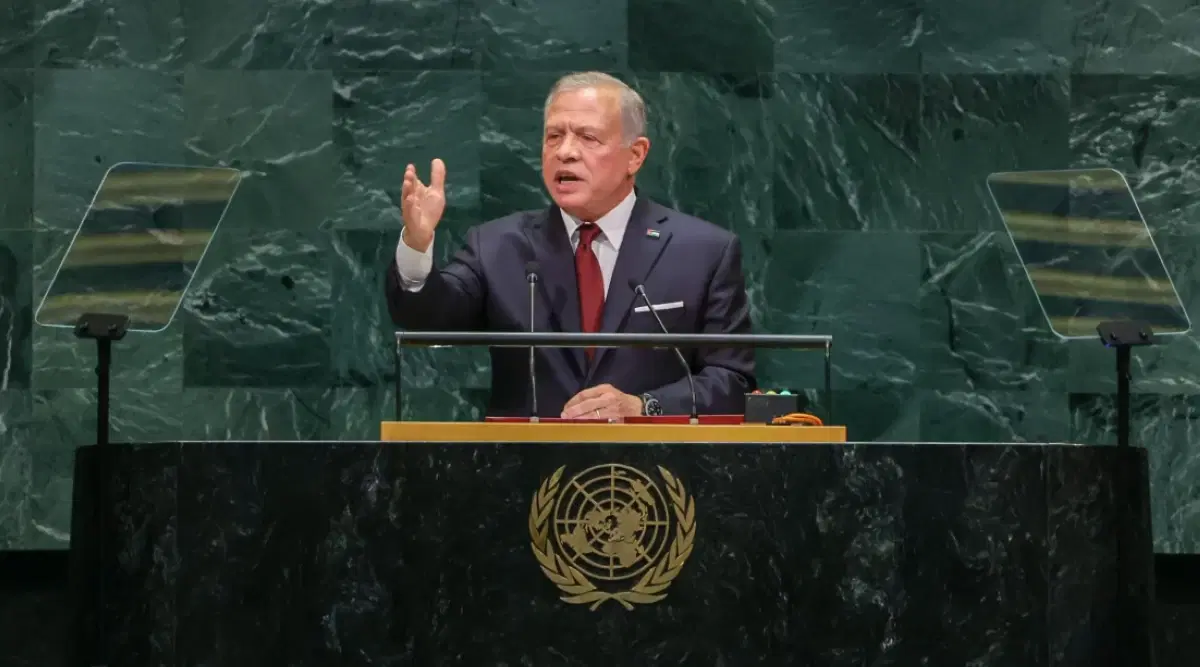
In a world where crises crowd together and collective memory fades rapidly in the face of a flood of events, His Majesty King Abdullah II’s speech before the 81st session of the United Nations General Assembly came to sound the alarm in strong, direct language that departed from diplomatic convention.
Academics confirmed to the Jordan News Agency (Petra) on Thursday that His Majesty King Abdullah II, as the first world leader to speak, did not merely describe the crises, but revealed the deep-seated reasons for their persistence, describing the humanitarian catastrophe in Gaza as a stain on an international community that is either helpless or silent.
They pointed out that His Majesty warned that the decline in global attention in the age of digital screens opens the door for the temporary occupation to turn into a permanent reality, stressing that the speech solidified the firm Jordanian position of adhering to a just peace and supporting Palestinian steadfastness at a time when international political calculations are shifting from one day to the next.
The Deputy Dean of Student Affairs at the University of Jordan, Professor of Law Dr. Abdullah Al-Tarawneh, said that His Majesty King Abdullah II’s speech before the UN General Assembly revealed a vision that goes beyond describing crises to analyzing the reasons for their persistence, presenting the concept of "attention" as an entry point for understanding international politics.
Al-Tarawneh explained that the speech showed that the decline in global interest in crises opens the door for the temporary to turn into the permanent, which the speech linked directly to the Palestinian cause, noting that the speech addressed Gaza and the West Bank within a single path that, according to the Jordanian approach, leads to changing the geographical and political reality and undermining the possibility of establishing a viable Palestinian state.
He said that the speech, from a legal perspective, moved from describing events to questioning the value of international law itself in light of the fact that violations and international resolutions remain unimplemented, based on descriptions such as forced displacement and de facto annexation.
He added that the concept of security in the speech expanded from protecting borders to protecting water and national interests, and confronting terrorism and smuggling, while linking developments in southern Syria directly to Jordanian national security.
Al-Tarawneh emphasized that the speech did not pit diplomacy against force, but rather considered that sustainable security requires, at the same time, law, institutions, trust, and the ability to protect interests.
He concluded that the central message of the speech is that ignoring crises does not maintain stability, but rather allows for the accumulation of facts that threaten security and peace in the long term.
Furthermore, Professor of Constitutional Law at the University of Jordan, Dr. Meshal Al-Majali, pointed out that His Majesty King Abdullah II’s speech before the UN General Assembly, as the first world leader to speak, constituted a stern disclosure to an international community accustomed to managing crises rather than solving them radically—a disclosure delivered in strong and direct language.
He noted that His Majesty warned of the decline in human attention span in the age of digital screens, and the danger of turning fateful issues into fleeting events, emphasizing that the future is shaped by what we choose to confront, not ignore.
Al-Majali indicated that the war on Gaza was at the heart of the speech, as His Majesty described the humanitarian catastrophe there as a stain on an international community that is either helpless or silent, and considered the targeting of civilians and hospitals and depriving them of food and medicine a complete crime that requires immediate action for a ceasefire, while confirming Jordan’s continued support for the steadfastness of our brothers and for UNRWA.
He pointed out that His Majesty linked the expansion of wars to the global cost of living, warning that the conflicts in Lebanon, Yemen, and Sudan threaten global stability, citing the impact of tensions in the Straits of Hormuz and Bab al-Mandab and the Red Sea on oil prices and global inflation.
Al-Majali explained that the King rejected the separation of Gaza from the West Bank, and described settlements, land confiscation, and forced displacement as a single strategy that undermines the establishment of a Palestinian state.
His Majesty also stressed the necessity of supporting the security and stability of Syria, and reaffirmed the Hashemite Custodianship of Islamic and Christian holy sites in Jerusalem.
He noted that His Majesty proved that military force does not build peace, putting international legitimacy to a real test, and confirming that Jordanian diplomacy represents a deterrent force through words and legal and moral arguments.
Dr. Assem Mohammed Al-Hunaity from Al-Balqa Applied University confirmed that His Majesty King Abdullah II’s speech before the 81st session of the UN General Assembly came to clearly outline the firm Jordanian position toward the region and the crises and neglect it suffers from, at a time when the world is teeming with successive conflicts.
Al-Hunaity said that His Majesty focused in his speech on the necessity of reordering priorities, pointing out that challenges such as economic inequality and food insecurity are not new, which, according to His Majesty, required giving them permanent, not fleeting, attention.
He explained that the speech formed a nucleus for reordering the priorities of international debate, as His Majesty made the Israeli violations against our brothers in Palestine, in Gaza and the West Bank, the two sides of the same coin for Palestine, the most prominent axis that requires attention in order to preserve humanity, which suffers daily as a result of these transgressions.
Al-Hunaity noted that His Majesty the King reaffirmed that the General Assembly has long warned of the dangers of leaving the Palestinian conflict without a solution, but this warning was met with treatment of the brutal violation as if it were a temporary matter, which solidified the conviction that the permanent approach has become the habit of the occupation.
He added that His Majesty emphasized the crimes that affected the children of Gaza in clear disregard for international law, and did not stop there, but extended to infrastructure, in addition to the intransigence in rejecting the idea of withdrawal, and the continuous tightening of the noose on the Palestinians.
Al-Hunaity stressed that His Majesty the King reaffirmed Jordan’s commitment, as a people, army, leadership, and government, to a just peace, supporting Palestinian steadfastness, and carrying the trust of the Hashemite Custodianship of Islamic and Christian holy sites, reflecting a firm Jordanian approach based on the values of openness to others.
Al-Hunaity concluded that Jordan, with its firm position in a time when political calculations change from one day to the next, has become a reliable model, thanks to its firm principles and positions that do not change no matter how intense the challenges become.