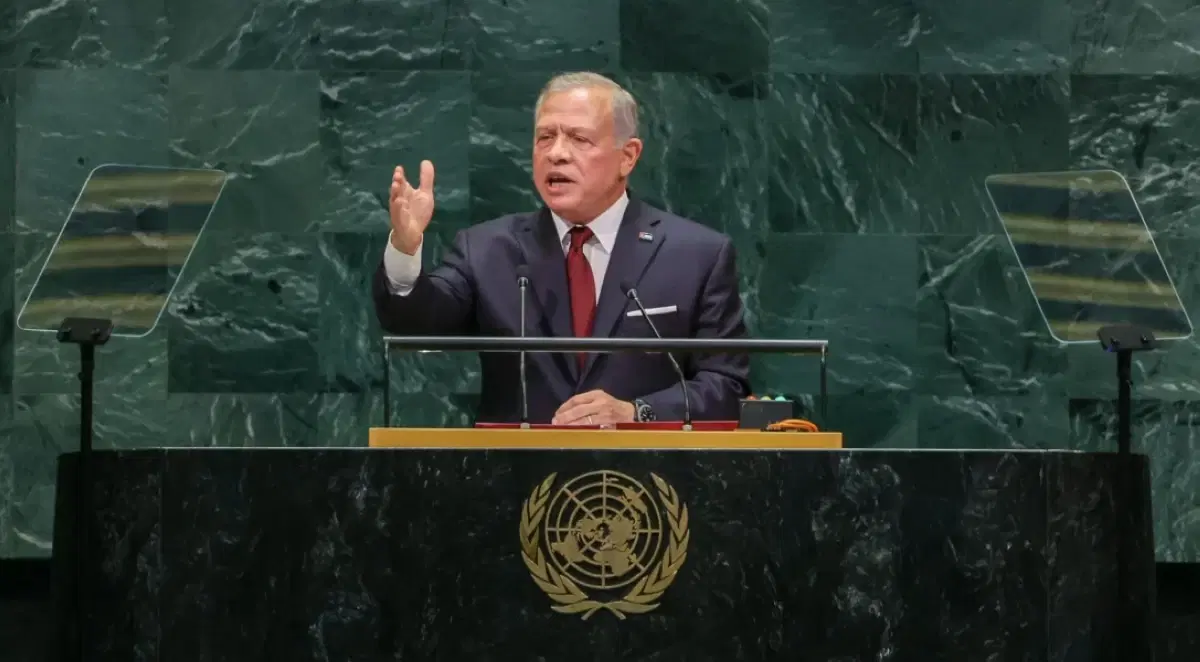
The King's Speech at the United Nations .. International Law Facing the Test of Action and Accountability
Amman6 min read
Share
King Abdullah II's speech at the United Nations General Assembly went beyond describing crises to holding international tools accountable for dealing with them, affirming that the continuation of violations, particularly those related to the Palestinian issue, places the international community with the responsibility of transitioning from positions to actions that ensure respect for international law.
Political experts and analysts told the Jordan News Agency (Petra) that the speech carried political, legal, and regional implications that reflected the constants of the Jordanian position towards the Palestinian issue and the responsibility of the international community in dealing with its repercussions, along with the challenges imposed by regional developments that affect the security and stability of the region.
Former Deputy Prime Minister Dr. Mohammad Al-Hallaique said that the King's speech placed the international community before its responsibilities regarding the continuation of violations and the decline in the effectiveness of international law tools, adding that the importance of the speech lies not only in the issues it addressed but also in the political messages it carried, as it was clear that His Majesty the King is dealing with the developments in the region as interconnected, and that continuing to address crises in a partial or temporary manner exacerbates their risks and expands their repercussions.
He pointed out that the focus on the West Bank alongside Gaza reflects a Jordanian reading of the nature of the coming phase, especially in light of the continuation of Israeli measures and their repercussions on the Palestinian issue and the region, while the reference to southern Syria and the Golan Heights carried an important implication directly related to Jordanian security, including water security.
He explained that water security for Jordan is not just a technical file or a resource issue, but a fundamental part of national and strategic security, and any change in the reality of water resources or control over them in neighboring countries can have direct repercussions on the Kingdom, making the protection of Jordanian water rights and interests a matter that goes beyond foreign policy to the core of national security.
He added that what is striking in the speech is the transition from warning about the repercussions of Israeli policies to emphasizing the need for non-compliance with international law to have a political and economic price, considering that the call for sanctions reflects a trend towards holding the international community responsible for using its available tools, rather than being content with condemning violations.
Hallaique said that the speech as a whole reflects a Jordanian vision that considers the continued dealing with Israel as an exception to the rules of international law as threatening the security and stability system in the region, and that addressing this imbalance is no longer just a Palestinian or Jordanian issue, but a matter related to the credibility of the international system and its ability to apply its rules equally.
For his part, former Minister of State for Media Affairs Eng. Sakhar Duddin said that the King's speech came as a high-level political and moral defense for the Palestinian cause, characterized by exceptional frankness in describing Israeli practices and direct criticism of international inaction in enforcing international law and decisions.
He added that the speech placed the international community before the responsibility of transitioning from containing the conflict to addressing its roots, warning that turning violations into familiar facts and remaining silent about their continuation threaten the credibility of the entire international system.
One of the most prominent implications of the speech, according to Duddin, was the clear link between what is happening in Gaza and the West Bank, considering them as two sides of a single strategy aimed at imposing a new reality on the ground and undermining the possibility of establishing a viable Palestinian state, noting that the speech went beyond general descriptive language to naming forced displacement in the West Bank as a war crime and emphasizing that accountability begins with recognizing the reality of what is happening and not covering it with misleading terms.
On the international level, Duddin explained that His Majesty the King directed a frank criticism of double standards, pointing out that the international community has political, economic, and diplomatic pressure tools, including sanctions, asset freezes, bans, and diplomatic isolation, and holding it accountable for keeping resolutions related to Israel on paper.
On the regional level, Duddin pointed out that the speech carried a clear warning against Israeli expansionist ambitions and their repercussions on the stability of the region, affirming that the security of Jordan's northern borders and its water security are non-negotiable parts of its national security.
He added that His Majesty the King reaffirmed Jordan's approach based on active diplomacy, strengthening defense capabilities, continuing to support the steadfastness of the Palestinian people, and adhering to the Hashemite custodianship of Islamic and Christian holy sites in Jerusalem.
For his part, Director of the Strategic Studies Center at the University of Jordan, Dr. Hassan Al-Moumani, considered the King's speech to be a model for speeches that the world currently lacks, noting that His Majesty, as a leader with vision and credibility, delivered a speech that reflects the vision of an exceptional leader, both in terms of content and body language.
He pointed out that His Majesty highlighted extremely important and powerful words, especially when he talked about the need to pay attention, the transformation of a temporary position into support for Israeli practices, and the international position that ignores the fact that Israel is an occupying state.
He considered that His Majesty the King's speech, in the history of Arabic and global speeches related to the Palestinian issue, was one of the strongest, clearest, and most courageous in expressing the position towards the occupying state.
He pointed out that every word spoken by His Majesty added something new to diplomatic language, explaining that His Majesty presented, in the diplomatic context, a balanced speech in terms of argument and strong in terms of content.
He said that the speech came under extremely difficult circumstances, especially the war on our people in Palestine and the regional developments linked to it, noting that these circumstances are related to what he described as the arrogance and brutality of the Israeli state.
He added that the speech reflected Hashemite and Jordanian convictions towards these issues, noting that His Majesty the King's speech reminded him of his speech last year during the United Nations General Assembly meetings in New York.
He said that His Majesty, through his speech, sent a message to the world and clearly represented a model of how great leaders should deal with international and regional issues.