The King's Speech: A Political, Legal, and Humanitarian Plea for a Fair UN Strategy
Amman6 min read
Share
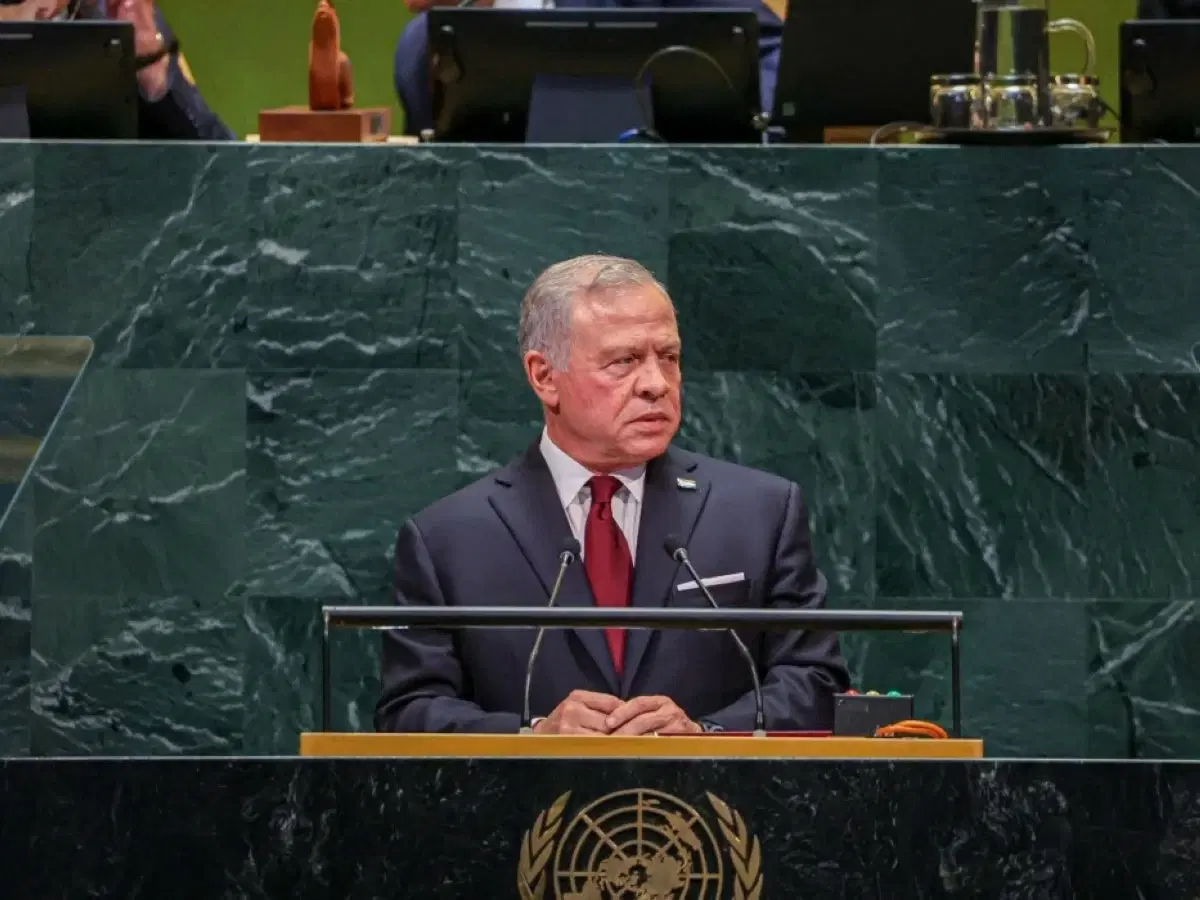
His Majesty King Abdullah II's speech before the 81st session of the United Nations General Assembly outlined Jordan's stance on regional crises in an attempt to reorder international discussion priorities. His Majesty chose to begin by shifting the international community's attention to the geopolitical concept, which is directly linked to the international ability to prevent wars from becoming permanent realities.
His Majesty's speech can be read as a political, legal, and humanitarian plea that is itself a strategic Jordanian message for peace. The speech placed the Palestinian issue at the heart of a broader crisis concerning the credibility and seriousness of international law, and it linked the continuation of occupation, settlement, and displacement to a decline in trust in the ability of international institutions to enforce their decisions.
At the same time, His Majesty clearly outlined the limits of Jordanian interests, affirming that diplomacy and openness to dialogue do not mean compromising on protecting Jordan's security, borders, waters, and national interests.
For many years, the Palestinian-Israeli conflict has been dealt with through concepts of de-escalation, de-escalation, crisis management, and a return to negotiations. The King's speech posed a new question: can the conflict be managed indefinitely without addressing its roots and identifying its true causes?
The implicit answer in the speech was that continuing to manage the conflict without a fair political solution will lead to the entrenchment of the existing reality, where occupation, settlement, displacement, and expansion are treated as temporary crises while on the ground they turn into realities that are difficult to change or ignore. His Majesty linked this to Gaza and the West Bank.
His Majesty's call for the international community to move from merely containing the conflict to addressing the root of the problem, and that this is related to the future of the political solution itself, was perhaps one of the strongest political messages in the speech regarding international law and the issue of its unequal application. This was evident in His Majesty's question about the value of the law if some of its decisions remain unimplemented for many years.
According to political analyst and academic Dr. Yousef Al-Muwaidi, while His Majesty's speech was directed at the international community, it also carried a clear message to the Jordanian domestic audience that diplomatic openness and balanced policy do not mean that Jordan accepts its interests or security being tested.
Al-Muwaidi added that Jordanian policy, as reflected in His Majesty's speech, is based on combining dialogue and diplomacy with the ability to protect national interests. He pointed out that this balance is evident in the set of files addressed by the speech, which were of utmost importance.
He noted that the Hashemite custodianship of Islamic and Christian holy sites in Jerusalem represents one of the fundamental constants of Jordanian policy. He explained that this came within the general framework of the speech linked to protecting the historical and legal status of the city and its holy sites, noting that the most important aspect of addressing Jerusalem was not separate from the call for peace but within a vision that considers the protection of holy sites as part of protecting peace opportunities and preventing the political conflict from turning into a religious one, noting that this point is particularly important in light of repeated Jordanian warnings against unilateral actions that could affect the status quo in Jerusalem.
Al-Muwaidi mentioned that the royal speech referred to regional and international crises, linking them to a central idea that ignoring crises does not lead to their disappearance, and that the world cannot choose only the crises it wants to deal with because the consequences of crises are transmitted and become cross-border.
Retired Major General Ali Salama Al-Khalidi, a military and security analyst, said that the message of His Majesty King Abdullah II was clear that the Jordanian message should be clear and unambiguous. Jordan is for peace, but it wants peace based on law and justice. Jordan is for dialogue, but it will not allow dialogue to be understood as abandoning its security. Jordan supports the Palestinian cause, but it also presents it as a global stability issue.
He added that His Majesty's speech before the United Nations General Assembly can be read through a number of parallel axes. The first axis focused on Palestine by emphasizing the centrality of the Palestinian issue, rejecting the continuation of occupation, settlement, and displacement, and adhering to a political solution that guarantees the establishment of a Palestinian state. The second axis focused on the international aspect by questioning the international community's ability to apply international law equally and to use the available political and economic tools to prevent the continuation of violations.
The Jordanian axis was confirmed by His Majesty's emphasis that the Kingdom will continue its open diplomatic policy, but at the same time, it considers its security, borders, waters, and national interests as lines that cannot be crossed.
Major General Al-Khalidi added that the most significant political value of the speech was the way His Majesty reordered the relationship between peace and law, between diplomacy and national interest, and between international attention and the responsibility of the international community, noting that the Jordanian message in New York was not just a description of what is happening, but a call to change the way of dealing with events.
Political and security writer Dr. Mutasim Al-Dulaimi said that the importance of the royal speech lies in its transition from warning about the consequences of violations to emphasizing the need for a political and economic price for violating international law, considering that this requires the international community to take responsibility for using and activating the tools available to it.
He added that this proposal is not only related to the Palestinian issue, as the continued selectivity in applying the rules of international law affects confidence in the entire international system, where the speech placed the Palestinian issue in a position beyond the limits of the conflict between Palestinians and Israelis. He continued, if occupation, settlement, and displacement continue despite international warnings, the question becomes related to the credibility of the institutions that are supposed to ensure respect for these rules.
Al-Dulaimi said that His Majesty's message to the international community was that the continuation of the current situation will not keep its impact limited to Palestine, and that the entire region is paying the price of the continuation of the conflict through security tension, reduced development opportunities, increased cost of wars and displacement, disruption of trade and investment, and increased risks of extremism and instability.
He said that His Majesty presented Jordan as a country open to dialogue, committed to diplomacy, and ready to work with all parties seeking peace, as diplomacy for Jordan is not a separate goal from national security, but one of the tools for protecting national interests.