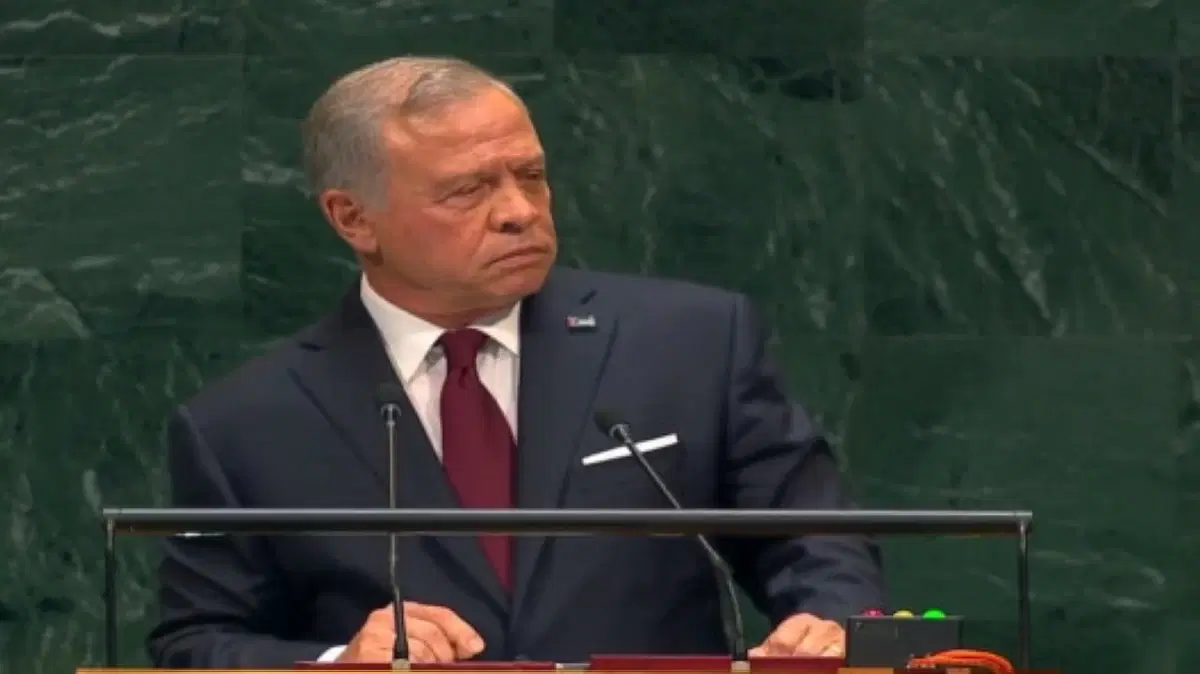
Attention turned to the podium of the United Nations General Assembly, where His Majesty King Abdullah II delivered Jordan's speech at the opening session of the 81st session. His Majesty's speech comes at a highly important and sensitive time on the regional and international levels, as challenges to security and stability and the future of the international system emerge.
His Majesty's speech at the United Nations carried important Jordanian diplomatic messages regarding key issues, foremost of which is the Palestinian issue, halting the escalation, protecting Jerusalem and its holy sites, and adhering to the two-state solution, alongside the security and sovereignty of Arab countries, and the necessity of dealing with the region's crises through political solutions and international law. The current session of the General Assembly, which includes about 130 heads of state and government, makes the UN platform a broad space for presenting national visions on global crises and challenges.
The Palestinian issue also received a wide space in the royal speech, which is a clear continuation of a Jordanian political constant that has been present in His Majesty's speeches to the General Assembly over the past years.
His Majesty clearly focused on the need to end the suffering of the Palestinian people, especially in Gaza, and to put an end to the Palestinian-Israeli conflict through a political solution and the establishment of an independent Palestinian state with East Jerusalem as its capital, emphasizing that sustainable security and peace.
Given current developments, His Majesty reaffirmed that the continued lack of a political horizon for the Palestinian issue is one of the most important sources of instability in the region and that dealing with the humanitarian and security consequences of the conflict does not replace addressing its political roots.
His Majesty's speech, which carried Jordan's vision and interests directly to international decision-makers, focused on the Palestinian issue and the two-state solution, in addition to the regional repercussions on Jordan and the search for a lasting political solution, especially since the continuation of the conflict directly affects the security and stability of the region and the future of its peoples, in addition to the royal vision related to Jerusalem and Islamic and Christian holy sites, which is a central issue in Jordanian policy, stemming from the Hashemite role in the care of the holy sites.
His Majesty, during his recent meetings in New York, warned against attempts to impose new facts in Jerusalem, the West Bank, and Gaza, emphasizing the need to protect the status quo and not allow measures that lead to further escalation, while affirming the right of the Palestinians to establish their independent state within the framework of the two-state solution.
Therefore, the Jordanian message in this context is that any unilateral change in the historical and legal status quo in Jerusalem would increase tension, weaken the chances of peace, and open the door to further tension in the region, especially in light of repeated Jordanian warnings against measures that could lead to changing the geographical, demographic, and political reality in the West Bank and Jerusalem.
Regional security and the sovereignty of Arab countries were present alongside the Palestinian issue in the royal speech, in addition to the state of instability in the region, calling for respect for the sovereignty of Arab countries and not turning their lands into arenas for conflict.
According to observers, the regional security axis is consistent with the messages presented by His Majesty during his meetings in New York before the speech, where he called on the international community to intensify efforts to end the escalation and protect the security and sovereignty of Arab countries, and emphasized the importance of supporting Lebanon and Syria in maintaining their security and the safety of their citizens.
This indicates that Jordanian policy seeks to link the security of Jordan with the security of its Arab surroundings, considering that the stability of the region cannot be fragmented and that the continuation of open conflicts creates an environment that allows for the expansion of crises and the transfer of their repercussions across borders.
For his part, academic and political researcher Dr. Yousef Al-Muwadeih said that His Majesty's speech at the United Nations was filled with important and deep meanings, starting from the fact that Jordan, which is at the heart of the event, presents itself to the international community as a country that seeks peace and stability, supports political solutions, and at the same time adheres to its sovereignty and national security.
Al-Muwadeih pointed out that His Majesty's speeches have always been a starting point and base for the pillars of Jordanian foreign policy and the priorities of balanced diplomatic work, adding that there is no doubt that the important and distinctive equation in His Majesty's speech is that Jordan emphasized the need to reduce escalation and political solutions, but at the same time affirmed the right of countries to protect their security, sovereignty, and borders in accordance with international law.
He pointed out that His Majesty's focus was that if the international system wants to restore the trust of the peoples, it requires the application of the principles of international law in a fair and consistent manner and not dealing with international issues with different standards.
Al-Muwadeih said that the speech undoubtedly reaffirmed Jordan's commitment to strengthening its international and regional partnerships, which also appeared in His Majesty's meeting with European Council President Antonio Costa, where Jordan affirmed its keenness to build on the strategic and comprehensive partnership with the European Union and look forward to hosting the Jordanian-European Investment Conference in November next, indicating that the royal participation in the meetings of the UN General Assembly could carry a parallel economic message, namely that political and security stability in the region is a necessary foundation for creating opportunities for development and investment.
Diplomatic analyst and former ambassador Jumaa Al-Abadi said that His Majesty's speech carried a supportive position for a more effective international move to end the escalation in the region, protect the sovereignty of Arab countries, and prevent measures that could undermine the two-state solution and preserve the historical and legal status quo in Jerusalem and support the Palestinian people in achieving their legitimate rights.
Al-Abadi added that the files addressed by the speech are not separate but are interconnected in the Jordanian vision, as sustainable regional security cannot be achieved without resolving the Palestinian issue, and peace cannot be protected with the continuation of changing the reality on the ground, and stable development cannot be built in a regional environment open to wars.
He said that the speech was directed to more than one party at the same time, the international community as a whole, UN institutions, and the global public opinion. It is also noteworthy that the royal speech before the United Nations was not separate from the diplomatic movement on the ground, as the speech came in the context of bilateral meetings held by His Majesty with international leaders and officials to discuss regional developments and the future of international cooperation.
The royal speech certainly emphasized that sustainable peace requires a fair political solution and that international law must be a reference for everyone, and that the security of the region cannot be achieved with the continuation of occupation or the threat to the sovereignty of countries or the change of facts on the ground.
Al-Abadi pointed out that Jerusalem, Gaza, the West Bank, the security and sovereignty of Arab countries, the role of the United Nations, economic stability, and development were the core of the Jordanian message in the speech, noting that a more secure and stable Middle East cannot be built without addressing the roots of the conflict, and lasting stability cannot be achieved without political justice that respects the rights of peoples and international law.