The Royal Address: Jordan's Compass for Protecting Security, Interests, and Building the Future
Amman6 min read
Share
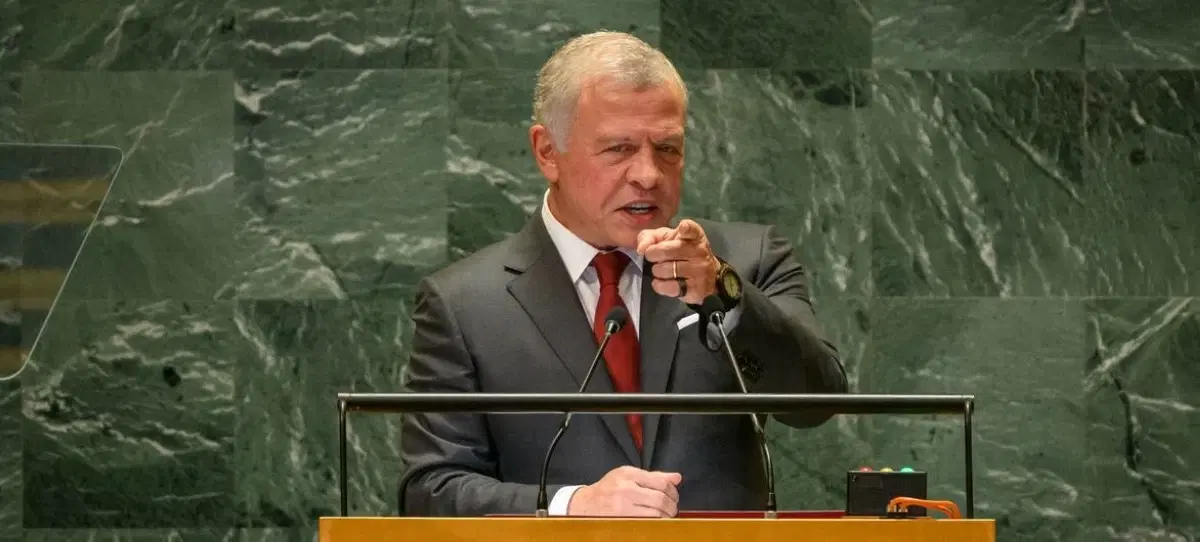
The royal address before the United Nations General Assembly carries multi-level messages, converging on protecting Jordan and its interests, enhancing its internal cohesion, continuing modernization, and building the future, alongside affirming that regional and international transformations necessitate early awareness of risks, and the ability of state institutions to translate the speech's contents into practical policies and procedures.
Dr. Mounir Hawawari, a member of the International Affairs Association, said that the royal address was focused on the international community, but it also carried a clear political message to the Jordanian domestic audience, to Jordanians and state institutions, by clearly reading the risks surrounding the Kingdom and linking what is ignored internationally to what the future may determine in developments.
He explained that His Majesty the King emphasized that the decline in attention to crises gives conflicting parties, especially Israel, an opportunity to impose new facts that are difficult to change later, pointing to the rejection of separating Gaza from the West Bank, and considering what is happening in both as part of a single Israeli strategy targeting the erasure of Palestinian presence in Gaza and imposing annexation and displacement in the West Bank and closing the path to the establishment of a Palestinian state.
Hawawari pointed out that the message to Jordanians is that the danger is no longer just Palestinian, in light of Israeli incursions into southern Syria, approaching water sources, and imposing new facts on the northern borders, affirming that Jordan is committed to peace and diplomacy, but that does not mean weakness, and will not stand by if its borders, water, or the interests of its people are threatened.
He stressed that state institutions face practical responsibilities, including building diplomatic alliances capable of exerting pressure, enhancing border protection, developing water alternatives and emergency plans, and protecting food, energy, and trade route stocks, alongside the role of the media, parliament, and government in clarifying how to translate the speech's contents into tangible policies and procedures.
For his part, Dr. Badr Madi, Professor of Political Science, said that the royal address represents a message for Jordanians that the leadership is keen to present to the people, confirming that the leadership and the people speak the same political and developmental language, which contributed to building bridges of trust between the leadership and the citizens, pointing to the importance of this message in light of the gaps suffered by Arab systems, and the confused relations in some countries between political institutions and the people, affirming that His Majesty the King speaks on behalf of all Jordanians in various issues, whether related to the Palestinian issue or Arab issues, including Lebanon and Syria.
Madi explained that the speech carried important messages regarding internal cohesion and social unity, and affirming the nature of the relationship between different groups and citizens of different political and religious backgrounds, alongside the importance of maintaining the relationship between Muslims and Christians and enhancing solidarity among different components of societies, noting that His Majesty the King spoke clearly about the issues that affect the interests of the Jordanian state, primarily the water and security dimensions, and the sources of threats and risks that Jordan may face in the coming phase.
He stressed that the most important question is how to translate the speech's contents into practical policies and procedures, which requires capturing its messages from the government, media, intellectuals, politicians, and activists, and that the state's vision should be present in various institutions and sectors, while maintaining a single Jordanian word and narrative characterized by moderation, moral responsibility, and inclusiveness, pointing out that Jordan has begun to move beyond the idea of locality towards a clearer global presence, and that the tolerant, peaceful, and strong discourse should be adopted by official and non-governmental bodies, politicians, academics, university and school students, and the media.
For her part, Dr. Tamara Al-Zraiqat, a researcher in political science at the Center for Strategic Studies at the University of Jordan, considered the royal address highly important, rich in meanings, and precise in its choice of words, carrying a message to the international and regional community and important signals for Jordan and state institutions, noting that the words 'attention, trust, principles, security, water, the interests of the people, continuity, and building the future' are repeated and connected to each other, to show a clear compass for the Jordanian state at this stage.
She pointed out that the national importance of the speech starts from the triad of 'our security, our water, and the interests of our people,' considering it a clear definition of the priorities of national security, state sovereignty, and the protection of its resources and the interest of the citizen, affirming that continuing to protect the present and build the future coincides with the political, economic, and administrative modernization project, which enhances the immunity of the state, the efficiency of its institutions, and its ability to continue and achieve.
Al-Zraiqat pointed out that 'attention' can be translated nationally into'strategic vigilance,' which means institutions that read the signal early and preempt the danger, elites that place information in the correct context, and a society that possesses the awareness that protects it against rumors, considering that strengthening the internal front is part of comprehensive national security, and trust is built through achievement, justice, and efficiency, and is protected by the citizen through awareness, belonging, and responsibility.
In the same context, Dr. Muhammad Al-Qatatsheh, Professor of Political Science, confirmed that the speech reflects a deep understanding of international joints, regional developments, and the mechanisms for dealing with them, and that comprehending these changes can be reflected internally with more understanding, dialogue, and unity of position.
He stressed that the phase requires enhancing efficiency, transparency, equal opportunities, and honesty among state institutions, providing space for national competencies, renewing public work, and benefiting from experiences and energies capable of developing performance, making policies, and shaping the future, emphasizing the importance of translating the speech's messages into institutional work, programs, and tangible achievements, and enhancing transparency, accountability, achievement, and addressing shortcomings.
Al-Qatatsheh also stressed the necessity of each institution carrying out its competencies according to the legal frameworks specified for it, ensuring integration, coordination, and non-overlapping of competencies, and resorting to laws in exercising competencies, which enhances the rule of law, raises the efficiency of institutional work, and serves the national interest.
Among these readings, a single criterion for measuring the impact of the royal address stands out, which is the transition from messages to practice, from priorities to policies, and from policies to programs and results that the citizen feels, enhancing security, stability, and trust, preserving Jordan's interests, and pushing towards building a future more capable of facing transformations.