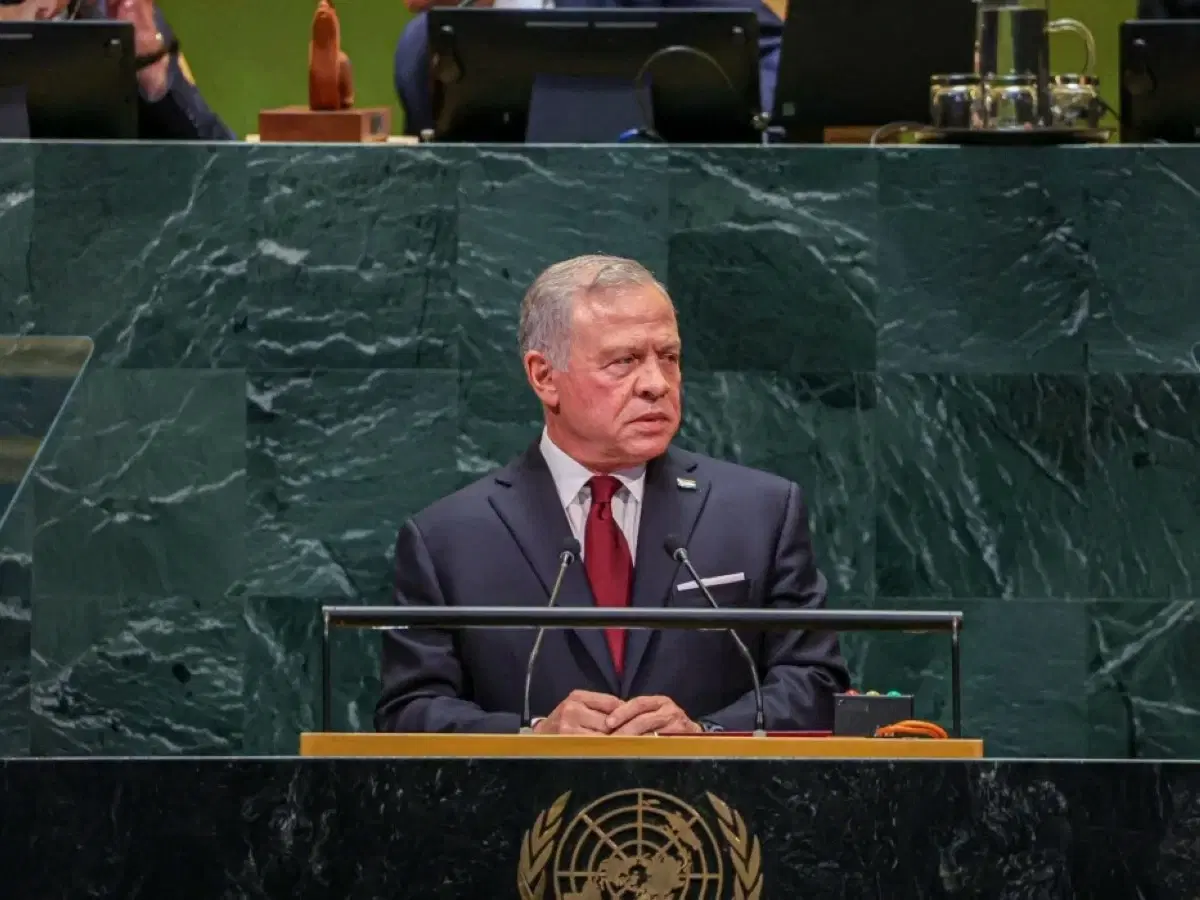
The Royal Speech at the United Nations.. National and Political Messages Echoing Among Students
Amman6 min read
Share
The echoes of the speech delivered by His Majesty King Abdullah II before the United Nations General Assembly did not stop at the limits of Jordan's stance on regional and international issues, but extended its contents to broader areas related to building awareness among young generations, and what the national and political messages contained in the speech can hold as material for discussion within educational institutions.
Experts believe that the royal speech, with its emphasis on Jordan's constants and positions on national and pan-Arab issues, alongside its discussion of the transformations imposed by the digital environment on the way information is received and paid attention to, provides an important space for schools and universities to turn some of its contents into discussion and analysis topics, thereby enhancing students' ability to understand Jordan's position in its regional and international surroundings, and to read political and media discourse more consciously.
Al-Humeissat: The Royal Speech Contains National and Political Lessons for Students
In this context, the head of the Parliamentary Initiative Bloc, MP Ahmed Al-Humeissat, called on the Minister of Education and Human Resource Development, Dr. Azmi Mahafza, to issue a circular to adopt the speech of His Majesty King Abdullah II before the United Nations General Assembly as a working paper in schools and universities, due to its national and political contents that contribute to building awareness among generations and enhancing values of citizenship, belonging, and national identity.
Al-Humeissat said that the royal speech contained national and political lessons that deserve to reach students in schools and universities, enabling generations to understand Jordan's position amid a turbulent region, and how to protect the Kingdom's security and interests without abandoning its principles and constants.
He added that the speech presented a model of combining steadfastness on the Jordanian position towards Palestine and Jerusalem, and safeguarding national security and the higher interests of the state, stressing that embedding these contents among students forms an important part of building citizenship, awareness, and national identity.
Al-Humeissat pointed to His Majesty the King's affirmation that Jordan is a “country on which the world can rely,” emphasizing the importance of raising generations who understand the value of their homeland and its positions, and are aware of their responsibility in preserving it, safeguarding its security and stability, and its achievements.
He stressed the importance of benefiting from the contents of the royal speech as an educational and informative working paper, allowing students to discuss its national, political, and humanitarian messages, and contributing to enhancing their awareness of national and regional issues and solidifying their responsibility towards Jordan, its interests, and its constants.
Al-Attum: The King's Speech Opens a Discussion on Attention in the Algorithmic Era
For his part, Dr. Ayham Al-Attum, a researcher in digital media and an advisor to the Media Belief Management Department, believes that what His Majesty King Abdullah II presented in his speech before the United Nations General Assembly about the decline in the duration of individual attention in front of the screen goes beyond the daily technical dimension, to touch upon a structural challenge represented by dealing with attention as a rare and valuable resource that algorithms and narratives compete for.
Al-Attum asserts that the strategic importance of the royal proposal lies in shifting the media perspective from the traditional question: How do we produce the message? to the deeper question: How do we gain attention, and what do we do with this attention once we obtain it?
Herein lies the opportunity for media colleges, through media and information literacy, to turn the royal speech into an applied laboratory, in which students study a comprehensive path starting with attention, then moving to perception, evaluation, and trust, leading to the formation of belief and the adoption of a position.
It also allows them to understand the role of algorithms and platforms in shaping the environment in which this path moves.
Al-Attum points out that the challenge in the algorithmic era is no longer merely harvesting views and attracting attention, but in building a culture of media and information literacy capable of consciously dealing with this resource, employing it to build understanding, protecting the public's priorities from attempts to manipulate them, and fostering a public dialogue.
Al-Qaraan: The Royal Speech Can Form a Subject for Dialogue and Analysis in Universities
Professor of Media and Communication, Dr. Muhammad Al-Qaraan, said that the speech of His Majesty King Abdullah II before the United Nations General Assembly can form an important subject for dialogue within universities, not only from a political angle, but as a national and international speech that raises issues affecting the present and future of the region, foremost of which is the Palestinian issue, security and stability, respect for international law, and the importance of dialogue and diplomacy in resolving crises.
Al-Qaraan added that the university is required to be a real space for analyzing the speech and discussing its contents, so that the student moves from the stage of listening to the stage of questioning, analysis, and discussion, noting that the university student today receives a huge amount of information through media and social media platforms, making his academic role the verification of information, analysis of media messages, and distinguishing between information and opinion.
He pointed out that the royal speech can open wide discussions among students about an important question related to how young people understand the transformations taking place in the region, and dealing with them with awareness and responsibility, away from rumors and misleading information.
He emphasized that the importance of the teaching staff is highlighted in managing the dialogue within the university classroom, so that the discussion does not turn into a process of indoctrination or a one-way direction, but rather a dialogue based on questioning, evidence, and respect for the other opinion, thereby enhancing students' skills in thinking, analysis, and discussion.
He pointed out that this aligns with what Jordanian academics have pointed out following the speech about the importance of the role of universities in enhancing awareness and embedding values of dialogue, peace, and justice among students.
Al-Qaraan stressed the importance of transforming the royal speech from a political occasion that is followed and ends into an educational opportunity that helps the student understand Jordan's position, analyze political and media discourse, and link international issues with the national reality, thereby enhancing his awareness, responsibility, and ability to dialogue.