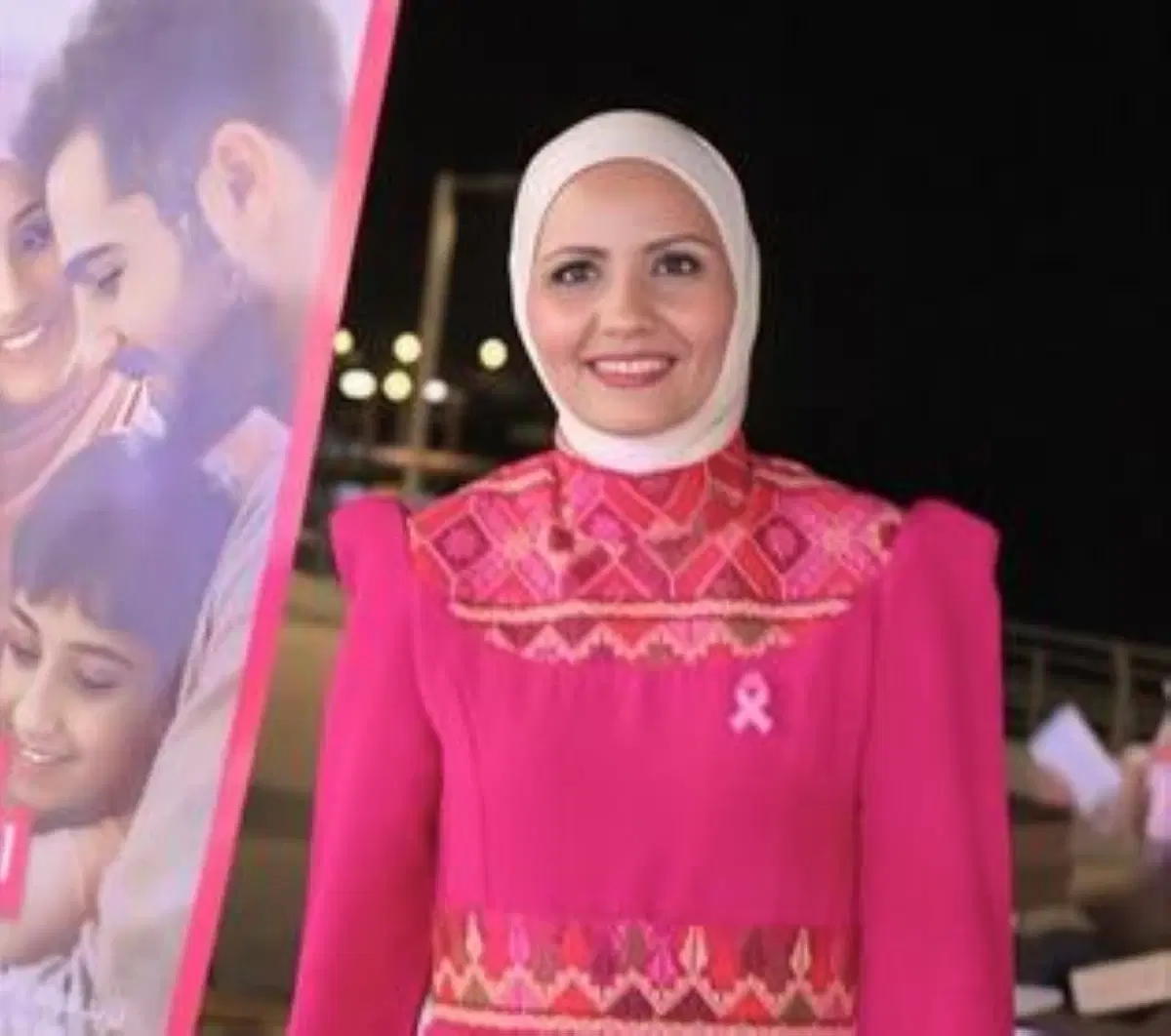
Abu Al-Azz stated that at the end of November 2025, she noticed lumps in her left breast and went for tests, even though she was under the age of forty. She insisted on having a mammogram alongside an ultrasound, and the tests revealed the presence of seven lumps or foci before doctors requested a biopsy of the left breast. She continued that Dr. Inas Al-Juhani informed her of the biopsy result, revealing that she had stage 3 breast cancer.
Abu Al-Azz pointed out that the first thing that came to her mind the moment she heard the diagnosis was her three children, who were still at very young ages, emphasizing that the news came after a series of difficult circumstances she had been through. She went to Amman to complete the tests, where it was found that the condition in the left breast was multifocal, with involvement in the armpit lymph nodes. A treatment plan was set for her that included eight doses of chemotherapy before surgery, to be followed by further treatment depending on the results, including radiation and hormone therapy.
Abu Al-Azz explained that the treatment journey was not easy; she faced fatigue, bone pain, hair loss, and weakened immunity, which sometimes led to the postponement of certain doses, alongside fear for her children and their future. She added that the loss of a number of her relatives during the treatment period added to the heaviness of this stage for her.
She confirmed that she had finished the eight chemotherapy doses, and subsequent tests showed a partial response to treatment, but she is preparing to undergo a full mastectomy of the left breast, along with lymph node surgery. She noted that doctors explained that reconstruction is not possible at the present time due to the tumor's extreme proximity to the skin, which poses a psychological challenge for her as she tries to adapt to the changes forced by the disease upon her life and body.
Despite this, Abu Al-Azz has not given up hope of returning to her children and husband, and to the social and awareness work that has formed an essential part of her life. She, who was accustomed to conveying the importance of early detection to women, now carries a deeper message, forged by experience rather than information alone.
For Abu Al-Azz, breast cancer is no longer a topic she talks about in an awareness meeting or an annual campaign; rather, it has become a human story whose details she knows from the inside. She knows how a single word can change the shape of days, how waiting for a result becomes a test of patience, and how the simplest wishes turn into big dreams.
She hopes to return to the people she loved and who loved her, to stand among them once again and convey her message through the eyes of a woman who knows that behind every test is anxiety, behind every diagnosis is a waiting family, and behind every female patient is a full life that deserves hope.
Perhaps what Abu Al-Azz holds onto most today is that the disease, no matter how it changes the details of life, does not reduce a person to their diagnosis, nor does it strip them of their right to dream. She is not waiting to return to her old life exactly as it was, but rather strives for a new life carrying what she has learned from pain, the strength given to her by loved ones, and the desire to give that remains in her heart. Once upon a time, she sowed awareness so that women would not face the disease too late, and today she hopes to return to sow hope from the standpoint of a woman who has known the difficult path, and realized that a person may change a lot on the treatment journey, but can retain their ability to rise, their love for life, and their faith that what awaits them at the end of the road is worth continuing to walk toward.