United Nations: Gaza faces the most severe economic crisis in the world
A life suspended under a deadly Israeli siege
Amman6 min read
Share
UNCTAD: 92% of economic establishments in the Strip have been damaged or destroyed
The United Nations Conference on Trade and Development (UNCTAD) has warned of an accelerating economic collapse in Gaza, describing the situation as the "most severe economic crisis recorded in the world."
Acting Secretary-General Pedro Manuel Moreno emphasized that the Palestinian economy has lost decades of accumulated development gains, turning Gaza into an unprecedented catastrophic epicenter.
UNCTAD data shows that 92% of economic establishments in Gaza have been damaged or destroyed since October 2023.
Per capita GDP reached only $212 during 2025—equivalent to 58 cents per day—a level that does not exceed 17% of its 2022 level.
In the labor market, unemployment reached 78%, while more than 90% of the working-age population was outside the employment circle, with hundreds of thousands of jobs lost and billions of dollars in accumulated labor income wiped out.
No major productive sector has been spared from collapse: agricultural and industrial production declined by 94% each, while the construction sector fell by 99% compared to its 2022 levels.
Less than 1.5% of agricultural land in Gaza remains available and undamaged, deepening the population's reliance on humanitarian food aid.
The report also recorded a sharp rise in prices, as the general price level in Gaza during 2025 remained 274% higher compared to 2022, while the prices of several basic commodities, including potatoes and cooking gas, became several times higher than their previous levels.
As for recovery and reconstruction needs in the Gaza Strip alone, UNCTAD estimated them at about $71.5 billion, in light of widespread destruction that affected infrastructure, productive sectors, and basic services.
The report estimates the physical damage to infrastructure at about $35.2 billion, while economic and social losses reached $22.7 billion, with estimates that the cost will rise if additional damage continues to be recorded.
UNCTAD asserts that restoring the Palestinian economy requires large-scale interventions to rebuild the agriculture, industry, construction, energy, and technology sectors, alongside protecting the banking system and securing Palestinian revenues.
"The Stalemate Trap"
The "Peace Council" plan seems theoretically promising: $400 million for temporary housing, $275 million for debris and unexploded ordnance removal, $50 million for hospital rehabilitation, $30 million for road repairs, in addition to $885 million for security projects, including $275 million for a permanent site for an international stabilization force in Rafah, and $120 million for the Palestinian police.
However, the initial amount is meager compared to the needs. The plan estimates that physical damage in Gaza amounts to $35.2 billion, and that full recovery and reconstruction will require $71.4 billion over a decade.
Even the initial amount of $2.45 billion has not been fully secured. Participating countries pledged $18 billion, but less than $300 million has been transferred so far.
As Jared Kushner, a member of the Executive Council, noted: "The recovery program is facing various delays in different aspects, regardless of the reason."
Blocking "Vital Materials"
The biggest obstacle is not money, but access, as Palestinian Minister of Public Works and Housing Ahed Bseiso says that the ministry has prepared a relief plan that requires the entry of 200,000 prefabricated housing units, but "the Israeli occupation prevents their entry and bans the entry of construction materials and heavy equipment needed to clear roads."
Even for the fiberglass units that the UN approved for entry under its development program, only 4,000 units out of 10,000 have entered.
The International Organization for Migration confirms that "basic tool kits, sandbags, water pumps, and construction materials such as timber and panels are still unable to enter Gaza due to restrictions imposed by Israeli authorities."
These materials are essential for repairing and reinforcing shelters against constant rain.
Since last October, the organization has sent more than a million pieces of shelter equipment, but they are "not flood-resistant."
Amnesty International documented that "flooding caused by heavy rain submerged thousands of tents and temporary shelters and caused many buildings to collapse," holding Israel responsible for exacerbating the catastrophe due to its continued prevention of the entry of vital equipment and supplies needed to rehabilitate infrastructure.
60% of the Strip under Israeli control
Israel conditions any withdrawal or the start of reconstruction operations on the complete disarmament of Hamas.
Hamas has accepted in principle to disarm in exchange for a gradual Israeli withdrawal from the areas it occupies, but the Israeli army still controls about 60% of the Strip's territory, which has reduced the available living space to only about 100 square kilometers.
Israel implicitly admits that this stalemate serves its short-term interests: Hamas no longer poses a security threat to Israel, but as long as it remains in control of the Strip, Israel retains a pretext to resume the war.
And as long as the Strip remains destroyed and uninhabitable, pressure on its residents to leave increases. Defense Minister Israel Katz previously stated that "there is no real solution for Gaza without migration."
However, this calculation may backfire: resuming the war would conflict with American and international expectations of ending the conflict, and migration from Gaza would face Egyptian, American, and international opposition.
Furthermore, the absence of an effective Palestinian police force means that the international stabilization force will not be able to begin, and therefore the reconstruction plan will not launch.
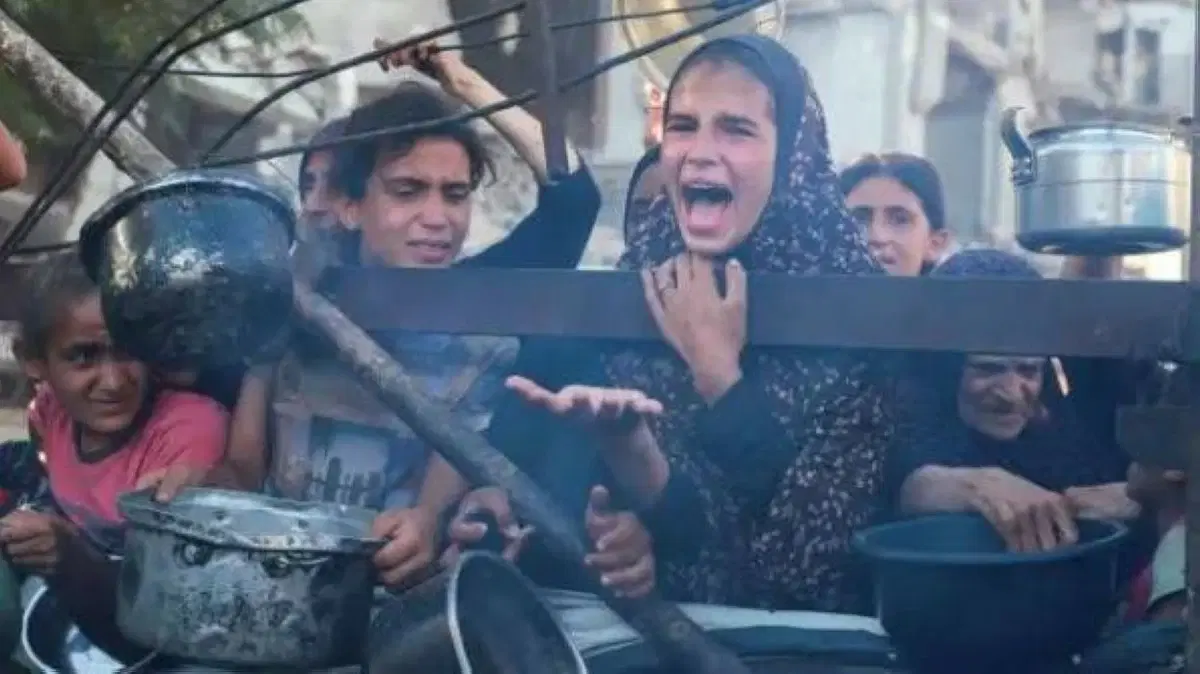
In Gaza, 77% of families are classified as displaced, as Ahmed Arafat says while standing in a street full of rubble: "We don't have money to go anywhere else, and we can't buy tents like others."
Alam Zaqout says outside the damaged building where he lives with his family: "What drives people to live in these places is that there is no shelter other than this... no tents, no basic necessities... tell me, where am I supposed to go? I have nothing but this house."
Shaina Low, spokesperson for the Norwegian Refugee Council, says: "People choose to stay in dangerous buildings because the idea of living in a tent is worse, and there are very few tent supplies available."
She adds that the buildings could collapse at any time, but they become more dangerous during bad weather, when rain leaks through cracked concrete and exposed rebar.
Reconstruction without access... and recovery without funding
Gaza today lives a difficult equation and catastrophic conditions: 92% of its economy is destroyed, 78% of its workforce is unemployed, 77% of its families are displaced, and less than 1.5% of its agricultural land is arable.... The reconstruction plan exists on paper, but it is held behind three closed gates: unsecured funding, blocked access, and deliberate political stalemate.