Trump denounces a "malicious conspiracy" against AI that serves China's interests
Amman5 min read
Share
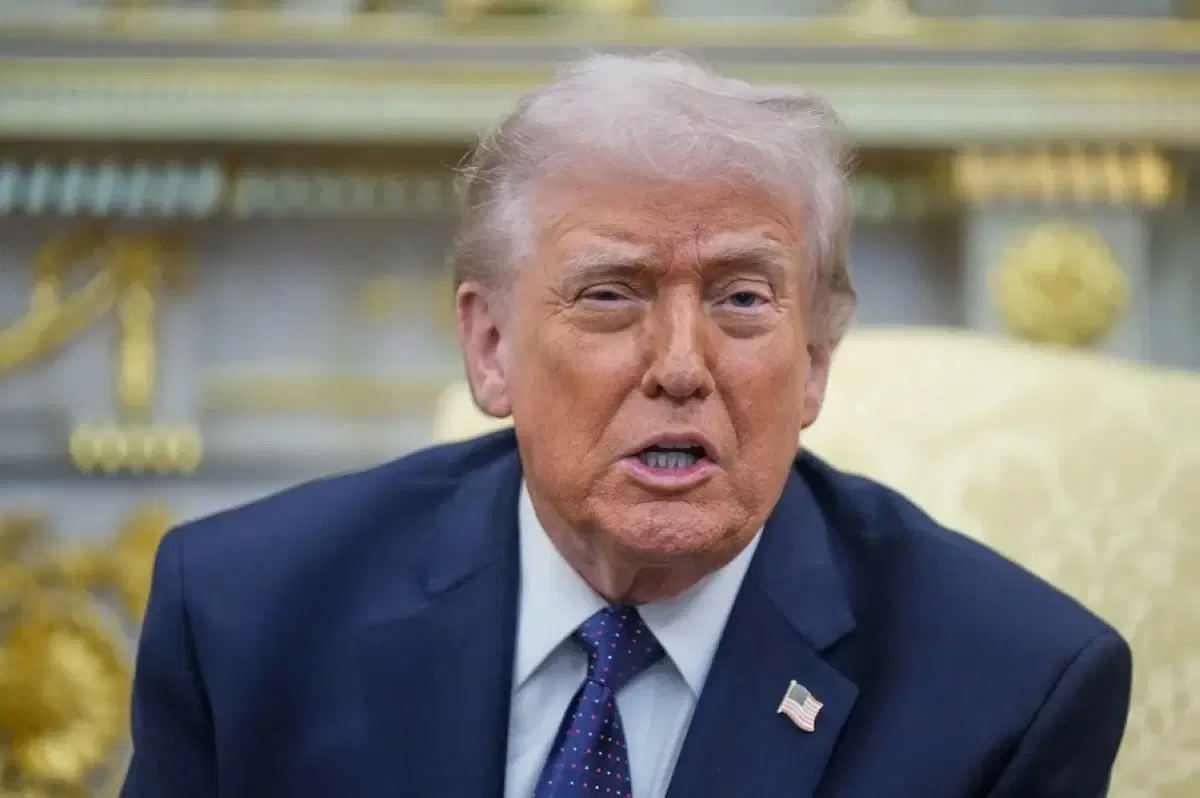
US President Donald Trump denounced on Monday a "malicious conspiracy" targeting artificial intelligence, arguing that growing calls to impose controls on its development, amid warnings of its potential risks to humanity, serve China's interests.
While emphasizing the need for Washington to maintain leadership in this sector, Trump singled out Anthropic CEO Dario Amodei for criticism, following his initiative on Saturday to call for slowing down AI development, a move that has been supported by prominent names in the sector.
Major technology stocks fell on Monday in light of these calls, which come amid fears that AI models could spiral out of control and eventually cause a nuclear war and the extinction of the human race.
Trump said in a post on his Truth Social platform that "the only regulation or 'guardrails' that AI needs is a strong, smart President with a high IQ! And the United States of America has many of those!"
He added, "There is a malicious conspiracy being hatched against AI and data centers, and China is the only party benefiting from that."
He continued, "Whoever wins the AI race, wins everything! We are beating China and everyone else in this field, and we will remain so," addressing "conspiracy theorists, agents, traitors, and leakers, beware."
Trump drew a comparison with "all the other conspiracies," including the investigation into the links between Russia and his election campaign and his impeachment proceedings due to the pressure he exerted on Ukraine during his first term.
- Benefits outweigh the harms -
Last week, Trump repeatedly criticized the warnings issued by American leaders in the technology sector regarding the risks associated with the rapid development of AI, arguing that imposing controls on it would give China an advantage in this field.
On Monday, Trump focused his criticism on Amodei, whose company developed the "Claude" model, and whose call to regulate AI was supported by Sam Altman, his counterpart at OpenAI, the developer of "ChatGPT," and Elon Musk, owner of "xAI."
The US President wrote, "The Trump administration stopped AI 'experts' from doing bad things, including Dario (Anthropic!) who is currently trying to appear as the 'perfect little angel'."
During his visit to Ireland over the weekend, Trump repeatedly affirmed his rejection of calls to regulate the pace of AI development.
Speaking to reporters on Air Force One on Sunday, Trump said he had heard the concerns of technology experts firsthand last week.
When asked if he was downplaying the magnitude of the concerns mentioned, he replied, "No, we are not downplaying them. But we know that the benefits (of this technology) will far outweigh its harms."
Trump has long considered American superiority in AI to be part of the frantic race with China. Washington has previously imposed restrictions on the export of ultra-advanced chips to Beijing, citing the protection of its national security.
Chinese President Xi Jinping is scheduled to visit the United States next week to meet with Trump.
Days before this anticipated summit, the head of the Chinese intelligence agency warned that AI has become a direct threat to national security, accusing foreign intelligence agencies and "hostile forces" of using it to influence public opinion, collect sensitive data, and infiltrate critical infrastructure in the country.
Minister of State Security Chen Yixin wrote in an article published on Sunday that "hostile forces" are misusing generative AI technologies to "fabricate political rumors and spread harmful information."
He added that the aforementioned parties are "waging a war targeting (Chinese) public opinion, as well as a cognitive war against China, which directly threatens our political, institutional, and ideological security."
He specifically mentioned the "Claude Mythos" model from Anthropic and the "GPT-5.5 Cyber" from OpenAI, which possess unprecedented capabilities to identify software vulnerabilities, making them easier to hack, arguing that such models pose "grave risks to China's critical information infrastructure."
- "Unprecedented risks" -
Beyond the direct competition between the United States and China, UN High Commissioner for Human Rights Volker Türk called on Monday for "urgent action" to curb ultra-advanced AI technologies, warning that this technology carries "unprecedented risks."
He said in a statement, "We are on the cusp of an irreversible change, the impact of which will not only be limited to us, but will extend to future generations of humanity," stressing the need for "urgent action commensurate with the unprecedented risks posed by pioneering AI."
In the context of growing concerns about the speed of AI development, British King Charles III is scheduled to host representatives of a number of leading companies in the sector in Scotland, according to a source close to the meeting on Monday.
The head of the French defense giant Thales Group also called on governments to take responsibility for setting rules and controls for AI.
However, similar calls have not previously resonated with Trump and his administration. Reflecting the continuation of the same approach, US Vice President JD Vance questioned the calls issued by company officials.
He said on Monday, "It is surprising that leading AI companies would turn to the government and beg it to regulate them." He added, "I feel like it's a Trojan horse."