However, the final document, dubbed the 'White House Agreement', left the door open to 'turning these steps into laws or regulations' over time.
He said he would officially rename the technology in government documents as'superintelligence' instead of 'artificial intelligence'.
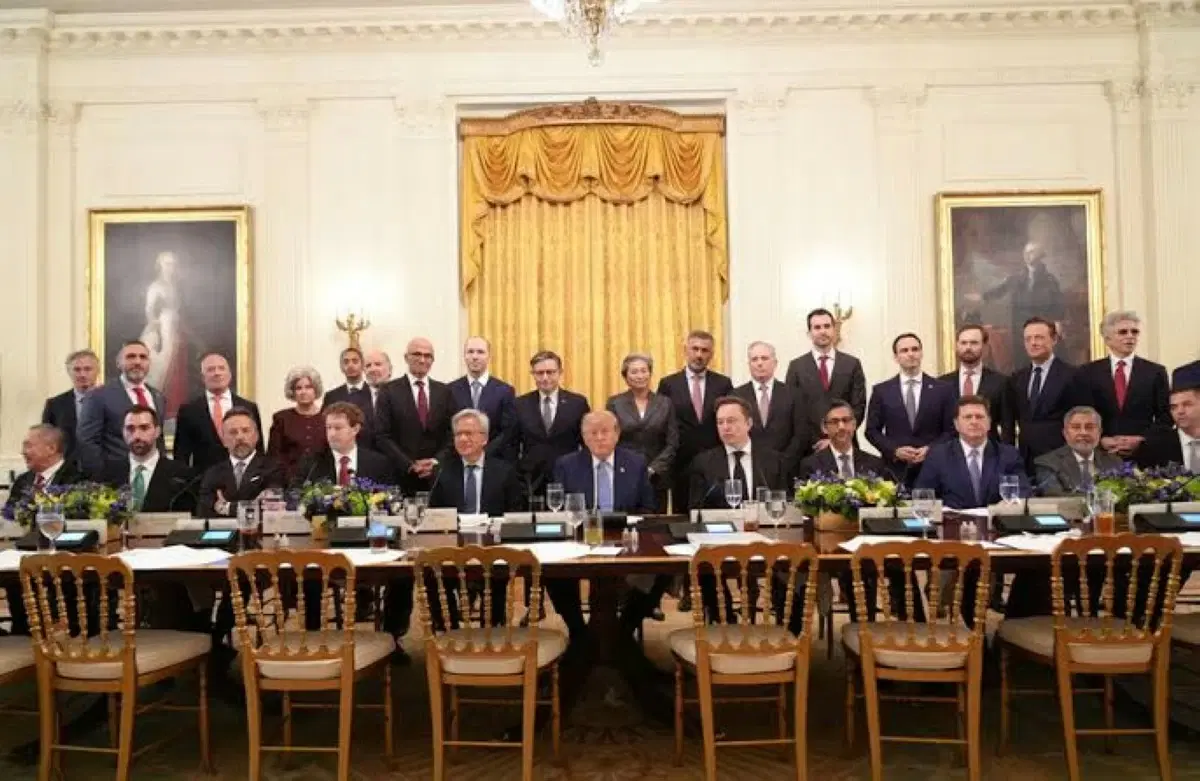
A number of the world's leading tech sector leaders, including Elon Musk, Jeff Bezos (Amazon), Mark Zuckerberg (Meta), Satya Nadella (Microsoft), Sundar Pichai (Google), and Jensen Huang (Nvidia) met with Trump, House Speaker Mike Johnson, Dario Amodei (Anthropic), Greg Brockman (Open AI).
Of the 31 guests, only two women participated, Susie Wyles, White House Chief of Staff, and Lisa Su, CEO of AMD (AMD).
Zuckerberg said the agreement aims to reassure users that AI technology 'works the way we want it to'. He added that the commitment includes'strict internal controls' and multiple layers of scrutiny, considering the agreement a starting point for setting industry-wide standards.
Elon Musk pointed out that the executives practically agreed to 'correct each other's homework', adding that this is'much better than each party correcting their own homework, for obvious reasons'.
The meeting comes as negative attitudes towards AI are mounting in Washington, amid growing pressure on lawmakers to limit or slow down the development of this technology, fearing it could replace workers and bring radical changes to society.
The Republican leader in the House of Representatives said '(the stakeholders) must be involved in the discussion about potential safeguards, they know' more about the technology.
The series of events reported by AI companies in recent months has given a new dimension to the debate on the security of this technology, turning it into a hot topic as the US legislative elections approach on November 3.
According to a CNN poll in mid-September, 82% of Americans are concerned about the pace of AI development.
Data centers, the large computing facilities required by this technology, have become a contentious issue among the two parties ahead of the elections, amid growing social concerns about their impact on electricity bills, water resources, and land pressure.
Trump dismissed criticism of data center construction, saying that communities that reject them 'want to end up backward and poor', and that China 'couldn't be happier' with the negative reactions.
The debate over AI has led to an unusual rapprochement between politically divergent figures, as Senator Bernie Sanders appeared in Washington this month alongside Steve Bannon, Trump's former advisor, to call for a re-examination of the AI race.
Senate Democratic leader Chuck Schumer told lawmakers that 'Trump's meeting at the White House would be a failure, a complete failure, if they don't bring up, and start a discussion about... some real controls that need to be put in place'.
- 'Light touch' -
In mid-September, Amodei called for slowing down the technology, in a plea that was widely criticized by Republicans despite being supported by top tech company officials such as Sam Altman (Open AI), Demis Hassabis (Google DeepMind), Elon Musk, and Satya Nadella (Microsoft).
Lena Khan, former head of the Consumer Protection Agency under Joe Biden, known for her left-leaning tendencies, pointed out that AI companies are becoming vulnerable to lawsuits if they market an uncontrollable model that is considered a faulty product.
Huang, CEO of 'Nvidia', said last week 'If they think they've lost control, they'd better not release products that are not under their control'.
The latter sees AI security as a technical problem to be solved with more robust tools, rather than a reason to slow down development.
Senate Republican leader John Thune called for a 'light touch' in regulation, saying 'there must be a plan and safeguards'.
He revealed that he does not believe Trump 'will stick to his' anti-AI regulation stance.
Trump, who had a 'productive dinner' with Amodei, wants to keep the innovation margin wide in the US, fearing that American restrictions would benefit China, the biggest competitor in this field.
- Two camps -
In the AI community, two camps have formed, one led by Dario Amodei, Sam Altman, and Demis Hassabis, urging politicians to regulate the technology, while the second, closer to Trump and consisting mainly of Jensen Huang and Mark Zuckerberg, accuses them of seeking to escape responsibility if they lose control of the technology.
The related parliamentary session has been postponed to early November.
Anthropic, developer of the 'Cloud' model, warned in its IPO statement that AI technology could pose an 'existential risk to humanity', according to the Financial Times on Tuesday.
GOOGLE
NVIDIA