He added, "In order to consolidate these relations and follow them up, a Jordanian-European Parliamentary Friendship Committee was formed in the Senate to promote bilateral relations in various political, economic and parliamentary fields, and to maintain coordination and consultation on various issues of mutual interest."
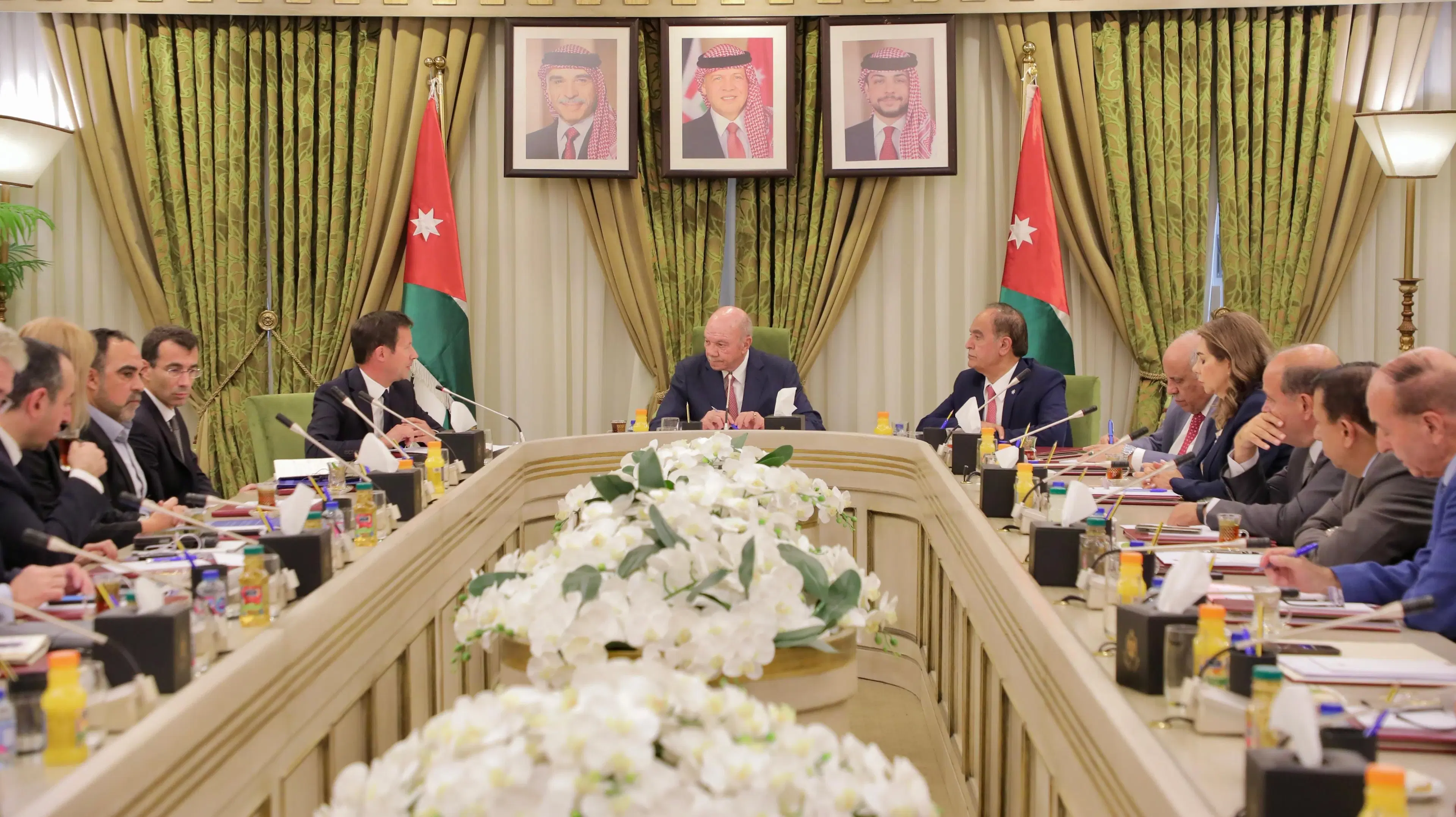
This came during his chairmanship of the meeting held by the Committee on Arab and International Affairs and Jordanian Expatriates, today Wednesday, in the Council, with a parliamentary delegation from the European Parliament chaired by François Pillet, in the presence of the European Union Ambassador to the Kingdom Pierre Kristof Schatzsavas.
Al-Fayez thanked the European Union for the financial and economic assistance it provides to Jordan, which enhances the strategic and comprehensive partnership between the two sides, supports economic development, human capital development and reforms in Jordan.
He pointed out that within the framework of Jordanian-European cooperation, an agreement was reached between Jordan and the European Union to hold the Jordanian-European Investment Conference, which will be held in November next in the Dead Sea, under the patronage of His Majesty King Abdullah II, and with the participation of the President of the European Commission Ursula von der Leyen, explaining that this conference comes within the framework of the commitment of both parties to continue to enhance economic cooperation, and to support sustainable growth in the Kingdom, and to expand trade and investment partnerships between Jordan and the European Union.
He added, "The conference will form a platform that brings together investors, companies and financial institutions from Jordan and the European Union countries, to review promising investment opportunities in the Kingdom, and to discuss the prospects for partnership and cooperation in a number of priority sectors, including renewable energy, clean technologies, the digital economy, industry, logistics and infrastructure."
He pointed out that Jordan will present during the conference an investment portfolio whose value is close to $15 billion, distributed over 15 sectors and sub-sectors, with the largest share of the portfolio concentrated in the energy and mining sectors, in addition to the water, transport, tourism, digital economy and clean technology sectors.
Regarding the current situation in the region, Al-Fayez explained that force is not the only way to resolve conflicts, as diplomatic tools must be activated and communication channels opened, pointing out that His Majesty's speech at the United Nations was of great importance.
Regarding the extremist practices of the Israeli government in the West Bank and the Gaza Strip, he stressed the importance of the European Union realizing that mere "condemnation" is no longer sufficient, as condemnation alone will not make a difference.
Al-Fayez went on to say: "I believe that the current conflicts in the region, led by Iranian and Israeli behavior, are threatening the security of the region and posing a direct danger to the global economy," pointing out that condemnation is no longer effective.
He pointed out that in his speech at the United Nations General Assembly, His Majesty "stressed that we need today serious and tangible action steps to end conflicts," in addition to practical measures, foremost of which is the imposition of economic sanctions against Israel, which should not be limited to settlers only, but should also target figures such as Ben Gvir and Smotrich, as they are the most extremist elements within the Israeli government.
Al-Fayez explained that the problem lies in the fact that Israelis do not care about decisions and do not adhere to commitments, and do not attach importance to the practices they commit, as they are driven by old, outdated mentalities that claim that this land is a "divine right granted to them by God," which is completely false, pointing out that we live in the 21st century, in the age of artificial intelligence and development, while these people are still thinking with old and outdated approaches and illusions.
He pointed out that there are two peoples living on the same land, and the only possible solution lies in the adoption of a "two-state solution," stressing the importance of taking decisive and urgent steps, as the Palestinian issue is no longer just a Palestinian or regional issue, but has become an issue whose impact extends to the whole world.
Al-Fayez explained that His Majesty pointed out in his speech that since the Arab Summit in Beirut in 2002, Arab countries have explicitly and clearly declared their readiness to establish normal relations with Israel and recognize it in return for peace, but the Israeli side did not pay attention to this offer and did not respond to it.
Al-Fayez pointed out that the region is experiencing major and devastating conflicts, as there is today the Iranian-American-Israeli war, and the continuation of the Israeli aggression against the Palestinian people, Lebanon and Syria, and the Iranian expansionist ambitions are no less dangerous than the aggressive and expansionist policies of the Israeli state.
He said that while we hope to reach a final agreement to end the Iranian-American war, Jordan strongly condemns the Iranian attacks and its arms in the region against the Kingdom and the countries of the Arabian Gulf, pointing out that His Majesty King Abdullah II emphasized the need to stop the Iranian-American-Israeli war and called on the international community to work to achieve a comprehensive and sustainable de-escalation, which contributes to restoring stability and achieving peace for all.
Regarding the Palestinian issue, he said that Israel continues to practice its heinous aggression against the Palestinian people for nearly eight decades, and its aggression has increased in ferocity since October 7, as it destroyed the Gaza Strip and committed the most heinous war crimes, and continues to kill Palestinians in Gaza and the West Bank, and continues the policies of annexing land and building illegal settlements in the occupied West Bank, as well as destroying homes and displacing residents, and seeks to forcibly expel Palestinians.
The President of the Senate explained that these illegal policies implemented by Israel in the West Bank pose a danger to Jordan, which is why Jordan rejects these extremist Israeli policies, and rejects any solutions to them that affect its national constants, and rejects the forced displacement of the Palestinian people, considering it a violation of international law and a war crime, and paving the way for further conflict in the region.
Al-Fayez praised the statement issued by the foreign ministers of a number of European countries, in which they confirmed that the only way to achieve a just, lasting and comprehensive peace is to implement the two-state solution, and their intention to impose restrictions on the trade of goods with Israeli settlements, which are illegal in the occupied Palestinian territories.
He said that despite these positive trends, they are not enough to deter Israel, as the international community needs more effective measures to counter Israel's aggressive and expansionist policies, pointing out that while the international community is aware of the tragedy of Gaza, it must also be aware of Israel's crimes and aggressive policies in the occupied West Bank, which are no less heinous than what is happening in the Gaza Strip.
He added that it is also necessary for the US administration to compel Israel to implement the ceasefire agreement in Gaza, to stop settlement and annexation, and to implement the two-state solution that the US President has affirmed, and that the European Union should not be content with imposing restrictions on the import of products from the settlements, but should impose a comprehensive economic boycott of the Israeli occupation state.
For their part, the European Parliament delegation affirmed their full commitment to strengthening bilateral relations with the Kingdom, reaffirming the European Union's support for Jordan in facing current regional and international challenges.
They confirmed that Jordan is a cornerstone of stability in the region, and expressed their appreciation for the pivotal role played by the Hashemite Kingdom of Jordan as a cornerstone of stability and a peacemaker in the region amid the instability prevailing in the world, stressing that standing by Jordan represents a clear commitment and a duty for the European continent.
The delegation highlighted its visit to the Zaatari Syrian refugee camp, expressing its deep appreciation for the generosity, solidarity and continuous support provided by the Jordanian people to the refugees.
In the framework of deepening the partnership, the European parliamentarians affirmed their keenness to provide all forms of support to ensure that the partnership is translated into tangible results, as evidenced by the package of financial support allocated to Jordan in the amount of 3 billion euros for the next three years.
The delegation also expressed its full solidarity with the Jordanian people, in light of the tensions and repercussions resulting from the military escalation between the United States and Iran, especially when Jordanian territories are directly threatened by Iranian attacks.
Regarding the Palestinian issue, the delegation affirmed its alignment with the firm Jordanian vision in defending the rights of the Palestinian people, praising the high-level speech delivered by His Majesty King Abdullah II before the United Nations General Assembly.
The delegation pointed to the European Parliament's continued voting in favor of those calling for a ceasefire in Gaza and full respect for international resolutions.
The delegation renewed its categorical rejection of Israeli settlement policies and actions in the occupied West Bank, affirming that the forced displacement of Palestinians is a direct threat to Jordan's national security and a violation of international law, pledging to convey this message firmly to Brussels to be at the forefront of European priorities.
European parliamentarians expressed concern over an international pattern attempting to impose the language of force at the expense of fundamental rights and internationally recognized borders, and the delegation affirmed its solidarity with Jordan in defending human rights, dignity, and respect for the sovereignty of states.
The delegation expressed a strong desire to strengthen channels of communication and cooperation with the Jordanian National Assembly in both chambers (Senate and House of Representatives), affirming the pursuit of establishing a comprehensive and shared parliamentary culture between the two sides.
During the meeting, both parties emphasized the importance of strengthening bilateral relations in various fields and enhancing joint coordination on various issues of mutual interest.