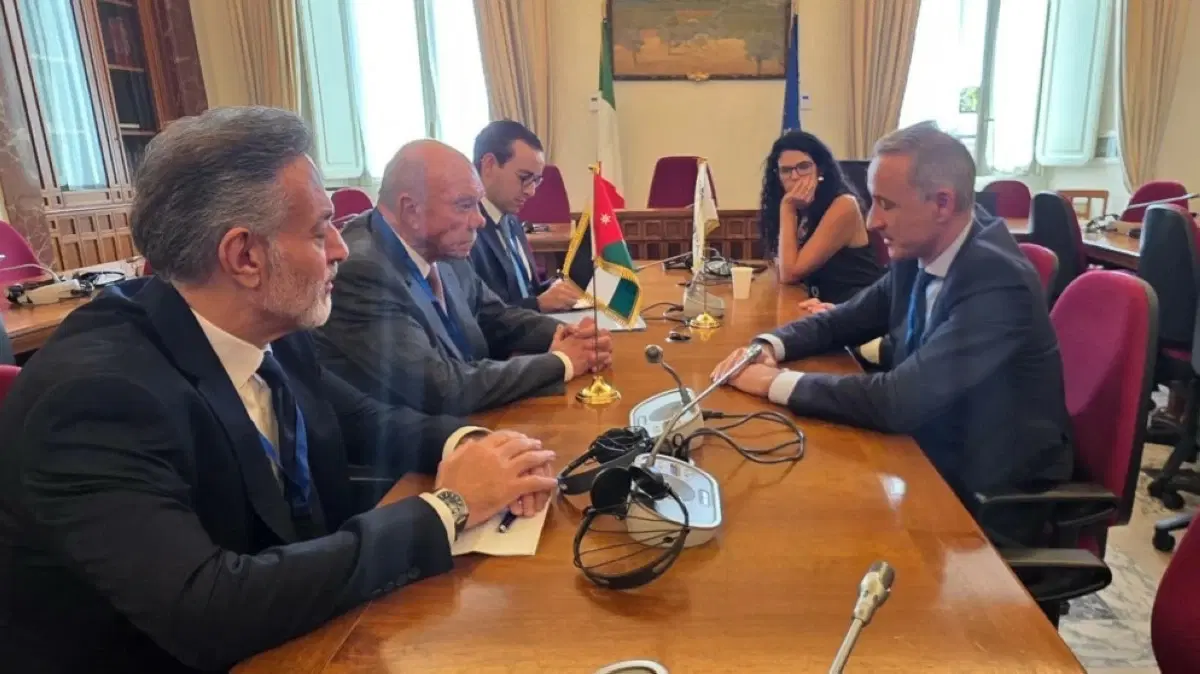
During the meeting, Al-Fayez pointed to His Majesty King Abdullah II's keenness to communicate with political leaders in EU countries and various European parliamentary institutions, with the aim of strengthening the Jordanian partnership with the European Union at all levels and in various political, economic, parliamentary, and security fields, and consulting on issues of common interest, based on the strategic and historical relations between the two parties.
Regarding the current situation in the region, Al-Fayez noted that His Majesty King Abdullah II, in his speech before the United Nations General Assembly, presented the international community with the reality of the conflicts and crises facing the world today, their political, security, and economic repercussions, and their impact on international peace and on human dignity and their right to a free and secure life. His Majesty called on the international community to take practical steps that protect humans, stop violations, and enforce respect for international law.
He said that His Majesty the King, in his speech before the UN General Assembly, warned the international community against Israeli aggressive policies in the region, and revealed to the international community the reality of the Israeli government and the war crimes it is committing in the occupied West Bank and the Gaza Strip. He called on the international community to hold it accountable for its crimes by imposing economic sanctions on the Israeli government, settlement entities, and extremists within it, to stop its illegal policies and so that this government does not remain outside the umbrella of international law.
He pointed to the dangers facing Jordan as a result of the continuation of the Israeli government's aggressive and expansionist policies, its pursuit of annexing the West Bank, liquidating the Palestinian cause, forcibly displacing the Palestinian people, and making Jordan an alternative homeland for the Palestinians, in addition to its attempts to tamper with the Hashemite Custodianship and the danger of illegal Israeli policies in Jerusalem aimed at entrenching the occupation in all occupied Palestinian land.
Al-Fayez stated that Jordan rejects these aggressive Israeli policies and rejects any solutions to the Palestinian cause at the expense of its national constants or tampering with its sovereignty, security, and stability, adding that Jordan's positions are firm regarding the Arab-Palestinian conflict, which is to empower the Palestinian people to achieve their rights and establish an independent Palestinian state.
Al-Fayez valued the economic, political, and security support provided by the European Union to Jordan, and the EU countries' affirmation of the Hashemite Custodianship over Islamic and Christian holy sites in Jerusalem, their condemnation of Israeli incursions into them, their rejection of settler violence and the changing of the legal and historical status in Jerusalem, and the emphasis on the two-state solution as a basis for achieving peace and stability in the region.
On another note, regarding the Iranian-American-Israeli war, Al-Fayez affirmed Jordan's rejection of Iranian attacks on the Kingdom and the Arab Gulf states, and that Jordan will not allow itself to be a battlefield for the parties to the conflict.
In this context, the two sides pointed to the danger of the continued Iranian threat to the countries of the region and emphasized the necessity of stopping this war, whose effects and repercussions are no longer limited to the countries of the region, but have become a threat to international stability and peace, as a result of its impact on commodities, energy prices, and trade exchanges, in light of Iran's continued closure of the Strait of Hormuz and the halting of oil supplies, and the threats of its proxies in the region to close the Bab al-Mandab Strait.
The two parties emphasized the importance of the international community taking serious and tangible steps to end conflicts in the region, in addition to practical measures that end the continuation of the Israeli government's aggressive policy against the Palestinian people in the West Bank and Gaza Strip, and stop its expansionist policies in the region.
During the meeting, Al-Fayez presented Jordan's firm positions regarding various regional issues, saying that Jordan emphasizes the necessity of finding a comprehensive solution to the Palestinian cause in accordance with international legitimacy resolutions and the two-state solution, and that His Majesty King Abdullah II constantly calls for ending all crises and conflicts according to political frameworks, stressing that His Majesty represents the voice of wisdom and continues his efforts to resolve the Palestinian cause and defend it.
For his part, the Secretary-General of the OSCE Parliamentary Assembly valued Jordan's pivotal role in the region and the world, and its active role in working to resolve various regional issues.
He pointed to the importance of continuing European security support for Jordan to enable it to face the challenges surrounding it as a result of regional conflicts, and to continue its pivotal role in confronting forces of terrorism and drug trafficking, and working for stability and security in the region.
On the sidelines of the conference, Al-Fayez also met separately with the President of the Italian Senate, Ignazio La Russa, and the Speaker of the Grand National Assembly of Turkey, Numan Kurtulmuş, and discussed with them aspects of bilateral relations and the current situation in the region, in addition to the importance of continuing bilateral meetings to strengthen parliamentary ties.