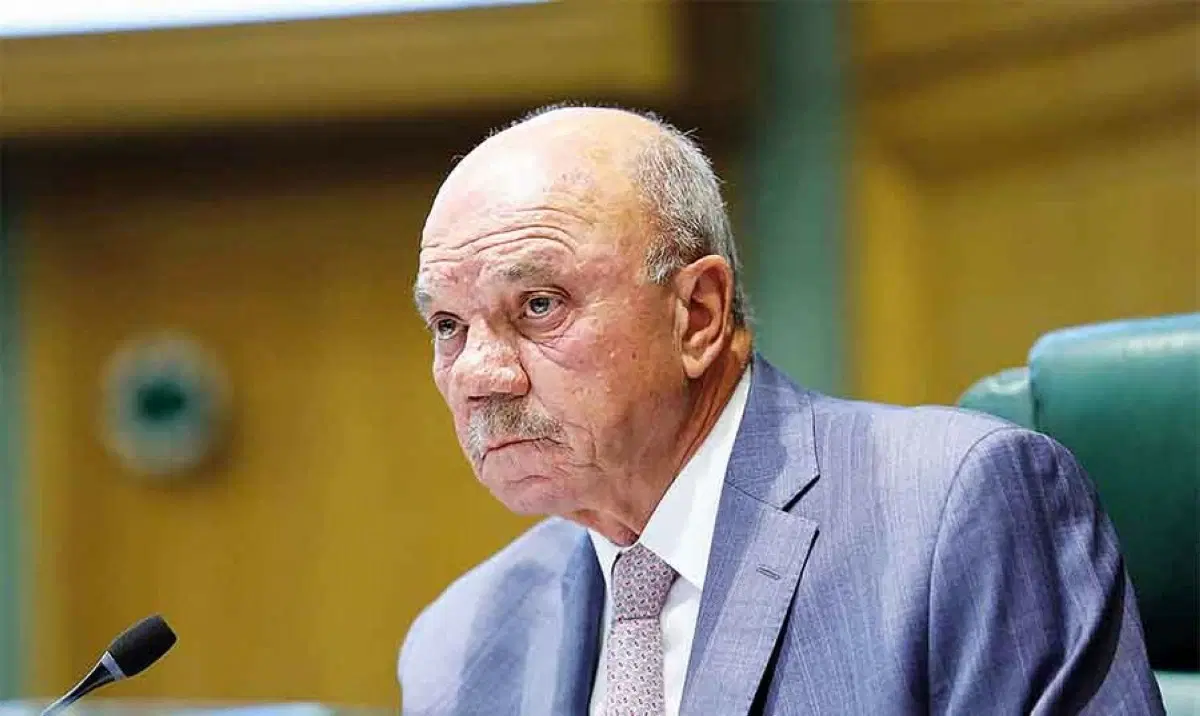
Al-Fayez: King's Speech at the UN is a Historic Document and its Messages Require an Active International Stance towards Israel
Amman7 min read
Share
The President of the Senate, Faisal Al-Fayez, confirmed that His Majesty King Abdullah II's speech before the UN General Assembly constituted a clear and explicit Jordanian stance towards what the region is witnessing, and described it as a "historic document that should be taught", due to the messages it carried to the international community regarding the Palestinian issue and Israeli violations, and the necessity of respecting international law and covenants.
Al-Fayez said, during his hosting on Sunday evening in the "Ten" program on the Kingdom Channel, that His Majesty the King enjoys great international presence and respect, and his positions towards the Palestinian issue are steadfast and extended across various international platforms, recalling His Majesty's speech before the US Congress in 2007, and his speeches before the European Parliament and in regional and international forums, and his continuous pursuit of achieving peace and stability in the region.
He pointed out that His Majesty the King's speech before the United Nations put the international community before its responsibilities towards Israel and its non-compliance with international covenants and agreements, and the violations it commits in the Gaza Strip and the West Bank, explaining that the Senate is about to send messages to the heads of parliaments around the world, addressing the contents of the royal speech and calling for taking economic measures and sanctions against Israel to pressure it to stop its violations.
Al-Fayez added that the Senate's movements and parliamentary contacts will cover various countries, emphasizing the importance of not limiting the pressure to the occupying state, through Western countries and the European Union, but it must extend to Eastern countries that have major trade and economic relations with Israel, including China, Japan, and South Korea, stressing the necessity of translating positions supporting the two-state solution into practical measures.
He pointed out that His Majesty the King emphasized that the issue is not limited to the settlers, and that Israel, despite presenting itself as a democratic state, does not adhere to the requirements of democracy and the rights of the Palestinians, recalling His Majesty's position on rejecting the Israeli government's two-state solution, and affirming that if this solution is rejected, the option of one state requires granting the Palestinians their legitimate political rights.
On the domestic front, Al-Fayez stressed the need to strengthen the internal front and preserve national unity and confront all attempts to spread sedition and undermine trust between the citizen and the state, affirming that national unity represents a safety valve for Jordan, alongside the Hashemite throne, and that the current phase requires direct communication with citizens and raising awareness of the magnitude of the challenges facing the Kingdom.
Al-Fayez added that "everyone who seeks to strike national unity does not want the good of this country", recalling King Hussein bin Talal's saying that "everyone who attacks national unity is my enemy until the Day of Judgment", and pointing out that King Abdullah II echoed the same position, saying that the coming phase requires working to protect and enhance national unity and confronting everything that might harm it or destabilize Jordan.
Regarding Israeli attacks on Syria, Al-Fayez said that Israeli military movements in southern Syria, especially in the Yarmouk Basin area, affect Jordanian national security, especially water security, given the importance of the sources of the Jordan and Yarmouk rivers, affirming that control over water sources constitutes an attack on Jordanian water security, which is part of national security.
He affirmed Jordan's support for Syria and King Abdullah II's support for the Syrian state and its leadership, pointing to the continuous communication between His Majesty and Syrian President Ahmed al-Sharaa, and that Syria's security, stability, and territorial integrity are part of Jordanian national security, and what is required is to enable the Syrian state to assert its sovereignty over its entire territory and build a strong army and security forces, in the face of attempts to incite internal sedition and divisions.
Al-Fayez pointed out that Jordan, under the leadership of King Abdullah II, and before him King Hussein bin Talal, God rest his soul, has always chosen the path of peace and diplomacy, but Israeli policies have rejected peace initiatives, including the Arab Peace Initiative of 2002, affirming that Jordan practices diplomacy from a position of strength, and adheres to its national rights and interests, relying on the honorable history of the Jordanian armed forces and the Jordanian people in defending the homeland and Arab issues.
He pointed out that the constants of the Jordanian state are based on the Hashemite throne and the civilian state institutions with their executive, legislative, and judicial powers, and on the strong bond between the people and the Hashemite leadership, affirming that Jordan's strength is based on its leadership, army, security agencies, and people, and its ability to overcome the challenges that have surrounded it throughout the history of the state, recalling the battles of Jerusalem, Latrun, and Bab al-Wad, and the Battle of Karameh, which "broke the Zionist pride", explaining that Jordan "will not yield" and will not give up its national constants and supreme interests, or deviate from its principles, stressing that the Jordanian people show their true mettle in times of hardship.
Regarding Jerusalem, Al-Fayez confirmed that talking about it is closely linked to the Hashemite custodianship of Islamic and Christian holy sites, warning of the danger of Israeli settlement plans, especially the "E1" plan, which aims to cut off the West Bank and isolate Jerusalem from its Palestinian surroundings, stressing that the greatest danger lies in attempts at displacement, which King Abdullah II confirmed as a red line for Jordan.
He explained that the Hashemite custodianship of the holy sites in Jerusalem extends historically since Sharif Hussein bin Ali, who contributed from his personal funds to the construction of the Al-Aqsa Mosque and the Dome of the Rock, and continued through the stages of Hashemite construction during the reign of King Abdullah I and King Hussein bin Talal, up to the reign of King Abdullah II, who continued to sponsor the holy sites, including the reconstruction of the pulpit of Salah al-Din al-Ayyubi.
Al-Fayez stressed Jordan's categorical rejection of any attempt to displace Palestinians or attack the Kingdom's territories, affirming that any threat to Jordan is a threat to Arab national security, which requires a unified Arab stance to confront current challenges and protect Arab interests.
He called for formulating a comprehensive Arab strategy for Arab national security, politically and economically, and reactivating and updating the Arab Joint Defense Agreement, warning of the dangers of continued Israeli expansion and hegemony in the region, and affirming that Arab countries possess the resources and capabilities to build a regional power capable of protecting their interests, confronting poverty and unemployment, and achieving economic and political integration.
Regarding the relationship with Iran, Al-Fayez confirmed that Jordan relies on diplomacy and dialogue based on rationality and wisdom, but at the same time rejects any attack or interference in the internal affairs of Arab countries or a threat to Jordanian national security, pointing out that the Jordanian message is clear in opening up to dialogue with Iran, provided that the sovereignty of Arab countries is respected and they are not interfered with.
On the Syrian issue, Al-Fayez expressed his hope that Syria would regain its sovereignty over its entire territory, and succeed in achieving national reconciliation and building a civil state that accommodates all components of Syrian society, affirming the depth of historical, social, and tribal ties between the Jordanian and Syrian peoples, and that Syria's stability and unity are in the interest of Jordan and the region.
Al-Fayez concluded his speech by emphasizing the importance of Jordanians standing as one in the face of any plans targeting the Kingdom's security and stability, stressing that stability forms the basis of development and economic growth, and expressing his confidence in the authenticity of the Jordanian people and their rallying around their homeland and leadership in the face of various challenges.