Al-Fayez Meets Algerian Ambassador and Discusses Strengthening Bilateral Relations and Regional Developments
Amman4 min read
Share
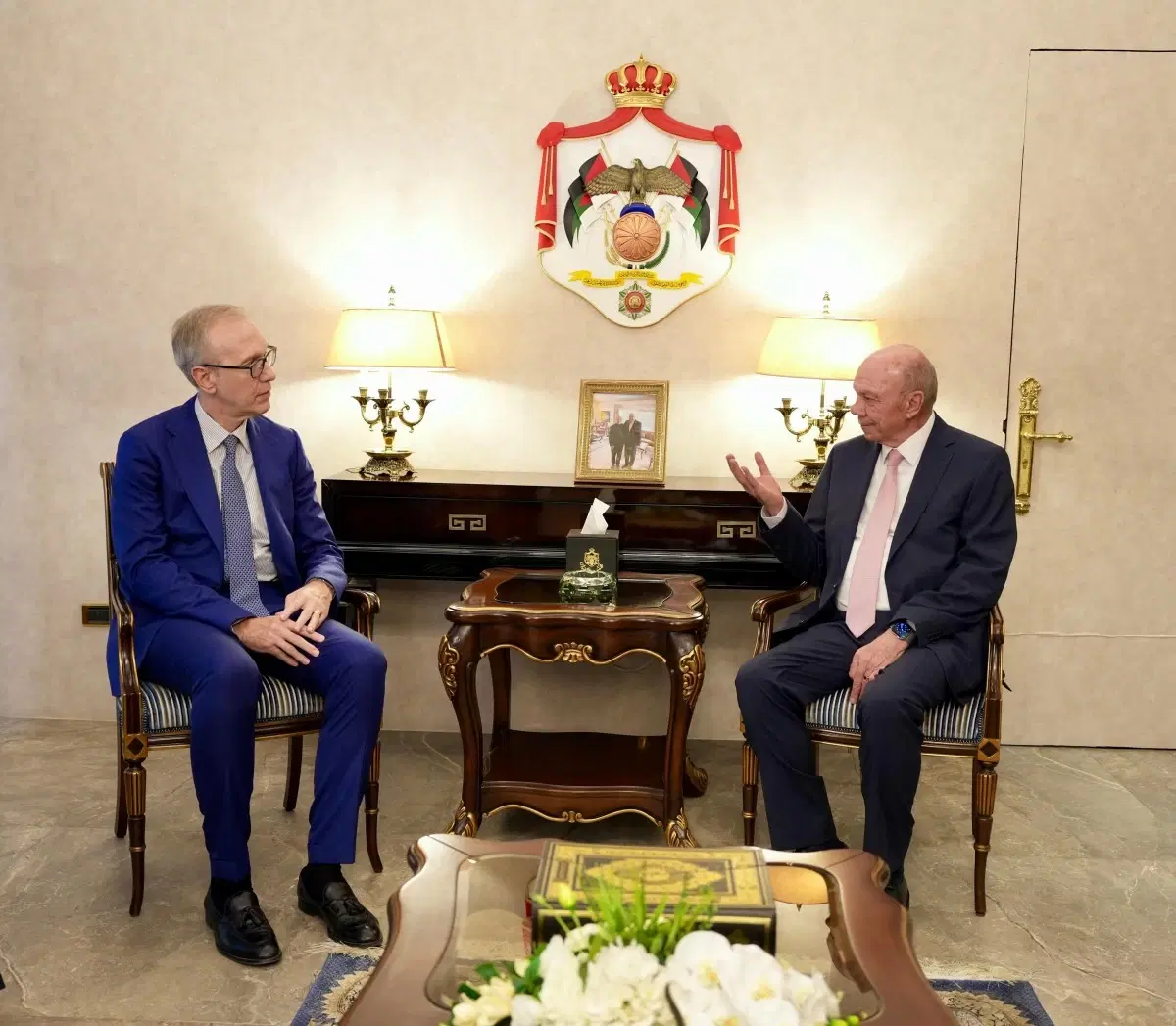
The President of the Senate of Jordan, Faisal Al-Fayez, met in his office on Sunday with several ambassadors of fraternal and friendly countries to the Kingdom individually, and discussed with them aspects of bilateral relations, ways to strengthen them, and build upon them in various fields.
Al-Fayez met with Algerian Ambassador Mohamed Zargat, Sudanese Ambassador Hassan Saleh Suwar Al-Dahab, and Italian Ambassador Pier Zamporletti.
Al-Fayez praised the high level of Jordanian relations with these fraternal and friendly countries, emphasizing the importance of building upon and strengthening them in various fields, especially political, economic, investment, and parliamentary.
During the meetings, the current situation in the region was reviewed, including the Iranian-American-Israeli war, the situation in the Gaza Strip and the occupied West Bank, amid the ongoing Israeli aggression against the Palestinian people, and against Syria and Lebanon.
The President of the Senate briefed the ambassadors on the royal speech delivered by His Majesty King Abdullah II at the United Nations General Assembly, and pointed out the main contents and messages of the speech.
He pointed out that His Majesty the King presented the international community with the reality of the stage the region is going through, especially regarding what is happening in the Gaza Strip and the West Bank, the dangerous developments in Syria, and their direct impact on Jordan's security and stability, and the responsibilities of the international community towards protecting security, stability, and stopping Israeli violations, and respecting the rules of international law.
He added, "His Majesty the King warned of the aggressive and expansionist Israeli ambitions in the region, which today have become a regional threat, and warned of the repercussions of Israeli incursions in southern Syria, and the attempt of the occupying state to impose a new reality on the ground, and questioned the role of international law, about if it was possible to ignore international law for decades, what remains of its value? And how can we apply it if we do not even recognize its violations? "
Al-Fayez explained that His Majesty emphasized the protection of Jordan's national security, and that any threat to Jordan's northern borders, or to our water security, is a threat to our national security, and therefore Jordan will not turn a blind eye to any threat that affects its security, water, and the interests of its people, while affirming at the same time, Jordan's commitment to peace, support for the steadfastness of the Palestinian people and UNRWA, the continuation of carrying the Hashemite custodianship, and the preservation of the historical and legal status quo of the Islamic and Christian holy sites in Jerusalem, explaining that Jordan's adherence to diplomacy does not exceed its commitment to humanitarian values, and should not be misinterpreted as weakness.
Al-Fayez pointed out that His Majesty the King called on the international community to move from crisis management to addressing their causes, and from recording positions to taking practical steps to protect human beings, enforce respect for international law, and prevent the continuation of the policy of imposing fait accompli.
He stressed that His Majesty's speech was not just a speech before the United Nations, but a deep Jordanian reading of the reality of the region, and a clear call to restore respect for international law, justice, and the right of peoples to security, peace, and statehood, in which he presented the risks resulting from the continuation of the Israeli occupation, and the aggressive and expansionist policies of Israel.
Al-Fayez explained that while His Majesty the King revealed the war crimes committed by the occupying state in Gaza, His Majesty did not overlook what is happening in the West Bank, and the expansion of settler violence, land seizures, and settlement expansion, which constitute war crimes as a whole.
For their part, ambassadors of fraternal and friendly countries praised the speech of His Majesty the King, and His Majesty's calls to the international community to bear its moral and legal responsibilities to end the conflicts in the region and achieve security and stability for its peoples.
They pointed out that His Majesty's speech comes within the framework of the efforts being made to achieve peace in the region, and the return of security and stability to it, affirming the pride of their countries in their relations with Jordan, and the keenness to develop and promote them, and maintain them in various fields, in a way that serves mutual interests, and enhances bilateral relations.