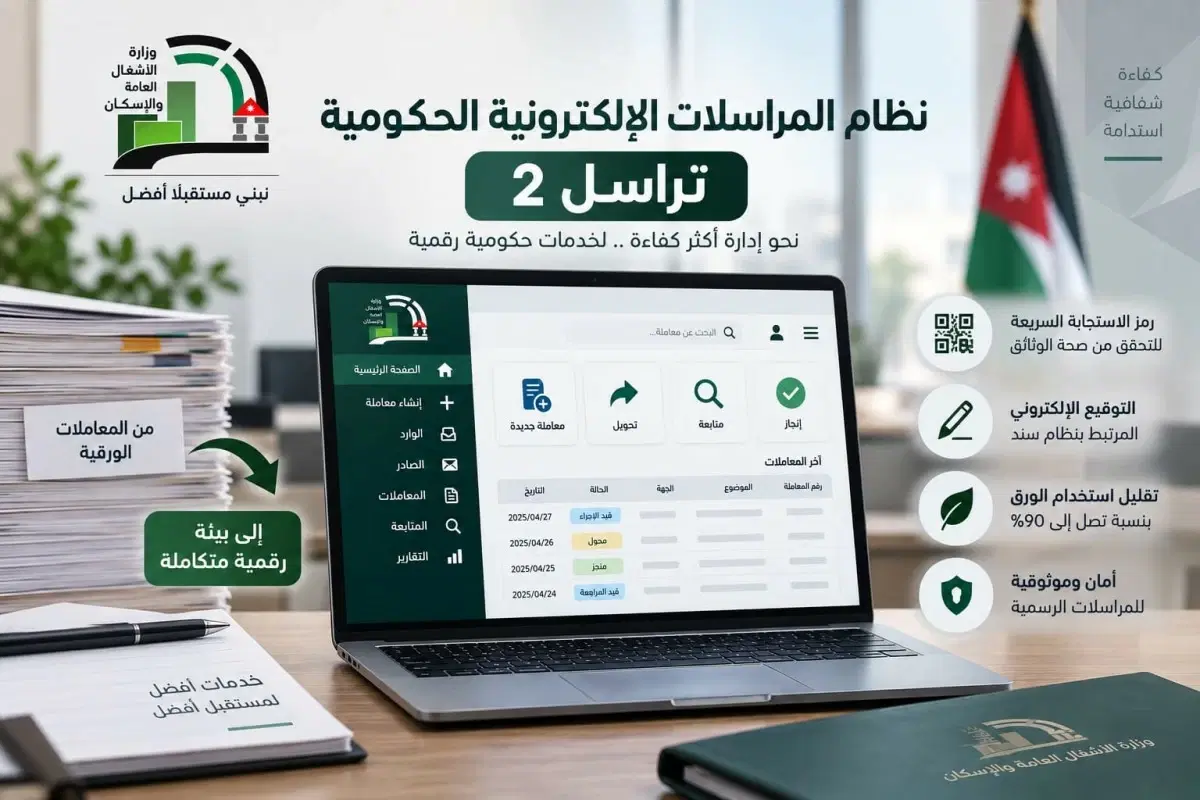
The application of 'Tawasul 2' represents a new step in the development and modernization journey pursued by the ministry, by transitioning from traditional paper transactions to managing official correspondence and transactions electronically, which contributes to simplifying procedures, enhancing the accuracy of follow-up, and shortening the time and effort required to complete tasks.
The system allows for the automation of the cycle of official correspondence and transactions, starting from the creation of the transaction and its transfer between directorates and departments, through the follow-up of its path and stages of completion, up to its approval and electronic storage according to security and protection standards, which enhances institutional performance efficiency and follow-up and control mechanisms.
'Tawasul 2' includes a number of technical features that enhance the reliability and security of official correspondence, most notably the inclusion of a Quick Response (QR) code in official letters, which allows for electronic verification of the authenticity of the letter and its conformity with the original document, thereby reducing the possibility of tampering or forgery.
The system also relies on the electronic signature of official correspondence and transactions, linked to the government 'Sind' system, which allows for the electronic approval of documents according to secure and reliable mechanisms, and supports the transition towards an integrated digital government work environment.
The application of the system is expected to contribute to rationalizing expenses and reducing the use of paper and printed materials, which supports sustainability efforts and preserves financial resources, as it is expected to contribute to reducing the costs associated with printing operations, including paper, ink, printers, and maintenance work, by approximately 90%.
Before the start of the application, a number of training programs were implemented for technical and administrative cadres at the ministry's center, aiming to enhance the readiness of employees and ensure a smooth and effective transition to the new system, while the Directorate of Computing and Information Technology continues to provide technical support to users and answer technical inquiries related to its use.
After about two weeks of the application's start, the ministry is currently working on collecting feedback from the system's users, noting observations and suggestions related to the user experience, and studying and benefiting from them in developing the system, improving its performance, and achieving its optimal use.
The implementation of 'Tawasul 2' comes within the ministry's ongoing efforts to update institutional work tools, simplify procedures, speed up the completion of transactions, and reduce reliance on paper transactions, leading to a more efficient and effective digital government work environment.