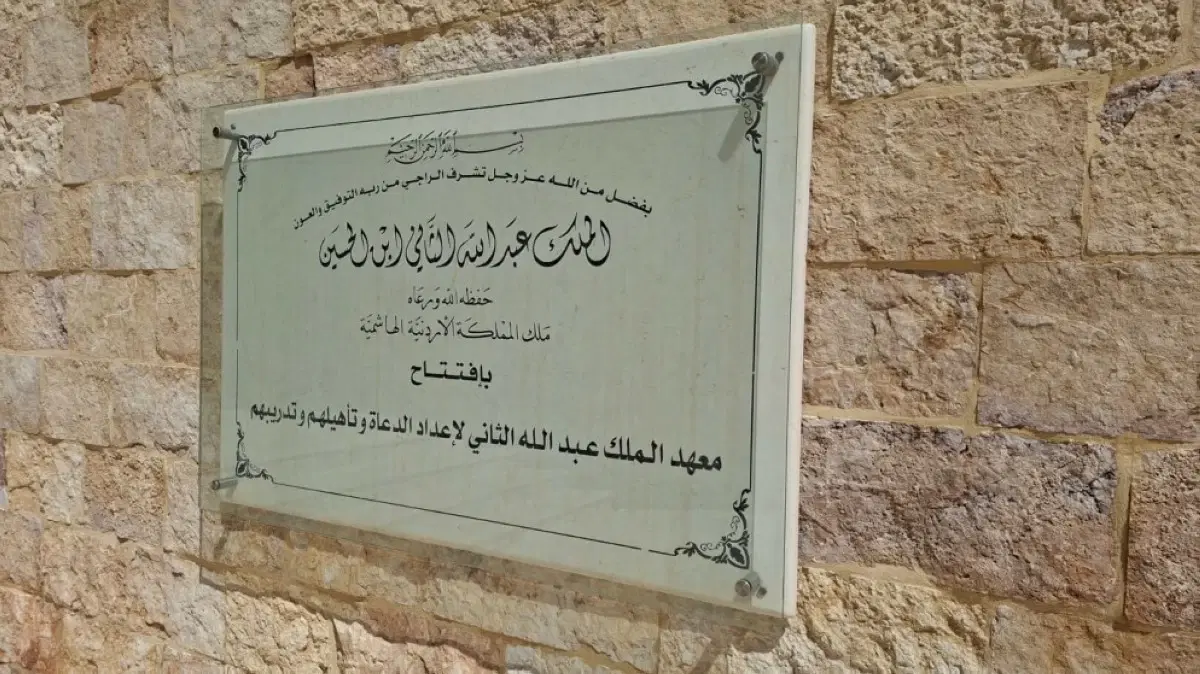
The Ministry added that the Institute implements a series of training and qualification programs and activities that meet the needs of the field and enhance the efficiency of workers in the da'wah field, thereby enhancing their performance and mission in serving the community.
The Ministry pointed out that the Institute offers a comprehensive package of training programs, mainly including foundational programs, workshops, advanced programs, skill-based programs, and career advancement programs.
It explained that the foundational programs aim to build the basic religious and linguistic knowledge of Imams and preachers, including fiqh courses that cover fiqh topics needed by Imams in their daily lives, through an explanation of the book 'Ummdat al-Salikeen wa 'Uddat al-Nasikh' by Imam Ibn al-Naqib, including topics such as purification, prayer, fasting, and Hajj, in addition to Arabic language courses through an explanation of the Matn al-Ajaroumiyyah, and courses on the recitation of the Holy Quran and Tajweed.
The Ministry also pointed out that the Institute implements refresher programs, which are short and intensive training programs, usually not exceeding eight sessions, aimed at renewing and revitalizing knowledge, including Tafsir courses that cover the interpretation of verses and surahs that Imams frequently need to explain, and courses on some fiqh topics, in addition to various da'wah topics.
The Ministry drew attention to the fact that the skill-based programs focus on developing the practical skills necessary for da'wah work, including the art of delivery, influence, and communication, scientific research, and the extraction of Hadith, which contributes to enhancing the scientific and professional efficiency of the preacher and Imam.
The Ministry explained that the career advancement programs are linked to the career path and are a requirement for promotion to the desired job level according to the systems and instructions in place.
The Ministry added that the Institute implements training workshops, which are short, practical training activities that focus more on practice, participation, and interaction than theoretical teaching, and aim to acquire or develop a skill through exercises, discussions, problem-solving, simulation, and teamwork.
The Ministry explained that the Institute focuses on the integration of religious qualification and da'wah skills, concerned with fiqh and its principles, the recitation and Tajweed of the Holy Quran, Arabic language, Tafsir, Hadith and its extraction, in addition to the skills of delivery, influence, communication, and scientific research, thereby enhancing the ability of the Imam and preacher to perform their mission efficiently and linking religious knowledge to the needs of reality.
The Ministry pointed out that the Institute works to continuously develop its training programs in light of the needs of the da'wah field and emerging societal challenges, by diversifying topics, introducing new programs in new fields, combining scientific qualification and skill-based training, and benefiting from the results of tests and electronic questionnaires that measure the benefit and evaluation of participants and lecturers.
The Ministry emphasized that the Institute plays an important role in promoting moderate religious discourse based on religious knowledge and a moderate understanding of Islam, through programs and courses that address topics such as the Amman Message, combating violence and extremist thought, and promoting values of moderation, tolerance, and dialogue, thereby enabling Imams and preachers to deal scientifically and consciously with deviant ideas and contemporary intellectual issues.
The Ministry said that the Institute continuously develops its programs in light of the needs of the field and emerging societal challenges, by diversifying topics and introducing new programs, combining scientific qualification and skill-based training, and benefiting from the results of tests and electronic questionnaires to evaluate courses and lecturers and measure the benefit of participants.
The Ministry emphasized that the Institute plays an important role in promoting moderate religious discourse through programs that address the Amman Message, combating violence and extremist thought, and promoting values of moderation, tolerance, and dialogue, thereby enabling Imams and preachers to deal with deviant ideas and contemporary intellectual issues.
The Ministry added that the Institute pays attention to developing da'wah communication tools to suit digital transformations and modern means of communication, and enhancing the skills of the preacher in delivering their message through available means and platforms.
The Ministry pointed out the introduction of courses on the extraction of Hadith, Aqidah, and Islamic Endowment, in addition to the development of existing programs and the addition of topics related to the needs of da'wah work.
The Ministry explained that the Institute pays attention to different societal groups, through courses on child protection, workshops on women's empowerment held in the three regions, and programs for youth, including awareness programs on the dangers of drugs implemented in cooperation with a number of Jordanian universities.
The Ministry explained that the Institute relies on pre- and post-tests and electronic questionnaires to evaluate courses and lecturers and measure the benefit of participants, thereby contributing to the development of programs and improving their outputs.
The Ministry emphasized that the Institute is moving towards continuing to develop the training system, by expanding specialized and skill-based programs, introducing programs that respond to emerging issues and the needs of the da'wah field, enhancing the use of modern technologies, developing tools for measuring the impact of training, and expanding partnerships with academic and community institutions, thereby contributing to preparing an Imam and preacher who possesses a solid religious qualification, da'wah skill, and the ability to deal with contemporary societal issues.