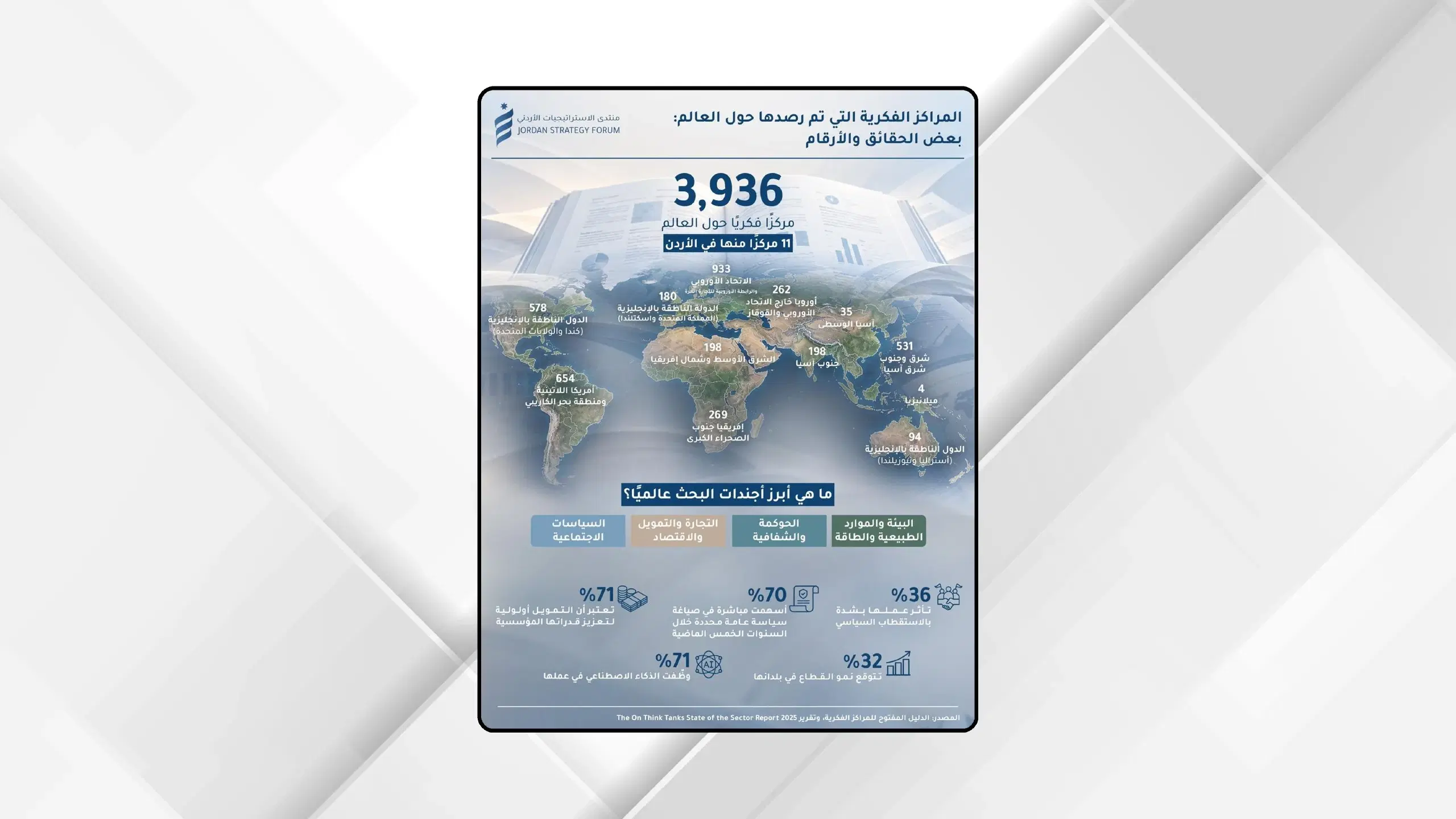
The report was based on the Open Think Tanks Directory, the (On Think Tanks – State of the Sector Report 2025), the (Think Tank Alert) classification, and the (100 Think Tanks to Watch 2025) initiative, to analyze the spread of think tanks, their challenges, international presence, and use of artificial intelligence.
The forum pointed out that the world is witnessing an unprecedented level of uncertainty, amid the coincidence of geopolitical conflicts, economic turmoil, climate pressures, and rapid technological transformations, which have become highly intertwined and difficult to deal with in isolation from each other.
It explained that the pivotal role of research and think tanks is reflected in linking scientific research to public policymaking, anticipating emerging challenges, and examining prevailing assumptions, based on collecting data, analyzing diverse viewpoints, and estimating their potential impacts.
The forum noted that think tanks differ according to their institutional nature, which reflects on their governance, funding, and relationship with decision-makers, and include independent civil society centers, university-linked centers, government or state-supported, corporate and private sector-linked, and politically affiliated.
The forum pointed out that the number of registered think tanks globally reached (3,936) centers by April 2026, according to the Open Think Tanks Directory, including the European Union region and the European Free Trade Association (23.7%), followed by English-speaking countries (Britain, Canada, the United States, Scotland, New Zealand, and Australia) with (21.6%).
It also includes Latin America and the Caribbean (16.6%), East and Southeast Asia (13.5%), and Sub-Saharan Africa (6.8%).
In contrast, the Middle East and North Africa region (198) think tanks, which is (5%) of the total think tanks worldwide, including (46) centers in the occupied state, (36) in Saudi Arabia, (13) in the UAE, (12) in Egypt, (11) in Jordan, (11) in Lebanon, and (10) in Morocco, reflecting the limited presence of think tanks in Arab countries compared to more than a quarter (26%) in the occupied state alone.
The forum's analysis showed that social policies, trade, economics, finance, governance and transparency, and the environment, natural resources, and energy top the research priorities of think tanks globally, while interest in technology, innovation, health, and childhood declined, despite their growing importance.
In the Middle East and North Africa, defense, peace, and security top the interests of think tanks, covering (46%) of them, reflecting the impact of the turbulent geopolitical environment in determining their research agendas.
The forum explained that international presence and influence in global policy discussions are a challenge for think tanks, especially in emerging markets, and institutions based in the United States and Western Europe topped the (Think Tank Alert) classification issued in August 2026.
In contrast, the (100 Think Tanks to Watch 2025) initiative relies on peer nominations and members of the research community to highlight striking practices and institutional innovation and actual impact, and is not presented as a competitive ranking of the best institutions.
The forum pointed out that the (The On Think Tanks State of the Sector Report 2025) report, based on a wide survey of about (333) think tanks from around the world, revealed challenges beyond funding to the political and institutional environment. Only (32%) of the institutions participating in the survey expected sector growth in their countries.
Also, (36%) of institutions globally reported that their work was severely affected by political polarization; that is, the sharp division in political positions and orientations within society, while centers in the Middle East and North Africa region were the least affected by political polarization, at (15%).
Securing funding was a priority for (71%) of think tanks to enhance their institutional capabilities.
The forum explained that basic funding is more widespread in high-income countries, although it is not a comprehensive solution to sustainability challenges.
The report's results also indicated that capacity gaps are more related to organizational structure than the size of the institution, as centers lacking specialized units for attracting funding, human resources, or financial affairs face a continuous need to enhance their capabilities in these areas.
Despite these pressures, (70%) of the participating institutions reported that they had directly contributed to the formulation of a specific public policy over the past five years, confirming their continued ability to achieve tangible impact.
The results showed that centers operating in a media environment that is receptive to their research output were more likely to benefit from their impact on public policy, highlighting the importance of the environment in which research is discussed and used.
Regarding artificial intelligence, the percentage of centers that reported using it increased from (57%) in 2024 to (71%) in 2025, and AI tools can speed up information processing, reviewing evidence and sources, and improving communication, allowing small and resource-limited centers to accomplish tasks that previously required larger research teams.
In contrast, the forum noted that this expansion in use may carry real risks that cannot be ignored, such as producing inaccurate information, citing fabricated references, bias in model training data, data privacy violations, and ambiguity of responsibility when errors occur in analysis or conclusions.
The forum recommended establishing a "trust structure" for using artificial intelligence, based on four elements: trained human competencies to critically deal with its outputs, clear institutional rules for its use, reliable sources, and research methodologies that make the supported work transparent and verifiable by third parties.
It added that the abundance of AI-generated content calls for think tanks to focus on original research, human judgment based on cumulative experience, and rigorous verification of evidence, rather than competing on the volume of published reports and studies.
The forum emphasized the importance of distinguishing between communication, which often involves transferring evidence and results to the recipient, and active engagement that creates spaces for dialogue and cooperation with stakeholders throughout the research and policymaking process, from defining the research question to implementing recommendations and monitoring their impact.
It emphasized the importance of think tanks in linking research evidence and experience to practical reality and transforming them into realistic and applicable public policy options, calling for the establishment of an integrated research system in Jordan, bringing together the government, think tanks, universities, the business sector, and civil society, within a continuous and reliable institutional dialogue.