The forum indicated in its paper that critical thinking is defined as: "A systematic process that includes interpreting information, analyzing arguments, evaluating evidence, and reaching justified conclusions, along with the individual reviewing their judgments and thinking", according to the specialist researcher Peter Facione.
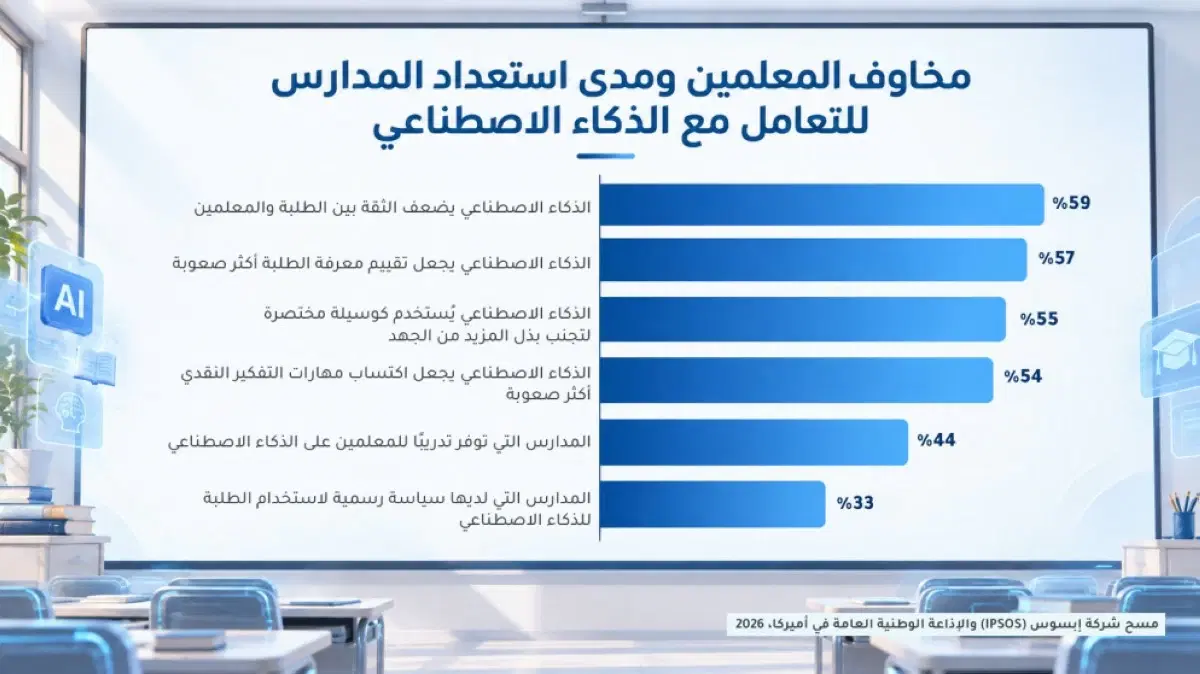
The paper also pointed out that recent evidence indicates growing concerns about the impact of artificial intelligence on education, as a survey conducted by IPSOS, in collaboration with National Public Radio in America in June 2026, showed that more than half of school teachers in the United States (59%) fear that artificial intelligence will weaken critical thinking among students.
Teachers also noted that (55%) of students often resort to artificial intelligence to reduce the effort exerted by them. Meanwhile, the percentage of schools that adopt official policies to regulate its use was limited (33%).
The forum pointed to another study conducted by the Boston Consulting Group in June 2026, which included (70) senior executives, warning of the phenomenon known as "Cognitive Debt", i.e., the erosion of critical thinking skills, sound judgment, curiosity, and originality of ideas, as a result of artificial intelligence replacing human thinking. Half of the participants reported that they are already noticing a decline in these skills. More than (60%) of the respondents to the study expected this decline to become a tangible threat within the next three to five years.
The forum noted in its paper that Jordan has taken important steps in integrating artificial intelligence into the educational system, most notably: the launch of the smart educational assistant "Siraaj", which now reaches thousands of teachers and students in public schools. This assistant is expected to improve the educational process, especially when used effectively and responsibly, thereby enhancing critical thinking.
The forum pointed out that the issue is no longer about using artificial intelligence in education, but rather about how to employ it in a way that enhances human thinking abilities. Accordingly, the Jordanian Strategies Forum recommended the necessity of establishing a national observatory for artificial intelligence and education, which includes a carefully selected elite of experts in education, artificial intelligence, critical thinking, evaluation, and scientific research, to monitor the use of artificial intelligence tools in schools, measure their impact on learning, critical thinking, academic integrity, and educational justice. In addition to its primary role in providing national evidence that supports curriculum review, developing evaluation methods, preparing teachers, and guiding national programs to build knowledge of artificial intelligence among teachers and students.