It was during that period that our personal, family, and cultural relationship began, which yielded many ideas, initiatives, and cultural projects in translation, participation in various seminars, and more. I had started working in the History Department at Yarmouk University in the 1989/1990 academic year, which was separated from the Professional Associations Complex only by a street. Therefore, a personal and cultural relationship was immediately forged between us in 1990, lasting for decades until the final weeks before his death.
We shared many things, including the rich outcome of our lives in Yugoslavia, especially regarding the cultural aspect and the feeling of falling short in translating what we knew into Arabic. In the first year, we lived through the anxieties of the collapse of Yugoslavia, then came the years of the war in Bosnia (1992-1995) to spark interest in the humanitarian and cultural aspect, including the destruction of cultural heritage such as the National Library in Sarajevo and the unique Oriental Manuscripts section at the Oriental Institute in Sarajevo, among others.
In those early years, Ismail Abu Al-Bandoura published his first translated work in 1992 titled "Yugoslav Stories" by two of the most famous Bosnian writers in Yugoslavia and the world: Ivo Andrić (1892-1975) and Meša Selimović (1910-1982), thus launching the second wave of introducing Yugoslav literature after the contributions of Sami Al-Droubi, Hussein Abdel Latif, Ahmed Smailović, and Jamal al-Din Sayyid Muhammad, who had first introduced Ivo Andrić and Meša Selimović. In those years, Jordan became attractive to well-known academic and cultural figures from Yugoslavia, such as Aleksandar Stipčević (whose book "The History of the Book" was published at that time in the Alam Al-Ma'rifa series), the Serbian orientalist Rade Božović, and the Bosnian orientalist Esad Duraković, which provided an incentive for work in cultural networking between the two sides.
In this context came the most important initiative: the translation of the book "Escape to Freedom" by the Bosnian President Alija Izetbegović, which had been published at that time (1999), and about which I wrote a review in "Al-Hayat" newspaper on February 27, 2000. We received an attractive offer from Dar Al-Fikr, whose director, the late Muhammad Adnan Salem, was interested in this figure who had captivated many. Ismail and I agreed to split the work (translation for him and review for me), and the book was published in 2002, opening a glorious page in motivating Ismail to do more work in this field. The book won the award for the best translated book in Jordan and Kuwait, and the book's editions continued until they reached twenty!
With this great start, the path was opened for more cultural communication with the Republic of Bosnia and Herzegovina after its independence, and Ismail Abu Al-Bandoura visited it several times, participating in literary and cultural seminars in Sarajevo. During those years, he began his major project of translating Bosnian literature into Arabic. In 2007, the Jordanian Ministry of Culture published his translation of the novel "The Fortress" by the well-known novelist Meša Selimović, making it the second in Arabic after "Death and the Dervish". The following year (2008), his translation of the novel "The Martyr" by the Bosnian novelist Dževad Karahasan (1960-2016) was published, representing the second generation of novelists after Andrić and Selimović. In this context, the Abdulaziz Saud Al-Babtain Cultural Foundation decided to hold its 12th session in Sarajevo in 2010 and issue several translations introducing Arab and Bosnian cultures, including "Selections of Contemporary Poetry from Bosnia," which was translated by Ismail Abu Al-Bandoura.
It seems that this distinguished participation in the Sarajevo session of the Al-Babtain Foundation award was a turning point for Ismail Abu Al-Bandoura to dedicate himself to a major project translating the masterpieces of Bosnian literature from its beginnings to the most important writers of our time. Thus, he returned to the beginning of the novelistic literature in Bosnia to publish in 2018 "The Green Meadow" by Edhem Mulabdić (1862-1954), which is considered the first novel in Bosnian literature, and followed it in the same year with the novel "The Inn" by the veteran Bosnian novelist Ćamil Sijarić (1913-1989), in which he addresses the transformations of Bosnian society from Ottoman rule to Yugoslav rule.
With this activity, the academic and former President of Bosnia, Haris Silajdžić, visited Amman in 2017, where he met with Ismail Abu Al-Bandoura and revealed the old-new literary side of his experience, as he had by then published his poetry collection "Meeting of Words," which Ismail translated and published in Amman in 2020.
In another return to the beloved writer Ivo Andrić, Ismail Abu Al-Bandoura provided a new contribution in 2021 by translating a selection of Andrić's stories titled "A Bridge on the Žepa River and Other Stories" to introduce the other side (stories) of Andrić in contrast to "The Bridge on the Drina" (novels).
In another step, Ismail Abu Al-Bandoura chose one of the novels by the contemporary Bosnian writer Dževad Karahasan (1953-2023), "Sara and Serafina," which won many European awards for his novels that were translated into several languages, while this was the first into Arabic, published in 2022. In that year, Ismail began translating a play by the well-known Bosnian writer Džemaludin Latić to complete this gap in Arabic and sent it for publication to the "World Literature" series in Kuwait, but his death preceded its publication.
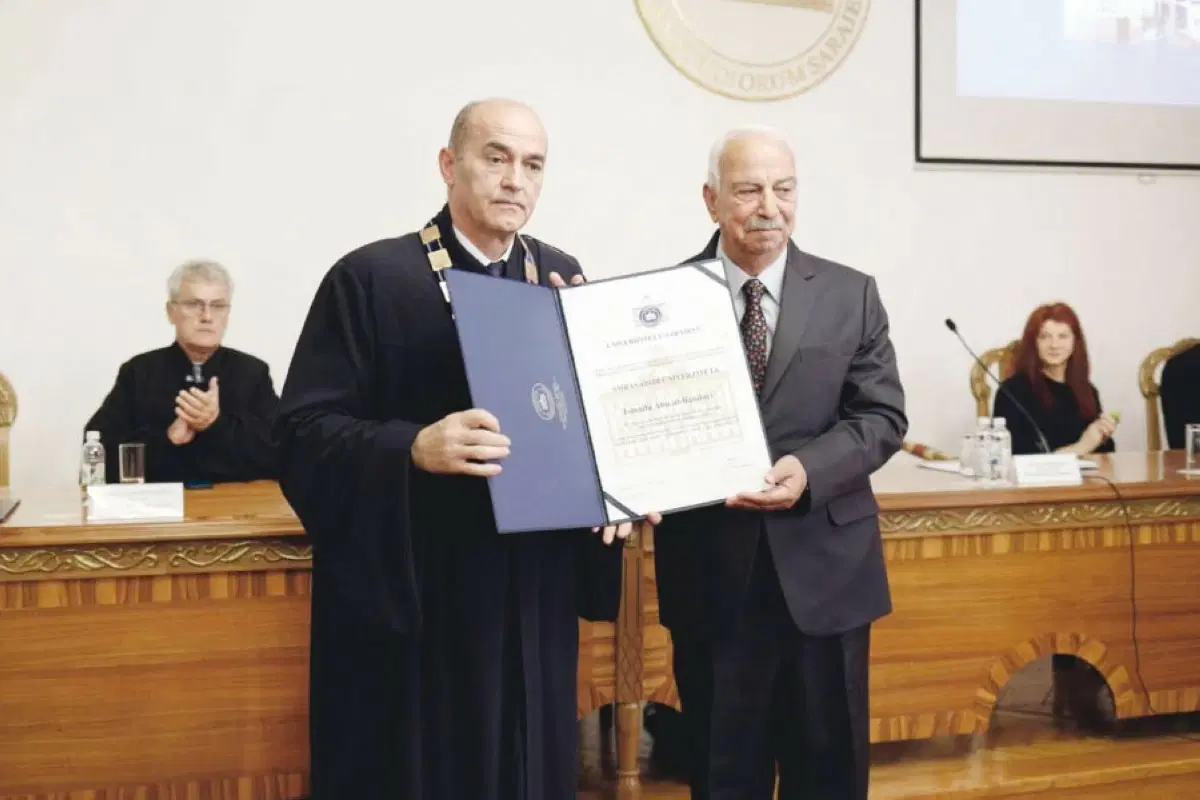
For all these contributions and others, through which Amman turned into a major bridge for introducing Bosnian literature to Arabic, Ismail Abu Al-Bandoura received recognition in Bosnia from intellectuals and academic institutions, as the President of the University of Sarajevo honored him on December 19, 2022, with the title "Ambassador of the University of Sarajevo," which is awarded to cultural figures who contribute to networking between cultures. Along with this great contribution that Abu Al-Bandoura accomplished, his appearance came in an evening held by the Abdul Hameed Shoman Foundation in Amman during April 2026 to honor me.
What Ismail Abu Al-Bandoura exerted in this major mission, which he occupied himself with and through which he introduced Arab readers to literature that was not sufficiently known, until Amman became considered a bridge for introducing the literature of Bosnia, Yugoslavia, and the Balkans, was enough for his name to be mentioned with all appreciation, whether by those who knew him or those who read his work.