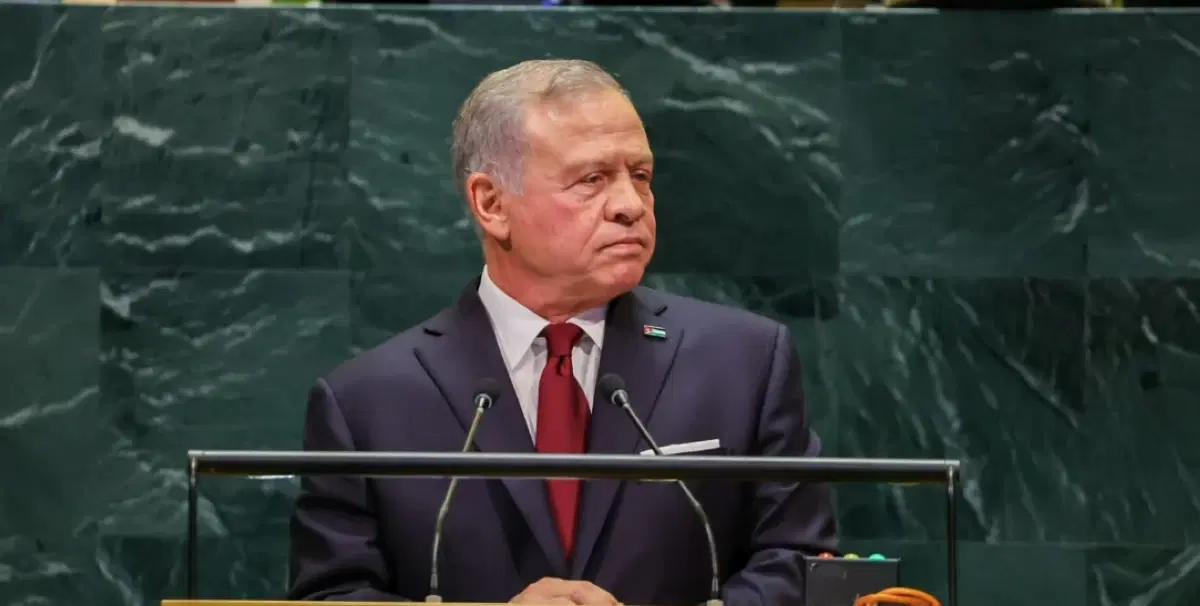
How did the international media cover the King's speech at the United Nations?
Amman5 min read
Share
International media outlets focused on King Abdullah II's speech at the 81st session of the United Nations General Assembly, highlighting his warnings about the repercussions of Israeli policies on regional security, developments in southern Syria and their impact on Jordan's border and water security, as well as his stance on events in the West Bank and Gaza Strip.
International media coverage emphasized that the King's speech combined the Palestinian issue with regional developments, placing Jordan's border and water security among the key messages he conveyed to the international community, warning of the continuation of imposing new realities on the ground and their consequences for regional stability.
The New York Times, in a report, highlighted the main issues presented in the King's speech, including the ongoing Israeli settlement expansion in the West Bank, escalating settler violence, and the displacement of Palestinians.
The newspaper, in its coverage of the regional landscape surrounding Jordan, discussed several files related to security developments in the region, before the King's speech placed the issue of developments in southern Syria and their impact on the Kingdom's security and water at the core of his message.
In an analysis of the King's speech, the Arabic newspaper Rai Al-Youm stated that the King publicly outlined broader boundaries for the crisis linked to the Israeli occupation, explaining that its repercussions are not limited to Palestinian territories but extend to Jordanian concerns related to border and water security.
The newspaper noted that the speech's focus on southern Syria reflects the importance of the rapid military and security developments near the northern borders of the Kingdom and their potential consequences for Jordanian interests, especially in the water sector.
The newspaper highlighted the King's warning against Israeli incursions in southern Syria and the imposition of new realities on the ground affecting vital water sources, considering that the Jordanian message carried by the speech represents a rejection of any arrangements that could affect the Kingdom's border and water security.
In his speech, the King emphasized that any threat to our northern borders or water security is a threat to our national security, stressing that Jordan 'will not turn a blind eye, but we will protect our security, our water, and the interests of our people'.
The journalist linked these warnings to the importance of the Yarmouk River region for Jordanian water interests, pointing out that developments in southern Syria place the water file at the heart of national security considerations, amid the overlap of security, border, and water dimensions.
The newspaper saw Jordan's raising of this issue before the General Assembly as reflecting the importance of the developments in southern Syria for the Kingdom and the potential consequences of any field changes in the region on national security and Jordanian interests.
For its part, the American magazine Washington Examiner focused on the Palestinian aspect of the King's speech, stating that His Majesty devoted a significant part of his speech to criticizing Israeli policies in the Palestinian territories and warning of the possibility of expanding Israeli movements in the region. (The magazine highlighted the King's warning against assuming that Israeli ambitions would stop at Palestine, noting his assertion that the 'expansionist ambitions' of the Israeli government had become a regional threat, alongside his warning about developments in Syria.
Washington Examiner also covered the King's criticism of Israeli policies in the West Bank and Gaza, including the forced displacement of Palestinians, ongoing attacks, destruction of civilian infrastructure, and refusal to withdraw, alongside his praise for the agreement proposed by US President Donald Trump on the reconstruction of Gaza.
As for Agence France-Presse, it focused its coverage of the speech on the King's warning that the 'expansionist ambitions' of the Israeli government had become a'regional threat', highlighting his warning against'repeated incursions' and 'geographical expansion' in Syria and the imposition of new realities on the ground, including those affecting vital water sources.
The agency highlighted the King's assertion that Syria represents an alarm that the international community chooses not to pay attention to, noting that His Majesty linked the developments in southern Syria with Jordan's border and water security.
Agence France-Presse also covered the King's warnings regarding the West Bank, describing the policy of forced displacement as a war crime, alongside his criticism of ongoing attacks and the destruction of civilian infrastructure in the Gaza Strip and the refusal to withdraw, considering that these developments could no longer be treated as mere temporary military measures. This coverage reveals a notable media interest in the regional dimension of the King's speech, alongside the Palestinian issue, as Rai Al-Youm particularly focused on Jordan's border and water security, Washington Examiner highlighted His Majesty's positions on the war in Gaza and Israeli policies in the Palestinian territories, and Agence France-Presse focused on the warning against Israeli expansion in Syria and its implications for regional security.
Thus, the media coverage of the speech reflected three main interconnected files; the Palestinian issue and what is happening in the West Bank and Gaza, developments in southern Syria, and the associated security, border, and water considerations for Jordan, alongside a warning against the escalation of tension in the region.
This comes at a time when, in his speech at the General Assembly, the King affirmed that Jordan would not ignore any developments affecting its security, water, or the interests of its people, alongside the Kingdom's renewed stance supporting Palestinian rights and calling for effective international action to end conflicts and promote regional stability.