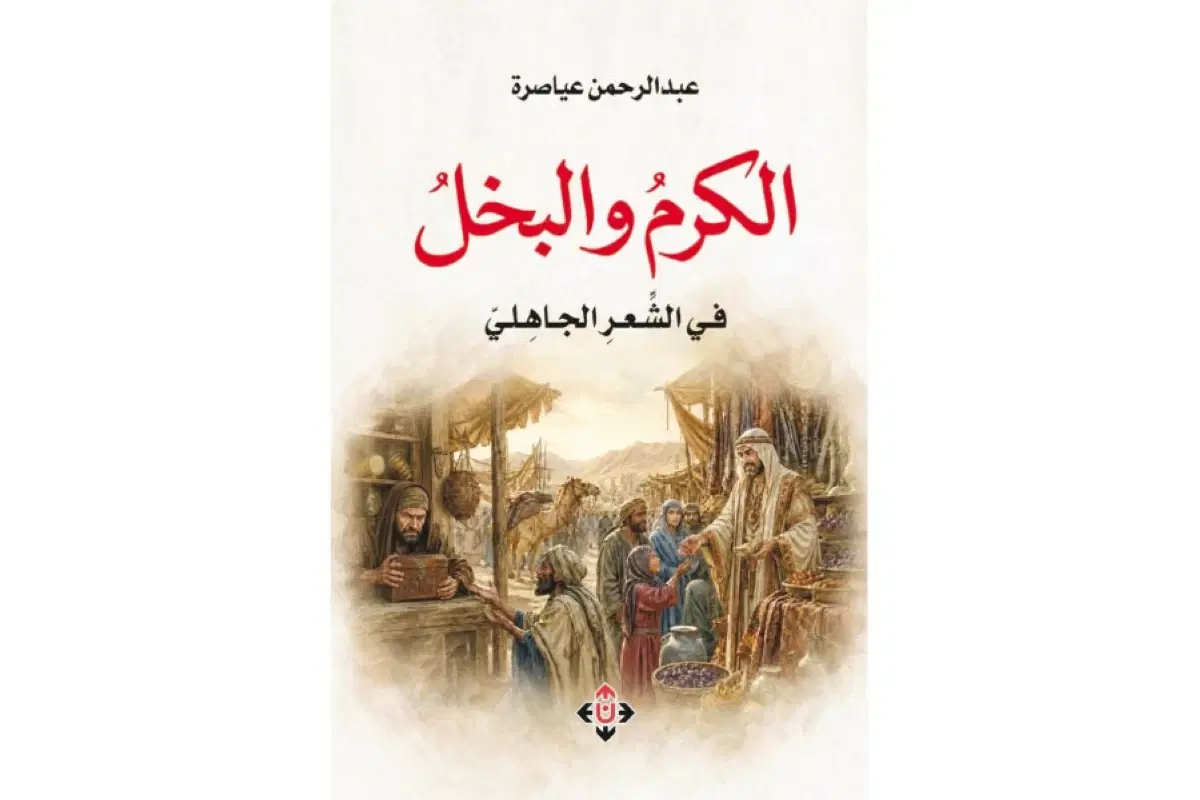
The book includes an introduction, a preface, three chapters, and a conclusion. The preface discusses the concept of generosity and stinginess in language and terminology, their presence in the Quran and the Sunnah, and Arabic poetry, in addition to introducing Hatem Al-Ta'i and Ahiha Ibn Al-Julah. The first chapter explores the motives of generosity in Hatem and its poetic manifestations, and the motives of stinginess in Ahiha and its manifestations in his poetry.
The second chapter focuses on studying the language and poetic lexicon of the two poets, while the third chapter provides an applied reading of Hatem Al-Ta'i's poem and Ahiha Ibn Al-Julah's poem according to the stylistic approach, at the phonetic and structural levels, leading to a set of results that summarize the most important findings of the study.
In his discussion of Hatem Al-Ta'i, Ayasarah recalls his image that has settled in the Arab memory as the leader of the Ta'i tribe, its poet, and its knight, and one of the most famous symbols of generosity and generosity until his name became synonymous with generosity in the Arab proverb «More generous than Hatem». He also stops at the stories related to his family and his mother, `Inbah, who was known, according to the heritage books, for generosity and hospitality in an attempt to document the environment that surrounded the formation of this image.
In contrast, the book sheds light on the personality of Ahiha Ibn Al-Julah Al-Awsi, the leader of the Aus in the pre-Islamic era, the poet, and the knight who was also known for his cunning, sound judgment, wealth, and stinginess. The researcher stops at the contradiction between this image and verses in his diwan that describe him as protecting, helping the fearful, and satisfying the hungry, thus opening the door to reading the relationship between the image created by the heritage narratives and the image presented by the poetic texts.
Through this paradox, Ayasarah tries not to treat Ahiha's image as a complete fact but reads the discrepancy between the news and the poems, stopping at the possibility of some praises being associated with the interests of the praisers, while simultaneously following Ahiha's manifestations of concern for money, building fortresses, trade, and wealth.
The essence of the study is based on reading the poem as a window that goes beyond expressing the trait to revealing its motives. Generosity and stinginess, according to the book's perspective, are not just opposing behaviors but rather gateways to understanding personality and its position in relation to money, society, and others, and the impact of these attitudes on building the poetic image.
The work is completed with a cover designed by the artist Eid Binat, combining literary study, stylistic analysis, and exploration of the poetic heritage to present the reader with two contrasting models that meet in being material for revealing human beings, their motives, and their stance towards giving and money.