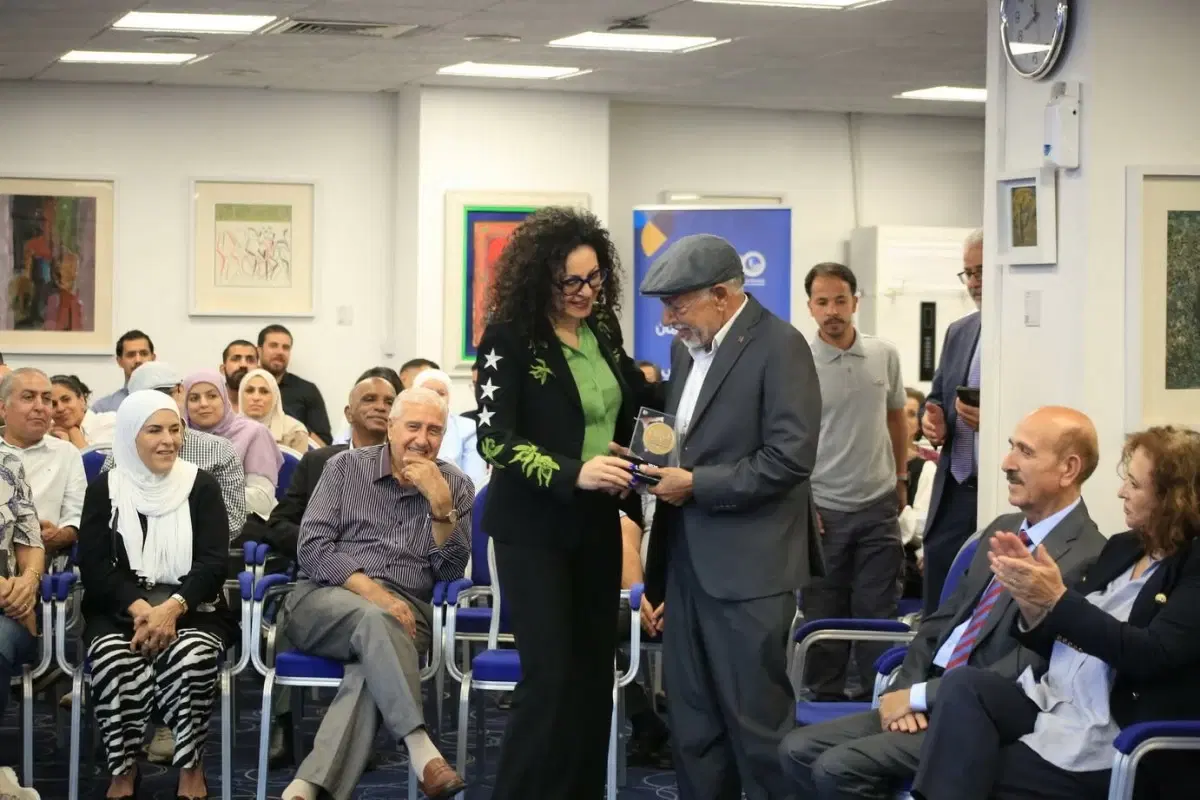
The executive president of the Abdul Hameed Shoman Foundation, Valentina Kassisiyeh, said that honoring Gharaibeh comes as a celebration of «the writer present in the Jordanian scene; a writer, intellectual, and a person with a stance and vision», noting the difficulty of separating his writing from his life experience, as the human being remained at the core of his literary project, and the transformations of society, its questions, and its contradictions were present in his texts.
She added that Gharaibeh built in his works a world that starts from the local towards the universal, giving his characters their presence as living beings carrying their weaknesses, disappointments, and questions, pointing out that the writer did not stay away from public life, but believed that the responsibility of the intellectual goes beyond the limits of the text, and that culture is a means for society to know itself and understand the transformations of its reality.
Kassisiyeh pointed to Gharaibeh's presence in the Jordanian Writers Association and cultural institutions and communities, and to his contributions in organizing and presenting creative writing workshops for writers, beginners, and those interested in narrative, where he presented the summary of years of reading, writing, and experimentation before new voices searching for their way in the world of creativity.
She stopped at his relationship with the city of Irbid, which formed an important aspect of his cultural experience, noting his efforts to build bridges of communication between the cultural community and academic institutions, especially his experience with Yarmouk University and its library, and contributing to opening the doors of the library to the local community, enhancing the presence of knowledge and books outside the traditional university framework.
Dr. Hind Abu Al-Sha'ar recalled a number of situations and milestones that brought her together with Gharaibeh, remembering her participation in celebrating his novel achievement, including the signing ceremony of the novel «Al-Shahbandar» at the Dar Al-Adaab in Beirut, as well as an evening in Petra where she accompanied him on the occasion of the launch of one of his works.
She also recalled the dialogue she conducted with him and published in the «Al-Bayan» magazine issued by Al-Al Bayt University during her presidency of its editorship, noting that Gharaibeh recounted his life story in a striking way before presenting it in a complete form in his book «One Year is Enough», in addition to his presence in the cultural seasons of Al-Al Bayt University, especially the novel forum in Jordan.
For his part, journalist and researcher Ahmed Abu Khalil addressed part of Gharaibeh's parallel and unofficial biography, recalling his experience as a friend, prisoner, and party member, saying that Gharaibeh left party work at the beginning of the 1990s, but continued his activity in sponsoring new experiences in the field of writing and creativity, through training, qualification, criticism, and encouragement.
Dr. Ruaa Hawamdeh said that Gharaibeh described himself through the saying «Human is what he loves, and human is what he pays attention to», indicating that he was biased towards being «an ordinary and free human», and was not concerned with creating the image of a hero around himself, but he left a wide impact that many benefited from.
She added that Gharaibeh was not transient in the Arab narrative scene, but was one of the writers who established their own experience away from the noise of literary schools and doctrines.
For his part, Dr. Omar Al-Ghoul reviewed his relationship with Gharaibeh, which dates back to 2018, when he was entrusted with managing the Hussein bin Talal Library at Yarmouk University, explaining the importance of the library as a knowledge and research institution capable of gathering university students and enhancing their connection with books.
Al-Ghoul pointed to the efforts made to attract students to the library and enhance the presence of books and reading, in addition to expanding the fields of cooperation with cultural institutions in Irbid, noting a meeting with Gharaibeh during which a number of projects and proposals related to the development of library activities were discussed.
He explained that Gharaibeh paid great attention to expanding the role of libraries, and participated in organizing specialized workshops in creative writing for students and those interested, in addition to his contributions to the activities of the book club at the university.
For his part, poet and short story writer Hussein Jilaad said that Gharaibeh contributed to expanding the Jordanian narrative map temporally and spatially, explaining that he did not deal with Jordan as a social presence only, but returned in his works to the Nabateans and Petra, Amman in its formative stages, the northern village, and the prison, making the novel a means of searching for the layers of the Jordanian place, from ancient history to the modern state.
He added that history in Gharaibeh's works does not necessarily start with a major event or a well-known historical figure, but may start from «a merchant's notebook, a stone, an oral memory, a prisoner, and a daily detail», giving small details the ability to reveal history, place, and human.
At the end of the ceremony, Gharaibeh expressed his appreciation to the Abdul Hameed Shoman Foundation for its initiative to honor him, considering this initiative a fulfillment of the promise to the creators and an appreciation of their contributions to enriching the Jordanian and Arab cultural scene.
Hashem Gharaibeh is one of the prominent voices in modern Jordanian narrative, as his literary experience extended through a project that opens up to the human being in his relationship with place, authority, memory, and political and social transformations. His writing remained closely linked to his life and cultural experience and to the questions posed by the transformations witnessed by Jordan and the region.
Gharaibeh's name has also been associated with Jordanian cultural life and the public sphere, combining the presence of the writer and the intellectual involved in the issues of his time, and approaching in his experience the issues of culture, society, and questions of freedom, justice, and humanity, in a writing where the sensitivity of the creator intersects with the awareness of the intellectual and his relationship with his environment.