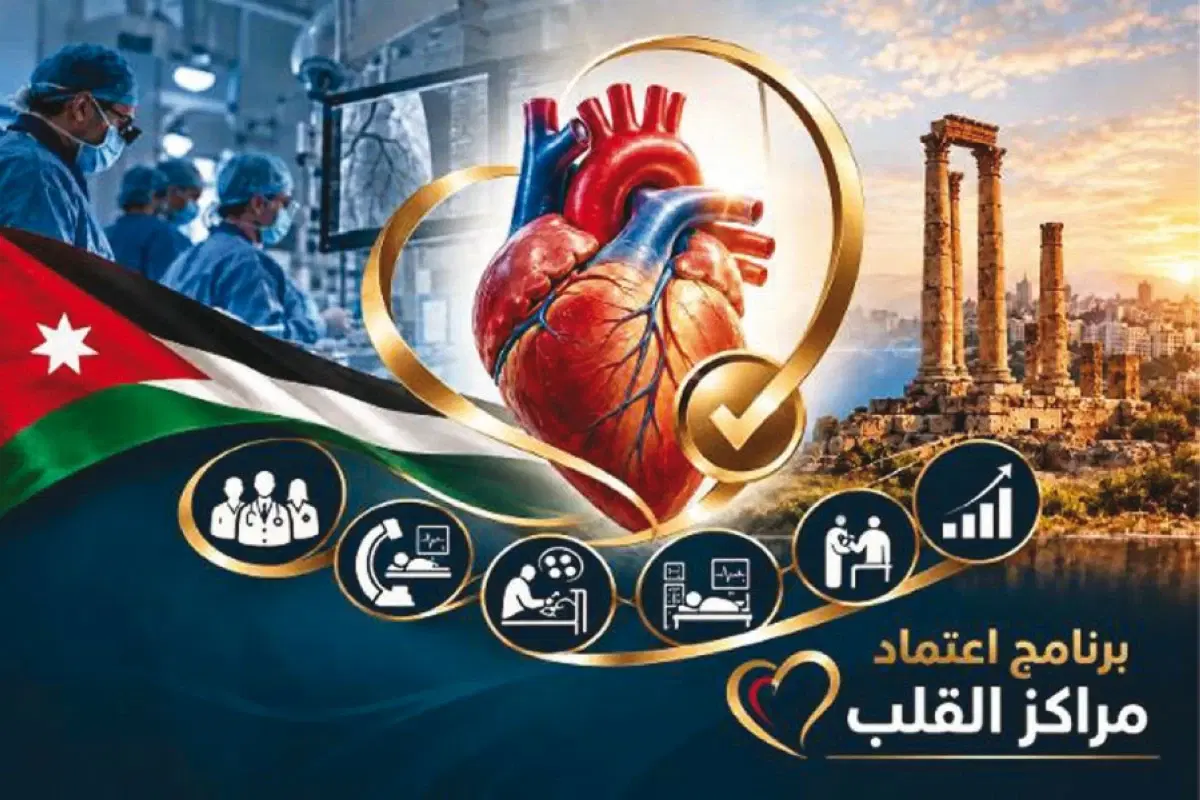
Cardiac Centers in Jordan.. Towards More Comprehensive Quality of Care Standards
A National Registry to Measure Outcomes and Complications
Amman5 min read
Share
Cardiac perfusion specialist Ammar Al-Awawdeh emphasized the importance of developing specialized accreditation standards for cardiac centers in Jordan to enhance healthcare quality and patient safety, linking the evaluation of cardiac services to therapeutic decisions, the competence of medical teams, and clinical outcomes, in addition to the established standards for medical equipment and procedures.
In a statement to "Alrai," he indicated that the development witnessed by cardiac services in Jordan, and the accumulated expertise in the "public, military, university, and private" health sectors, form an important foundation to build upon the existing national accreditation system and develop more specialized standards that suit the nature of cardiac care and the complexity of its procedures.
Al-Awawdeh explained that the Health Care Accreditation Council (HCAC) system provides an important basis for patient safety, staff competence, continuity of care, and continuous improvement, pointing to the importance of strengthening this framework with detailed indicators that link the quality of medical decisions to the safety of therapeutic intervention and the final outcomes for the patient.
He pointed out that evaluating the quality of cardiac services is not limited to the technical success of a catheterization or surgery, but also includes the appropriateness of the therapeutic intervention for the patient's health condition, based on scientific assessment and available medical options.
According to Al-Awawdeh, the treatment of coronary artery diseases may depend on medication, interventional catheterization, or surgery depending on the nature of the case, which reinforces the importance of having institutional mechanisms to discuss complex cases through multidisciplinary cardiac teams.
He added that these mechanisms contribute to documenting and reviewing therapeutic decisions, while taking into account risk factors, comorbidities, and the patient's preference after explaining the therapeutic alternatives, their benefits, and risks.
He drew attention to the possibility of benefiting from indicators that compare patterns of interventional catheterization and coronary artery surgery use between centers, provided that differences in the nature of patients and the severity of their cases are taken into account, allowing for the review of therapeutic practices in a scientific and objective manner.
Al-Awawdeh stressed the necessity for specialized accreditation standards to cover all stages of cardiac care, starting from patient admission, diagnosis, and therapeutic decision-making, through catheterization or surgery, anesthesia, cardiac perfusion, and intensive care, up to rehabilitation and follow-up after hospital discharge.
He continued that the results of cardiac surgeries depend on the integration of a multidisciplinary system, including surgery, anesthesia, cardiac perfusion, nursing, intensive care, laboratories, blood banks, pharmacy, and rehabilitation.
He noted the importance of linking accreditation standards to the competence of health personnel according to their actual responsibilities, through professional qualification, continuous training, performance evaluation, and readiness to deal with emergencies and complications.
He pointed out that evaluation in the field of cardiac perfusion, for example, should include clinical experience, professional competence, and training on handling malfunctions and emergencies, in addition to operating heart-lung machines, to enhance the safety of medical procedures.
Al-Awawdeh called for the development of a unified national registry for cardiac centers in Jordan, which would allow for data collection, analysis of clinical outcomes, and performance indicators, helping to promote continuous improvement and the exchange of expertise between health institutions.
He explained that the proposed indicators include complication rates, such as bleeding, kidney injury, strokes, infections, and re-intervention, in addition to the length of stay in intensive care and hospital readmission rates.
He emphasized the necessity of analyzing these indicators according to the patients' risk levels and the nature of their cases, explaining that centers receiving more complex cases may record higher complication rates, without this necessarily reflecting the quality level of care provided.
Al-Awawdeh warned that developing specialized quality standards could positively reflect on the efficiency of health spending in Jordan by reducing preventable complications and minimizing the need for additional interventions and prolonged hospital stays.
He added that complications may increase the consumption of medications, tests, blood, beds, and human resources, making investment in quality improvement a means to enhance the optimal use of health resources.
According to Al-Awawdeh, adopting clear and measurable indicators can support health institutions, especially in the private sector, in documenting the quality of their services, in addition to enhancing the objectivity of evaluating medical necessity and insurance claims.
He believed that Jordan possesses the elements to develop a specialized model for evaluating cardiac services, based on national expertise and the existing accreditation system, which could be utilized in the future at the regional level.
He cautioned about the importance of quality standards not ending upon the patient's discharge from the hospital, but rather including cardiac rehabilitation, medication review, risk factor management, and subsequent follow-up.
Al-Awawdeh considered that developing the accreditation of cardiac centers represents an opportunity to enhance the quality and sustainability of care by ensuring the appropriateness of treatment for the patient's condition, the competence of the treating team, and measuring outcomes to utilize them for continuous improvement.