Bathina Al-Eisa in 'Shouman': 'The Gardeners' an attempt to turn Gaza's nightmare into a global humanitarian question
Amman4 min read
Share
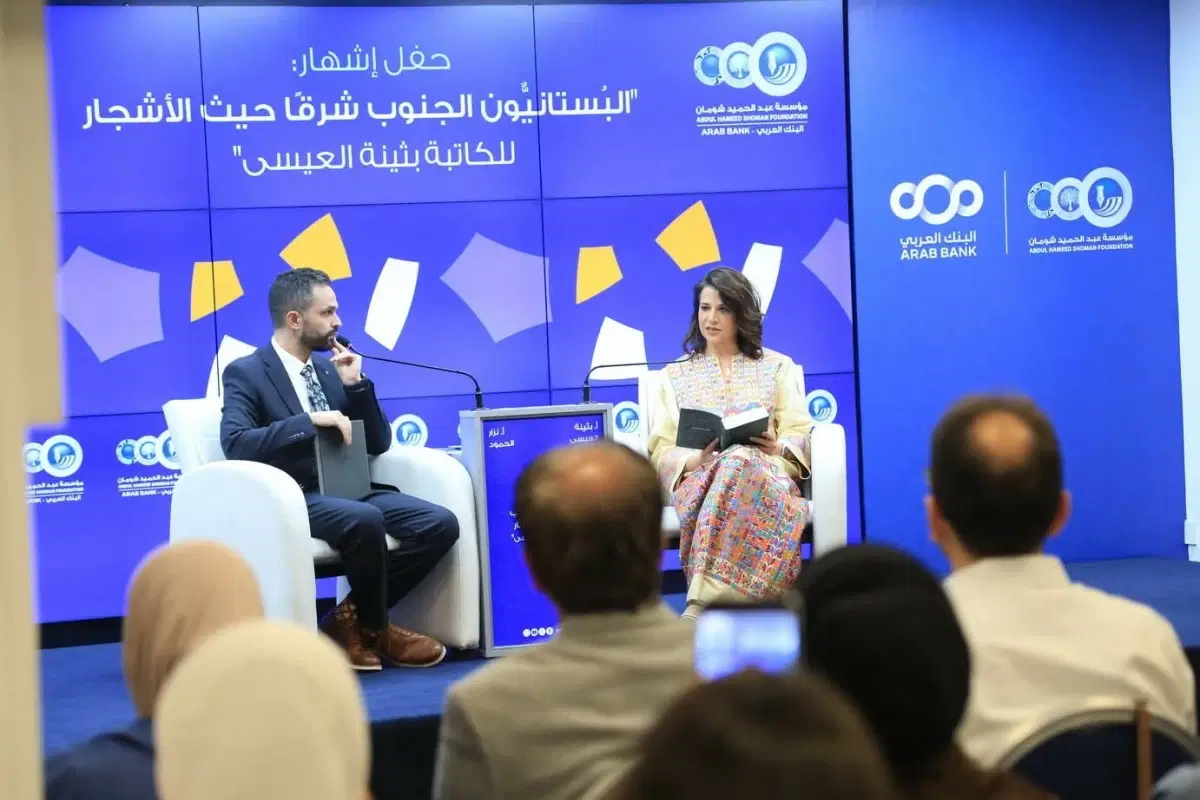
Kuwaiti writer and publisher Bathina Al-Eisa, yesterday evening, at the Abdul Hamid Shouman Cultural Foundation Forum, announced her new novel 'The Gardeners: The South East Where the Trees Are', in the presence of a number of writers and intellectuals interested in cultural affairs.
The announcement of the newly released novel came within a literary dialogue moderated by the director of the Abdul Hamid Shouman Library, Nizar Al-Hamoud, during which Al-Eisa spoke about her experience in writing the work, and her choice of dystopia and science fiction as narrative frameworks for the novel.
The events of 'The Gardeners: The South East Where the Trees Are' take place in 2084, in an imagined dystopian world that emerged in the aftermath of a third world war, where the novel revisits questions of humanity, authority, science, and technology in a turbulent world.
Al-Eisa said that she cannot read the novel in isolation from what the world has witnessed over the past two years, especially since October 7, explaining that what happened made her wonder about the form of literature that can be written after witnessing a reality she described as nightmarish.
She pointed out that dystopia seemed to her the most capable form of expressing her questions and concerns, explaining that she wanted to take what happened in Gaza and turn it into a novel idea that could happen anywhere, thereby opening the door for the reader to reconsider his ability to understand what is happening around him.
Regarding the presence of science fiction in the novel, Al-Eisa pointed to her constant fear of writing in this field, especially in light of an Arab geography that she sees as not producing science as much as it consumes it.
She explained that science fiction, when placed in its global context, is often associated with what she calls the 'global north' as a producer of technology and science, while this technology, when it moves to the 'global south', can turn into a form of cognitive, digital, or cultural colonialism. She said that what seems like science fiction in one place may turn into a dystopia in another.
The novel took about two years to write, and Al-Eisa said that the experience of completing it was significantly different from her previous experiences, noting that the work required maps and drawings to serve its imagined world.
She explained that the novel's drawings were completed by the artist Zahra Al-Mahdi, who is known for her interest and professionalism in drawing maps, which the novel needed to build its world and places.
Al-Eisa expressed her happiness at being at the Abdul Hamid Shouman Foundation for the second time, and her pride in announcing her new novel at this Jordanian cultural institution.
Bathina Al-Eisa, founder and director of the 'Takoween' Library and Publications in Kuwait, is one of the prominent names in the Gulf and Arab novel scene, and her novelistic presence began early with works including 'Collision... No Echo Heard', 'Rage', and 'Rain Bride', before continuing her experience in several novels, most notably 'I Grew Up and Forgot to Forget', 'Maps of Confusion', 'All Things', 'Guardian of the World's Roof', and 'The Blind Sinbad'.
In her novel 'Dar Khoula', released in 2024, Al-Eisa clearly returned to the Kuwaiti environment, addressing questions of identity, family, and cultural transformations.
As for the novel 'Guardian of the World's Roof', it transported her experience to a futuristic dystopian space where imagination becomes suspicious, and the surveillance and prohibition of books become part of a system that seeks to control the human being itself.
The novel gained international presence after the release of its English translation, reaching the final list of the American National Book Award in the translated literature category, and was chosen by Time magazine as one of the hundred most worthy books to read in 2024.
The novel won the American 'Inside Literary Prize' in August last year in its third edition, a prize characterized by its readers' committee being formed from inmates of American correctional institutions.
Al-Eisa received the State Encouragement Award twice; the first for the novel 'Rage' in 2005, and the second for 'I Grew Up and Forgot to Forget' in 2013, and she also received the Sharjah Award for Gulf Women's Creativity in the field of the novel in 2021, and the Sharjah Award for Women's Literature in 2022 for 'Guardian of the World's Roof', in addition to the novel 'All Things' reaching the shortlist for the Sheikh Zayed Book Award.