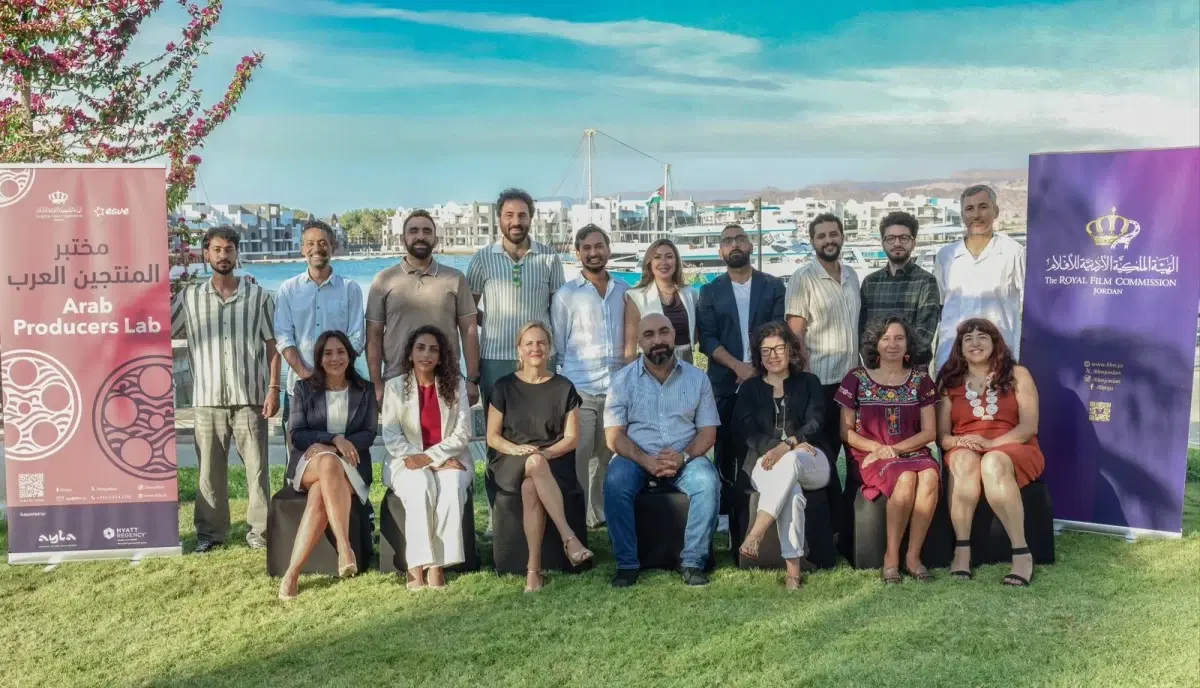
The third edition of the Lab in Aqaba was implemented with the support of cooperation with the Aqaba Governorate and the Aqaba Special Economic Zone Authority, alongside Ayla Development Company and Hyatt Regency Aqaba Ayla Resort, which contributed to facilitating local arrangements, logistics, and providing the venue for the program. Organizing the Lab in Aqaba brought together regional talents and international expertise within an environment that encouraged filmmakers and sector specialists to collaborate, exchange knowledge, and build professional relationships, reflecting the importance of cooperation between the film sector, public institutions, and development, tourism, and hospitality sectors in supporting the creative ecosystem in Jordan.
The third edition featured six projects reflecting the diversity of voices, stories, and cinematic visions in the Arab region, including: 'About Love and the Laws of September' by producer Khaled Al-Awad and co-writer Khaled Al-Waleed from Sudan; 'City 2008' by producer Alaa Amer and director/screenwriter Youssef Al-Sabahi from Yemen; 'Bury Me' by producer Meral Ezzet Al-Fakhrani and director/screenwriter Reem Morsi from Egypt; 'Ahmed Al-Dhahabi' by producer Mahmoud Sarour from Jordan and director/screenwriter Mustafa Khalaf from Iraq; 'Bloodline' by producer Abdul Rahman Al-Kilani from Syria and director Jamal Katibi from Saudi Arabia; and 'Tree of Forgetfulness' by producer Haider Ibrahim and director/screenwriter Hassanin Khazaal from Iraq.
Out of 42 applications, the projects were selected following a regional reading and evaluation process involving film industry specialists from various countries and backgrounds. The reading and evaluation committee included: Yassine Karmoudi (Morocco/Netherlands), Dalia Al-Nimr (Jordan), Qismt Al-Sayed (Egypt), Khaled Abu Sharif (Jordan), Lobna Baqsair (Sudan), Linda Belkhairia (Algeria/France), Munir Atta Allah (Jordan/United States), Raghad Bajbaj (Saudi Arabia), Sarah Al-Nawasrah (Saudi Arabia/United States), and Suha Samir (Egypt).
Throughout the Lab, participants worked closely with experts Heidi Zardy (France), Jennifer Sabbah-Imagine (France), Mayy Al-Ouda (Palestine), and Naeem Mahbub (Sweden).
Through group sessions, individual meetings, and project-specific discussions, participants addressed their projects from creative, financial, and strategic perspectives, focusing on project development, scriptwriting, financing, co-production, legal frameworks, market positioning, sales, distribution, and access to international markets.
The Director General of the Royal Film Commission, Mohannad Al-Bakri, said: 'Holding the Arab Producers Lab in Aqaba reflects our broader vision for Jordan as a meeting point for Arab filmmakers and a platform for regional cooperation and exchange with the international film industry. Developing this ecosystem goes beyond individual programs and depends on building strong connections between talents, institutions, places, and partners. The support and cooperation of Jordanian and international institutions and partners demonstrate how different sectors can contribute to providing a supportive environment for filmmakers. Through these partnerships, we aim to provide Arab producers with the tools, networks, and pathways that help them advance their projects to more advanced stages.'
Tina Trab, CEO of EAVE, commented on the continued collaboration: 'Organizing the third edition of the Arab Producers Lab alongside our distinguished partners at the Royal Film Commission of Jordan is a source of great pride and an extremely enriching experience for us. This collaboration is a natural extension of our long-standing commitment to supporting and developing talent. By combining our shared expertise, the valuable support provided by the Commission, and EAVE's methodology and mentoring programs, we are proud to offer outstanding development opportunities for the selected producer and director/screenwriter teams, providing a practical and meaningful path to reaching the international scene.' She added: 'We are very pleased with the selection of this year's projects, which feature a distinguished group of talents and a richness of stories that have the potential to reach international forums and ultimately contribute to enhancing the film industry and cooperation at the regional level.'
On her return to EAVE this time as a mentor, Mayy Al-Ouda (Palestine) said: 'Returning in 2026 as a mentor holds great meaning for me. After all these years, I can share the lessons, challenges, and successes that have shaped my experience and pass this knowledge on to a new generation of Arab producers.' She added: 'The projects are bold, diverse, and ambitious, and I am grateful to accompany these producers on this stage of their journey.'
The third edition of the Arab Producers Lab highlighted the importance of continuing project development pathways and the role that the Commission's various initiatives can play in the multiple stages of a film's journey.
Alaa Amer and Youssef Al-Sabahi, participants in the Yemeni project 'City 2008', said: 'The Royal Film Commission of Jordan believed in our project from the beginning. The film's journey actually began at the Amman Filmmakers Initiative (AFID) 2024, where we received our first cash prize, and then the Screenwriters' Narrator Lab 2025 contributed to taking the script to an entirely new level. The Commission has a clear record of supporting Yemeni stories, and we are proud to be part of the third edition of the Arab Producers Lab.'
Mahmoud Sarour and Mustafa Khalaf, participants in the 'Ahmed Al-Dhahabi' project, said about their experience: 'The Arab Producers Lab was a truly valuable experience that helped us develop on both personal and professional levels. The Commission's team and EAVE mentors were very supportive and generous in sharing their knowledge, creating an inspiring environment for learning and building relationships. We leave the Lab today with new insights, valuable tools, and greater confidence in our journey as filmmakers in Jordan and the region.'
In addition to developing the six participating projects, the third edition of the Lab emphasized the importance of building a broader professional community for Arab producers and filmmakers, creating opportunities for establishing relationships that can continue in the future through co-productions, festivals, markets, funding pools, and other regional and international professional platforms.
Through the Arab Producers Lab and its broader range of regional training and project development programs, the Royal Film Commission of Jordan continues to support Arab filmmakers in developing their projects, enhancing their professional networks, connecting them with regional and international opportunities, and reinforcing Jordan's role as a platform for creative development, professional exchange, and cooperation across the Arab region. Applications for the fourth edition of the Arab Producers Lab will open in May 2027.