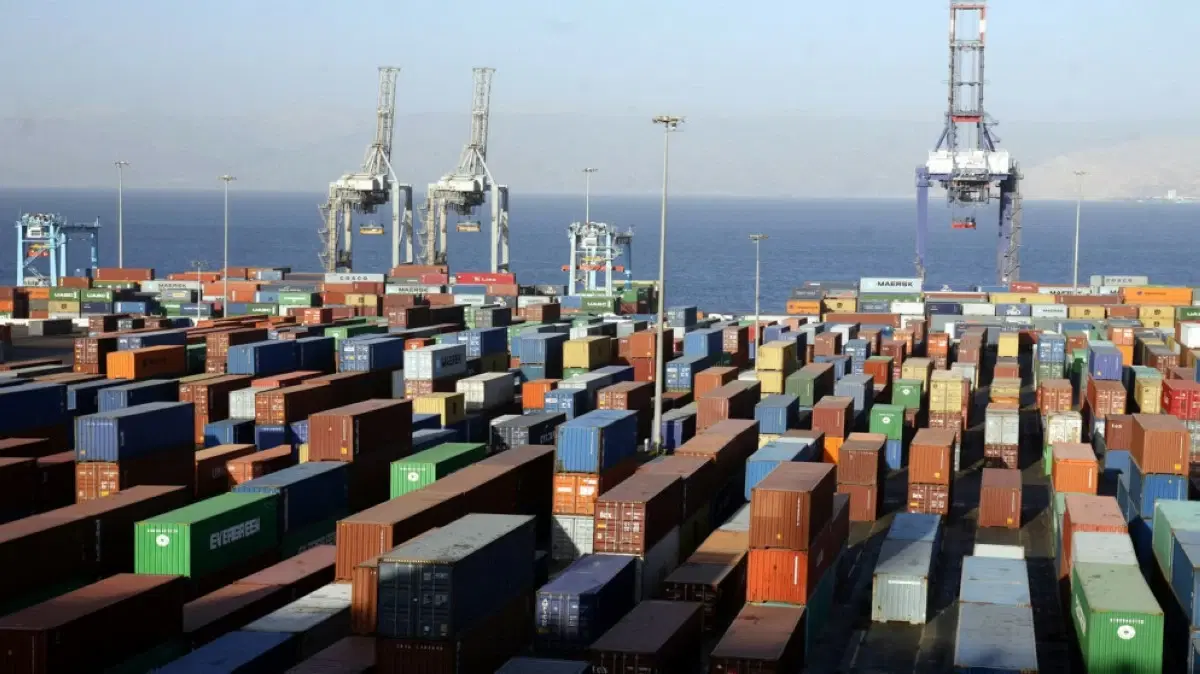
"Aqaba Authority": Integrated measures to enhance the operational capabilities of Aqaba ports
Amman8 min read
Share
The ports and logistics services system in Aqaba is moving towards enhancing its operational capabilities and raising its efficiency in handling cargo traffic through an integrated package of governmental and operational measures aimed at addressing bottlenecks across various links of supply chains, reducing the dwell time of goods and containers, organizing truck movement, and increasing the storage capacity of yards and logistical facilities.
These measures fall within a package of steps proposed by the Aqaba Special Economic Zone Authority (ASEZA) and approved by the government, which have been implemented to address transit cargo traffic in a way that preserves the efficiency of supply chains within the Kingdom, enhances trade flow, and supports national food security.
These measures also come within the framework of the Cabinet's recent approval of a set of measures aimed at enhancing the operational capabilities of the port system and supply chains in the Kingdom, and complementing procedures initiated by the government, the Aqaba Authority, the Aqaba Development Corporation, the Jordan Customs Department, relevant official bodies, and port operators over the past period, with the goal of raising the readiness of the port and logistics services system in Aqaba and addressing operational challenges.
Mohammed Abu Omar, Commissioner for Economic Affairs and Investment at the Aqaba Authority, stated that the new measures come within an integrated system aimed at addressing operational challenges and raising the readiness of ports and logistics services, rather than just solving bottlenecks at a single point.
He pointed out that among the most prominent measures approved by the Cabinet is increasing the grace period granted to national exports in ports from 7 days to 14 days for a period of 6 months from the date of the decision, which gives exporters more time to complete their procedures and relieves burdens associated with storage and delays. He added that the measures included reducing the fee for the destruction of goods from 500 dinars to 50 dinars per ton or part thereof—exempting the liable party from paying 450 dinars—for a period of 3 months according to the conditions set by the Cabinet. This aims to encourage stakeholders to process accumulated goods, accelerate the clearance of yards, and utilize available storage capacities, in addition to speeding up customs clearance procedures, reducing cargo dwell times, organizing truck movement, improving yard efficiency, and enhancing the capacity of ports and logistics centers.
Regarding the acceleration of clearance procedures, he explained that work has been done to adopt customs inspection at the arrival center whenever possible, transfer part of the refrigerated container inspection operations to Customs Yard No. (4), and complete clearance procedures for certain goods at the Amman Customs Center / Al-Madhounah. Target and adoption rates were also reviewed to rely more heavily on risk management methodology, achieving a balance between the speed of transaction processing and maintaining regulatory requirements.
He added that work is underway to enhance work continuity and complete customs transactions at maximum possible capacity, including working during holidays when necessary.
At the level of truck movement, he stated that the authority, in coordination with the relevant authorities, has worked on a package of measures directly aimed at reducing the truck cycle time and increasing its operational capacity, rather than merely addressing congestion at a specific stage of the supply chain. He explained that these measures included raising the upper limit of the number of monthly trips allowed for container transport trucks from 8 to 9 trips, in addition to reducing the load spacing period for trucks operating in the container sector from 48 hours to 30 hours. Furthermore, the validity period of the permit for the truck entry and exit regulation project was reduced from 8 hours to 6 hours to ensure the availability of trucks for transporting ready loads.
He indicated that transit trips operating at border crossings were exempted from the applicable number of trips for 3 months, and technically equipped trucks meeting public safety requirements were permitted to transport two 20-foot containers on a single truck, which raises the efficiency of the transport fleet and increases the capacity to remove containers from the port.
Regarding the regulation of truck entry and load distribution, he noted the continued work to improve organizational mechanisms, contributing to their regulation and availability for transporting loads and reducing waiting times, which reflects positively on the efficiency of the truck cycle within the logistical system.
Regarding the enhancement of yard storage capacity, he stated that additional spaces have been allocated for storing empty containers, totaling 150 dunums distributed across several sites, including Yard No. (10) with an area of 70 dunums, a yard allocated for CTL Company with an area of 20 dunums, in addition to 60 dunums in other locations designated for the same purpose, alongside available yards in the port and other specialized empty container storage yards within the region. He added that work is underway to open additional yards in the multi-purpose port to receive and store vehicles with an additional storage capacity of up to 6,000 vehicles, alongside efforts to open other yards.
He pointed out the expansion of Yard No. (4) and the remediation of the impoundment and hazardous goods warehouse conditions within it, stressing that these combined measures aim to distribute pressure across the various links of the logistical system so that the system as a whole becomes more capable of absorption, handling, and clearance.
In evaluating operational results, Abu Omar said that the primary addition of these measures lies in increasing the flexibility and efficiency of the logistics system as a whole by addressing bottlenecks at multiple stages simultaneously—starting from the arrival of goods, handling, clearance, and inspection, all the way to the exit of containers loaded on trucks from the region. He noted that the measures have begun to achieve tangible operational results, as the average dwell time for transit containers decreased from about 14–15 days to approximately 12 days, while maintaining the average dwell time for containers imported for the local market at around 8 days. Additionally, the daily capacity of container exit gates increased from 900 to 1,200 containers.
He indicated that these indicators reflect an improvement in the system's ability to handle the movement of goods and trucks, while the new measures approved by the Cabinet aim to enhance and support this improvement, particularly by supporting national exports, freeing up additional spaces in logistical yards, and encouraging the processing of accumulated goods.
As part of handling unclaimed containers and goods, he explained that the provisions of Article (27) of the Customs Regulation in the Aqaba Special Economic Zone are being applied to unclaimed goods, in accordance with approved legal mechanisms and in coordination with the Jordan Customs Department, relevant official entities, and port operators. He stated that a unified mechanism has been agreed upon to inventory containers for which no customs declaration or document has been filed within the legal periods—amounting to 21 days for local imports and 5 days for transit—while excluding impounded cases or those subject to judicial or administrative procedures.
He added that work is currently underway to transfer between 1,500 and 2,000 containers to the yards of the authority's Storage and Logistics Services Directorate, which spans 280 dunums, in accordance with legal procedures, at the expense and responsibility of the carrier or their agent. He noted that this step contributes to freeing up spaces within the port system and restoring them for operational use.
On another front, he emphasized enhancing readiness to handle refrigerated containers by adding 120 electrical reefer plugs inside the port, addressing the shortage of refrigerated transport trucks, and giving priority in handling, clearance, and release to national food supplies, imports designated for the local market, and national exports.
Regarding the timeline for implementing the measures, he stated that a large portion of them have already become effective and are being actively applied, while operational procedures and related infrastructure are being completed according to specific implementation plans. He explained that the measures approved by the Cabinet in its recent decision have become effective in accordance with the periods specified in the decision, adding that the authority and partner entities are simultaneously continuing to implement other operational procedures, including yard expansion, the transfer of unclaimed containers in accordance with legal provisions, and increasing capacity allocated for refrigerated containers, alongside monitoring the daily performance of ports, yards, and trucks.
He stressed the continuation of periodic coordination meetings between the government, the Aqaba Authority, the Aqaba Development Corporation, the Jordan Customs Department, relevant official entities, and port operators, aiming to monitor implementation, measure results, make any necessary corrective adjustments, and build a logistics system that is more responsive to demand and more flexible in facing pressures or changes in trade movement and supply chains.