This was followed by Amman Customs with 75,207 declarations, Jaber Customs linking the Kingdom with Syria with 67,470 declarations, Zarqa Free Zone Customs (goods + vehicles) with 48,856 declarations, the E-commerce Center Customs with 35,037 declarations, and the remainder distributed among other customs and border centers spread across many regions of the Kingdom.
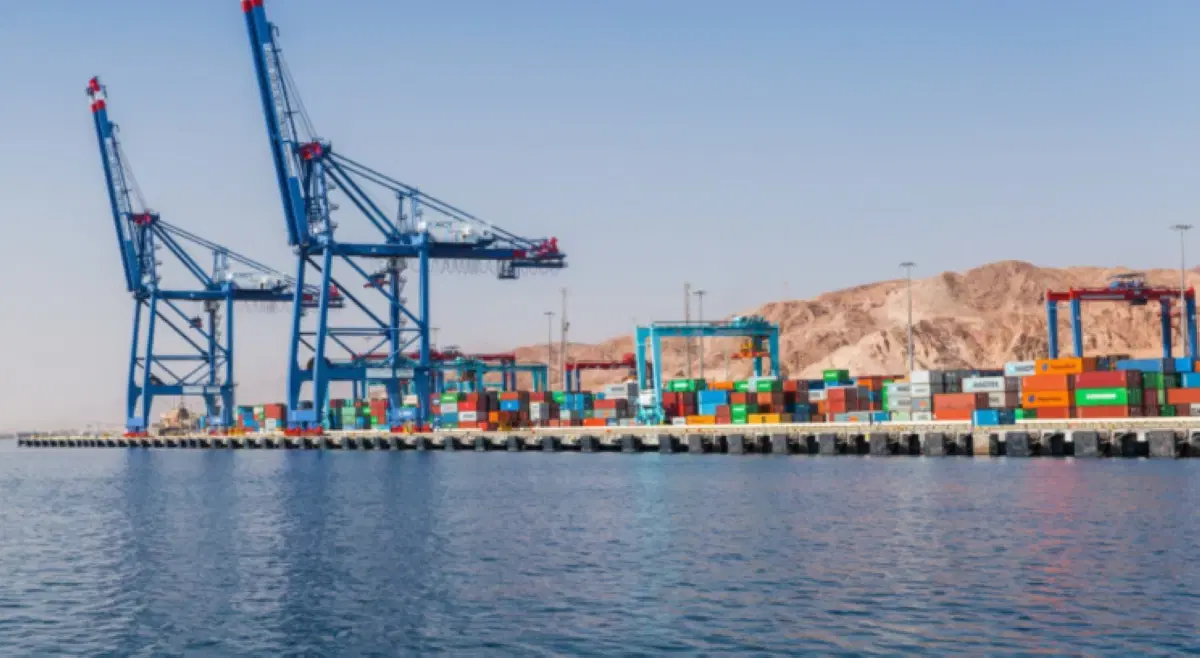
According to the syndicate, which based its statistical data on official figures, the number of ships that arrived at the Aqaba Container Terminal during the same period reached 438 ships, compared to 446 ships for the same period of last year 2025.
It pointed out that the handling volume at the Aqaba Container Terminal during the same period reached 786,949 containers (TEUs), compared to 738,353 containers (TEUs) for the same period of last year, an increase of 7 percent.
The number of loaded imported containers reached 411,244 containers, compared to 370,531 containers for the same period last year, an increase of 11 percent, while the number of loaded exported containers reached 77,328 containers. According to the syndicate, which based its statistical data on official figures, the number of ships that arrived at the main ports in Aqaba and completed their unloading during the same period reached 1,274 ships, compared to 1,183 ships for the same period last year, an increase of 8 percent.
The ships were distributed among the main port with 320 ships, compared to 290 ships for the same period last year, an increase of 10 percent; 126 ships arriving at the oil and gas port, compared to 91 ships for the same period last year, an increase of 38 percent; and 828 for the passenger port, compared to 802 ships for the same period last year, an increase of 3 percent.
The total handling volume in Aqaba's main ports during the same period reached 10,878,955 million tons, compared to 7,342,816 million tons in the same period last year, with a growth rate of 48 percent, distributed among the handlings of the main port, oil and gas, and the passenger terminal.
The syndicate indicated that the total shipping movements across land border crossings and customs centers were highest in the Aqaba axis with 699,296 movements, followed by Al-Omari Customs with 442,181 movements, Jaber Customs with 367,011 movements, and Al-Karamah Customs with 330,711, followed by the remaining centers in varying numbers.
It pointed out that the number of vehicles handled during the same period via the Zarqa Free Zone reached 61,116 vehicles, distributed among vehicles entering the local market with 22,905 vehicles, including 5,787 gasoline-powered vehicles, 4,019 diesel vehicles, 5,823 hybrid vehicles, and 7,276 electric vehicles, while the number of vehicles exported outside the Kingdom reached 38,211 vehicles.
The President of the Syndicate of Clearing and Freight Transport Companies, Dr. Daifallah Abu Aqoula, told the Jordan News Agency (Petra) that the port of Aqaba has become today an attractive logistical gateway par excellence for importing all types of goods, not only to the Kingdom, but also to the GCC countries, Iraq, Syria, and Lebanon.
He commended the decisions issued by the government regarding reducing fees and facilitating the flow of goods through customs centers, in addition to many decisions and procedures related to the port of Aqaba and transport and shipping operations, emphasizing that all of this served the interest of work.
He pointed out that the language of numbers and statistics is clear, embodying the massive volume of work and qualitative achievement undertaken by the Customs Department and the port system.
Abu Aqoula praised the great and appreciated efforts exerted by the General Customs Department and all Aqaba ports, whether the container port, the main port, or the gas port, pointing to the high level of professionalism and efficiency enjoyed by the cadres working in managing the inbound and outbound movement of goods.
He noted that the Jordanian logistics sector has proven its merit and high capacity to shoulder national responsibility in loading, handling, and transporting goods arriving via ports and border centers, whether destined for the local market or heading to neighboring countries under the transit system, indicating that the numbers of trucks handled at border centers and ports are very large, with remarkable speed in the flow of goods.
He explained that the speed and accuracy in completing transactions by the General Customs Department and security agencies reflect the depth of true partnership and constructive integration between the various entities operating in the sector, which work as one team with the aim of facilitating procedures and removing obstacles facing the movement of goods and trade.
Abu Aqoula emphasized that the logistics and transport sectors constitute a fundamental pillar and a pivotal leverage in achieving the objectives of the Economic Modernization Vision by supporting trade and facilitating the smooth flow of goods between Jordan and neighboring countries.
He commended the great efforts exerted by the Customs Administration, the Aqaba Special Economic Zone Authority, the management of the main port and container port, and the security agencies operating at border centers and ports, stressing that this comes within the framework of national efforts aimed at consolidating Aqaba's and Jordan's position as a regional logistics hub and a distribution center for all Arab, regional, and international countries.
Abu Aqoula noted the importance of partnership and continuous coordination between the public and private sectors to address any challenges that may arise across customs, border centers, and ports, pointing out that the syndicate is an essential and active partner with the various relevant official institutions it deals with.
It is noteworthy that the Syndicate of Clearing and Freight Transport Companies, established in 1982 and registered with the Ministry of Labor, aims to serve the sector, address challenges facing those working in it, and raise the standard of the profession and the efficiency of its cadres.
The number of operating and licensed clearing companies in the Kingdom stands at 467 companies, with about 2,000
branches spread across all customs and border centers, providing nearly 10,000 job opportunities for Jordanians working in the centers and administrative offices.