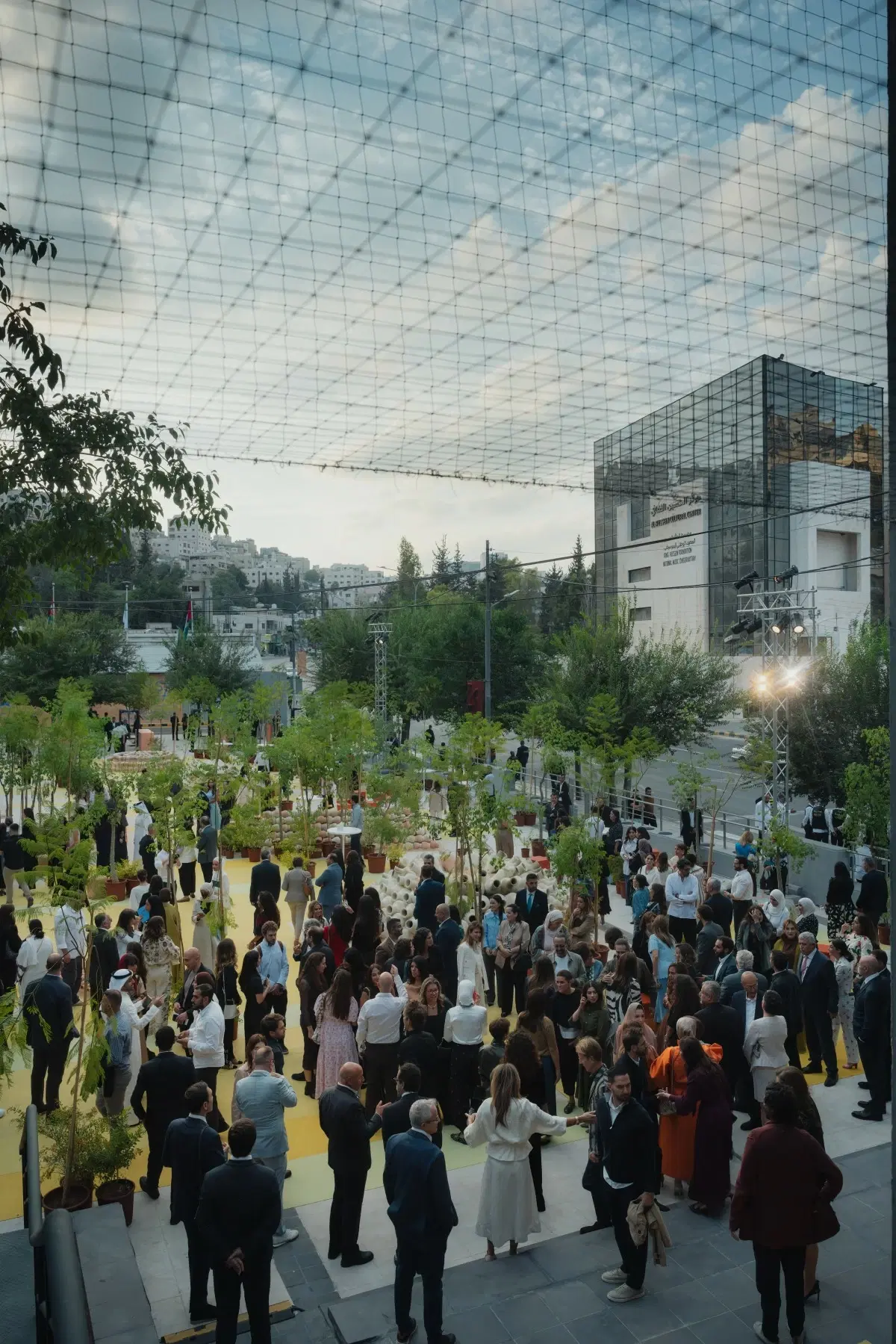
The Hangar was built in the Ras Al-Ain area in the 1930s in a valley surrounded by Amman's hills, as a site for the power generators that supplied the capital with energy. Over time, the building became a witness to the modern and industrial transformations the city underwent, before turning into a standalone landmark. After being rehabilitated, it transformed into a cultural space hosting major art exhibitions, lectures, and various events.
The Hangar features works by over 90 local, regional, and international designers. Opposite the Hangar, a public space opens up to the details of daily life through conversations and meetings. Other artworks are located in the Ras Al-Ain Park, inspired by the history of the city and the region.
Amman Design Week 2026 is organized in partnership with the Greater Amman Municipality and its exhibitions and events are distributed in other locations within Amman and Aqaba, including Jabal Al-Luweibdeh, Paris Circle, the intersection of Sharia College, Iraq Al-Amir, Jabal Amman, and Ayla Oasis in Aqaba.
In Jabal Al-Luweibdeh, Darat Abu Adnan, a restored house dating back to the 1950s and now owned by 'Ben Al-Umeed' who restored and rehabilitated it, hosts several exhibitions and events, including the third cycle of the Students' Exhibition, supported by the Ghaith Foundation and Nadeh Sekhtman.
In Iraq Al-Amir, works are displayed at several sites, including Qasr Al-Abd, where Dima Saroujj presents an intervention titled 'The People of the House', alongside a work by Qais Al-Rawi in collaboration with Julia Corner titled 'Lamella Clay Series'.
For the first time, Amman Design Week reaches Aqaba, with four works displayed at Ayla Oasis in partnership with 'Wujud'. In Jabal Amman, a group of studios, cafes, and cultural centers participate in the program through exhibitions, workshops, lectures, and open days.
As part of the visitors' experience, the week allows collecting identification cards for designers' works while moving between exhibitions, and keeping them to form a personal collection that gradually expands with the discovery of more works and sites.