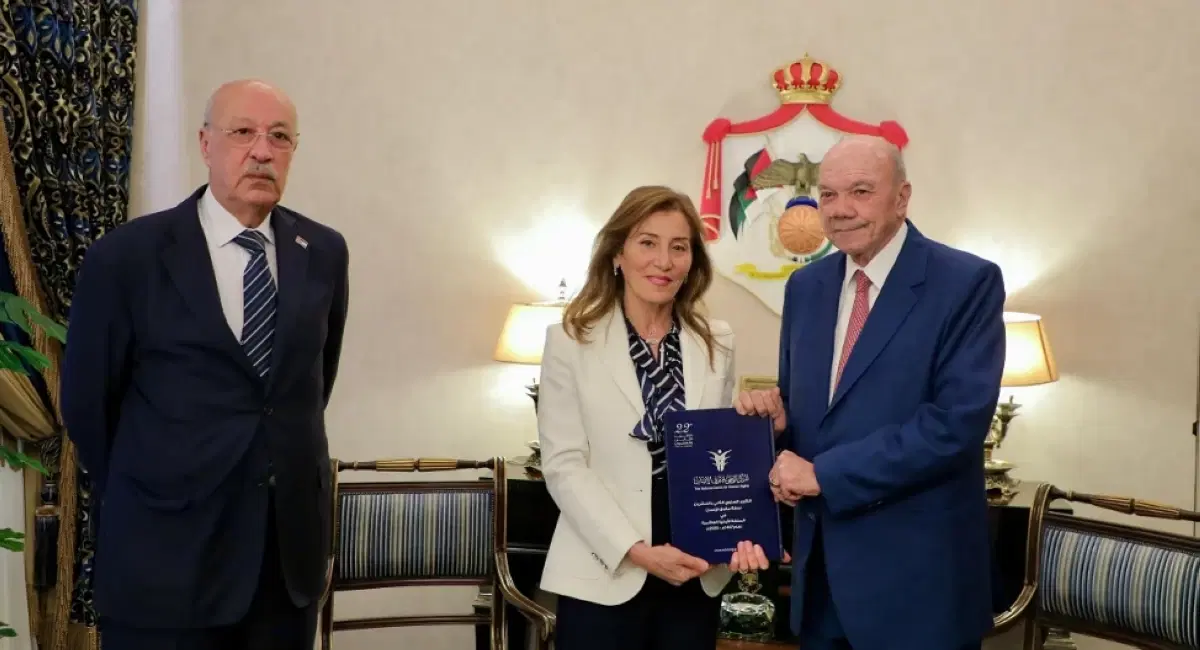
Al-Fayez receives the 22nd annual report on the state of human rights in Jordan for 2025
Amman2 min read
Share
President of the Senate, Faisal Al-Fayez, received a copy of the 22nd annual report on the state of human rights in Jordan for 2025, during his meeting today, Thursday, at the Council, with the Chairperson of the Board of Trustees of the National Center for Human Rights, Samar Al-Haj Hassan, in the presence of the Commissioner-General for Human Rights, Jamal Al-Shamayleh.
Al-Fayez expressed his appreciation for the Center's efforts and its contribution to the field of protecting human rights in Jordan. He called on the Center to develop a comprehensive national plan to build upon what has been achieved in protecting citizens' rights and freedoms, and to promote a culture of human rights in coordination with various relevant authorities, while taking into account the developments the society has witnessed over the past years. He also emphasized the need for the Center to take clear positions against hate speech and violations occurring across various social media platforms.
He stated that the Senate attaches great importance, through its specialized committees, to all details contained in the Center's report on the state of human rights in Jordan, and to identifying the Center's needs and the requirements for advancing its role and enhancing its capabilities, in a way that contributes to strengthening the system of legislation and regulations that safeguard human rights and the rule of law, in translation of the directives of His Majesty King Abdullah II.
For her part, Al-Haj Hassan presented the procedures taken by the Center to assess the state of human rights in Jordan, which are conducted according to objective foundations and high professionalism, following the best international practices and standards.
She affirmed the Center's pride in its relationship with the Senate and its keenness on positive interaction with the Senate's specialized committees to discuss the report and the recommendations and observations contained therein, and to determine the possibility of incorporating them into the Senate's legislative and oversight outputs.