15 Solo and Group Exhibitions Opened as Part of the Sharjah Calligraphy Biennial
Amman13 min read
Share
200 calligraphic and artistic works by over 100 creators at the Sharjah Art Museum and the Emirates Fine Arts Society
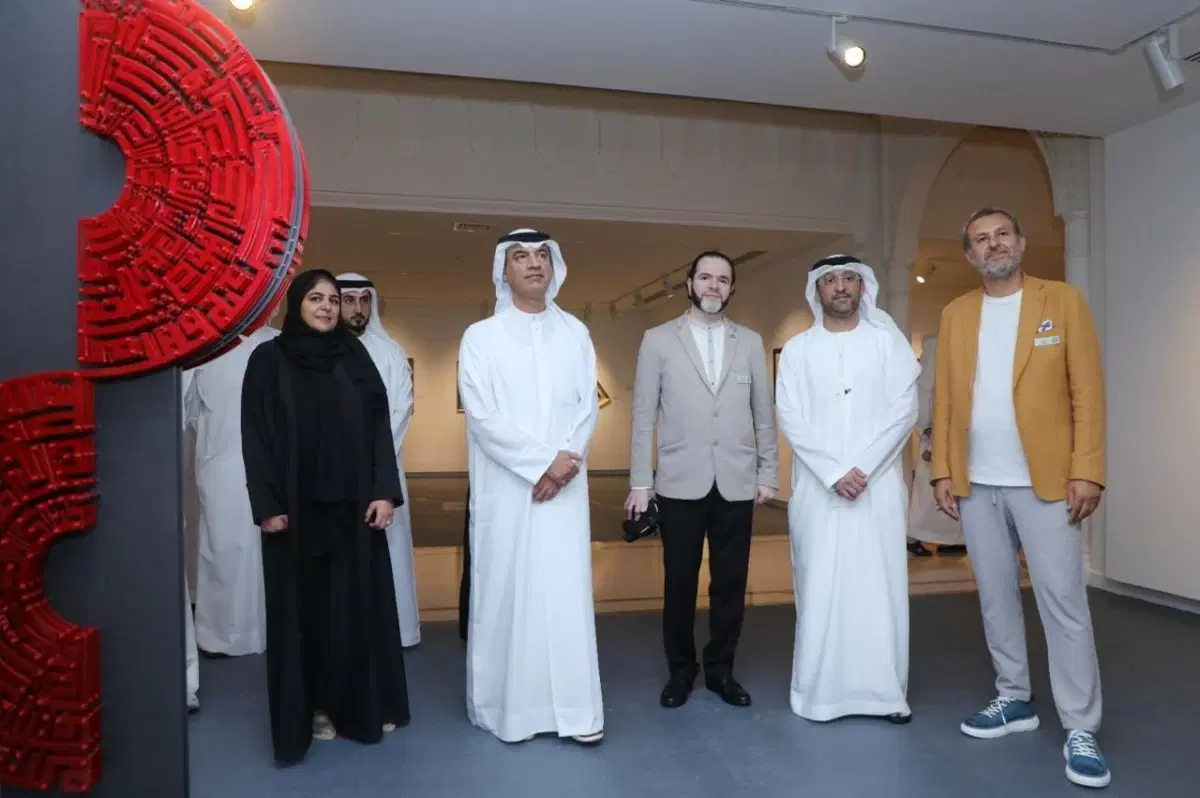
Abdullah bin Mohammed Al Owais, Chairman of the Sharjah Department of Culture, and Mohammed Ibrahim Al Qaseer, Director of the Department of Cultural Affairs at the Department of Culture and Director of the Sharjah Calligraphy Biennial, inaugurated 15 solo and group exhibitions featuring over 100 creators in Arabic calligraphy, Islamic ornamentation, contemporary works, and photography. The opening took place at the Sharjah Art Museum and the Emirates Fine Arts Society, in the presence of Maysa Al Suwaidi, Director General of the Sharjah Museums Authority, and a large number of artists, calligraphers, and enthusiasts of Arabic calligraphy.
Approximately 200 calligraphic, artistic, and photographic works are distributed across the collection of solo and group exhibitions, which collectively paint a diverse visual scene of Arabic calligraphy, reapproaching it from a contemporary perspective that transcends its traditional boundaries. The collection included 9 solo exhibitions, allowing each artist to present their own experience and aesthetic vision of the letter, alongside 6 group exhibitions where multiple artistic styles and trends converge.
Al Owais, Al Qaseer, and the attendees toured the exhibitions, viewing a collection of calligraphic, ornamental, and gilded works created by more than 100 artists. They also listened to explanations from the artists regarding their materials, techniques, visual processing methods, and the aesthetic ideas their works carry, reflecting the diversity of the participating experiences.
The attendees paused at the most prominent highlights presented by the exhibitions, particularly works that revive the aesthetics of Arabic calligraphy in contemporary formulations, and those that blend letters, color, and raw materials using innovative methods.
"Art Museum Exhibitions"
The Sharjah Art Museum hosted 9 solo exhibitions and 5 group exhibitions, each carrying its own artistic vision and experience, offering a remarkable diversity in styles, experiences, and artistic trends. These exhibitions formed a rich space for dialogue between artists and the public.
The solo exhibitions were as follows: "Nasta'liq Script by an Arab Hand" by artist Osama Al-Hamzawi from Syria; "Between Layers: Balance of the Universe" by artists Asli Turkmen and Hasan Turkmen from Turkey; "Barzakh" by artists Sarah Ahli from the UAE and Farida Stait from Egypt; "The First Trace" by artist Abdelrahim Hamza from Morocco; "Pulse of a Letter" by artist Fatima Al Hammadi from the UAE; "Infinity" by artist Mohammad Younus Jami from Afghanistan; "Essence" by artist Murat Kurt from Turkey; "Fragments of an Invisible Space" by artist Mounir Fatmi from Morocco; and "Good Calligraphy (Modification)" by artist Nurullah Özdem from Turkey.
Meanwhile, the group exhibitions were titled: "Al-Hilya Al-Sharifa," "Mizan," "Al-Warrad," "Images from My Beautiful Country," and "The Language of the Letter and the Eye."
The exhibition by Syrian calligrapher Osama Al-Hamzawi, titled "Nasta'liq Script by an Arab Hand," celebrates the aesthetics of one of the most unique and beautiful scripts, revealing the Arab calligrapher's ability to handle Nasta'liq, which involves many fine details and aesthetic particularities. Through a collection of works, the exhibition reveals the flexibility and fluidity of this script, and the vast possibilities it offers in composition, movement, and rhythm. Thus, the exhibition presents a contemporary Arab reading of a script that originated in a different cultural environment, confirming that the aesthetics of the letter are capable of crossing cultures, and that creativity in Arabic calligraphy remains open to discovery and renewal.
The exhibition "Between Layers: Balance of the Universe" brings together two complementary artistic experiences by Turkish artists Asli Turkmen and Hasan Turkmen in a visual dialogue based on the rich heritage of Islamic arts, re-presenting its aesthetics within a contemporary vision. Artist Asli presents ornamentation and gilding works, inspired by the traditions of Islamic arts and their characteristic precision, balance, and harmony between decorative elements and space. Meanwhile, artist Hasan presents Arabic calligraphy works, based on the established rules and traditions of this art, with an approach that allows the letter a beautiful and expressive presence in the artwork.
The work "Barzakh" explores the emergence of meaning through the interaction between light and shadow, matter and image, movement and stillness. It combines digitally animated Arabic calligraphy with seven suspended, heat-formed glass panels, where language is transformed through reflection, refraction, and constant change. As light passes through each glass surface, the writing fragments, bends, and then reforms, inviting the viewer to experience language as a spatial presence before it is a readable text. Inspired by the concept of Barzakh as a threshold between two states, the work presents perception as a living encounter, in which meanings are revealed through the continuous interaction between light, glass, and space.
Artist Abdelrahim Hamza's work stems from a deep meditation on the concept of the "dot" as the origin upon which the Arabic letter is built, and as a visual and philosophical element that plays a hidden regulatory role within the structure of calligraphy. The dot is not reduced to being a formal beginning; rather, it transforms into a precise measure that regulates the harmony of letters and directs their movement within space.
The exhibition consists of a collection of vertical sculptural installations, each crowned with a sphere representing a symbolic extension of the dot, as if it were a transcendent energy descending from above to establish a relationship between gravity and balance, between heaven and earth. Inside these columns, letters condense in circular and fluid movements, while central geometric shapes perform the function of a scale, as an invisible law organizing this visual flow.
The exhibition of Emirati artist Fatima Al Hammadi includes a collection of paintings that vary in their expressive ideas, yet are unified in adopting the letter as a starting point for building a free visual world. The collection relies on the harmony of color, line, and movement, and on the reciprocal relationship between fullness and emptiness. Colors are not a decorative background, but an expressive element carrying states of joy, calm, nostalgia, and strength. The dot, the curve, and the extension transform into musical vocabulary that leads the viewer's eye within the work and invites them to discover its own meaning.
The work "Infinity" presents a visual meditation on the concepts of continuity, repetition, and the absence of an end, within a space where the boundaries between beginning and end vanish, and where lines, geometry, rhythm, and light overlap to form a visual movement open to endless possibilities.
Murat Kurt's experience transforms the visual language of Kufic calligraphy into a contemporary field of color, geometry, and movement. His works are based on Turkish cultural memory, poetry, and architectural inscriptions, but they move calligraphy from the surface of writing to the spaces of painting, sculpture, and spatial experience.
The selected works present a dialogue between circular, square, and sculptural forms. In works such as "Layla," "Surat Al-Inshirah," "Hu," and "Ayat al-Kursi," the color structure and geometric repetition transform into rhythm and visual architecture for the text. As for the "Parallax" sculptures, they extend this approach to the third dimension, where writing, shadow, and perception interact in multiple layers.
The exhibition "Fragments of an Invisible Space" explores the unstable region where language decomposes into form, movement, sound, and memory. Through sculpture, photography, and light works, Mounir Fatmi investigates the invisible structures that form communication and perception, transforming letters and words into spatial experiences suspended between physical presence and disappearance.
The artworks in the exhibition of Turkish calligrapher Nurullah Özdem are based on a vision rooted in the classical styles of Islamic Arabic calligraphy, and rely on a rich visual and cultural heritage formed over centuries of practice, experimentation, and aesthetic accumulation. The collection includes works inspired by historical writing traditions and composition patterns established in the Arabic calligraphy heritage, evoking the aesthetics, balances, and rhythms of the letter as essential elements in building the artwork.
"Group Exhibitions"
The group exhibitions—"Al-Hilya Al-Sharifa," "Mizan," "Al-Warrad," "Images from My Beautiful Country," and "The Language of the Letter and the Eye"—brought with them a diversity of themes and artistic experiences, gathering works of multiple styles and techniques, allowing the visitor a wider space to discover the richness of the creative scene and its multiple directions.
The calligraphic exhibition "Al-Hilya Al-Sharifa" presented the Hilya with a renewed artistic vision, based on the richness of Arabic calligraphy and the diversity of its schools, revealing the letter's ability to rephrase the text in different aesthetic frameworks while maintaining its essence and spiritual status. Multiple calligraphic experiences met in the exhibition's works to form a visual dialogue between the authenticity of heritage and the specificity of contemporary experience. Here, the difference in pens is no longer just a variety in style, but becomes a space to discover the aesthetics and rhythm of the letter.
From this perspective, the experiences of 10 calligraphers were embodied in the exhibition, each presenting the Al-Hilya Al-Sharifa through the specificity of the script they chose, so that styles multiplied and approaches varied, while the text remained retaining its essence and status. Turkish calligrapher Hakan Arslan presents the Hilya in Thuluth and Naskh scripts, while Iraqi calligrapher Mahfouz Thanoon revives the aesthetics of Muhaqqaq and Rayhani. In the experience of Syrian calligrapher Mohammed Qana, the Hilya takes on the features of Nasta'liq and Jali Nasta'liq, while the Mushafi Kufic is present in the experience of Emirati calligrapher Omran Al Baloushi. As for Syrian calligrapher Mohannad Al-Sa'i, he presents the Hilya in Diwani and Jali Diwani scripts, while Tunisian calligrapher Amer bin Jeddo represents the presence of Kairouani Kufic in this calligraphic diversity.
Moroccan calligrapher Abderrahim Kouline presents the Hilya Sharifah in the Moroccan Thuluth and Mabsut Mujawhar scripts, while Kuwaiti calligrapher Jassem Meraj showcases examples of the Riqa and Tawqi scripts, and Syrian calligrapher Ayman Hassan participates with a Hilya Sharifah manuscript. This scene is completed by the experience of Chinese artist and calligrapher Haji Noor Deen, who offers a unique approach blending the aesthetics of Arabic calligraphy with the spirit of Chinese art, establishing a visual style that carries the features of contemporary Islamic Hurufiyya. He emphasizes the ability of Arabic calligraphy to cross geographical and cultural borders and open up to new artistic experiences without losing its authenticity and specificity.
The "Mizan" (Balance) exhibition constitutes more than just a creative idea; it is a visual and aesthetic principle that rearranges the relationship between the letter, the word, and the space. In this context, a group of Arab experiences meet to offer different readings of the concept of balance, revealing how the letter, with its geometric rigor and aesthetic flexibility, can be transformed into a formative composition pulsating with meaning.
Five artists and calligraphers are participating in the exhibition: Ahmed Al-Bashir from Syria, who presents works in the Jali and ordinary Diwani scripts, while Syrian Mounir Al-Shaarani presents works in the Kufic script. From Egypt, Dr. Bilal Mukhtar participates with works in the Thuluth script and its variations, while Emirati Jamal Al-Suwaidi presents formative applications in the field of compositions, and Iraqi Alaa Ismail participates with Hurufiyya works that explore the visual potential of the Arabic letter.
The "Pioneers" exhibition brings together seven of the most prominent calligraphers in the Islamic world in an artistic experience that celebrates the essence of authentic Arabic calligraphy, while simultaneously revealing the multiplicity of visions and styles that can be formed within a single frame of reference. The exhibition features: Othman Hamed from Egypt, Ahmed Al-Arbili from Iraq, Obeida Al-Banki from Syria, Abderrahim Kouline from Morocco, Taj Al-Sir Hassan from Sudan, Othman Ozcay from Turkey, and Mohammed Issa Khalfan from the UAE, in a meeting that brings together experiences belonging to diverse cultural and geographical environments, yet meeting in their deep appreciation for the art of Arabic calligraphy, its rules, and its aesthetics.
The "Images from My Beautiful Country" exhibition comes in cooperation with the Union of Arab Photographers, and based on the importance of the image in documenting visual memory and highlighting the beauty of the place and its cultural specificity, to give photographers an opportunity to express their love for their homelands through their lenses, and to highlight the natural beauty, historical landmarks, and heritage and cultural aspects that reflect the diversity and richness of the Arab identity.
36 artists are participating in the exhibition, each presenting one artwork, bringing the total number of participating works to 36 photographs that reflected the diversity of visions and styles in capturing the beauty of Arab cities, their landmarks, and their heritage. Three winners were chosen from among the participants: in first place, Mahmoud Mohammed Al-Jabri from the Sultanate of Oman; in second place, Imad al-Din Mahmoud Alaa al-Din from Syria; and in third place, Ibrahim Ahmed Bani Rashid, in recognition of the excellence of their works and their ability to provide a striking visual vision that highlights the beauty of the place, its spirit, and its cultural identity.
The Emirates Photography Association, as part of the 12th edition of the Sharjah Calligraphy Biennial 2026, presents an exhibition titled "The Language of the Letter and the Eye," as an artistic and cultural experience that explores the relationship between the Arabic letter and visual perception, and examines the transition of the letter from a means of writing and communication to an aesthetic element pulsating with intellectual, spiritual, and artistic dimensions.
The exhibition includes 60 artworks by 30 artists, whose experiences and styles vary in employing the Arabic letter within contemporary visual contexts, highlighting its ability to combine authenticity and innovation, and heritage and modernity. The works reveal the diversity in dealing with the letter as a language that is read and seen at the same time, while its connotations integrate with the image, composition, color, and space.
"Arabic Calligraphy"
The Emirates Fine Arts Society, in cooperation with the Department of Cultural Affairs at the Department of Culture, held the "Arabic Calligraphy" exhibition for five calligraphers: Abdul Razzaq Al-Mahmoud, Muwaffaq Bassal, Musab Al-Douri, Hossam Abdel Wahab, and Taj Al-Sir Hassan. Through 17 artworks, they present various ideas that stem from the authenticity of Arabic calligraphy and explore the concept of balance as an aesthetic and intellectual value manifested in the structure of the letter, the rhythm of the composition, and the harmony of the word with the visual space.
The exhibition includes experiences that vary between classical and contemporary Arabic calligraphy styles, reflecting the richness of the participants' artistic practices and confirming the ability of Arabic calligraphy to renew itself and maintain its presence in the contemporary art scene. Through these works, "Midad Al-Mizan" opens a visual dialogue between the authenticity of the letter and its contemporary possibilities, celebrating the aesthetics of composition and the precision of balance, and embodying an artistic vision that aligns with the Biennial's theme of celebrating the Arabic letter and highlighting its aesthetic and intellectual energies.