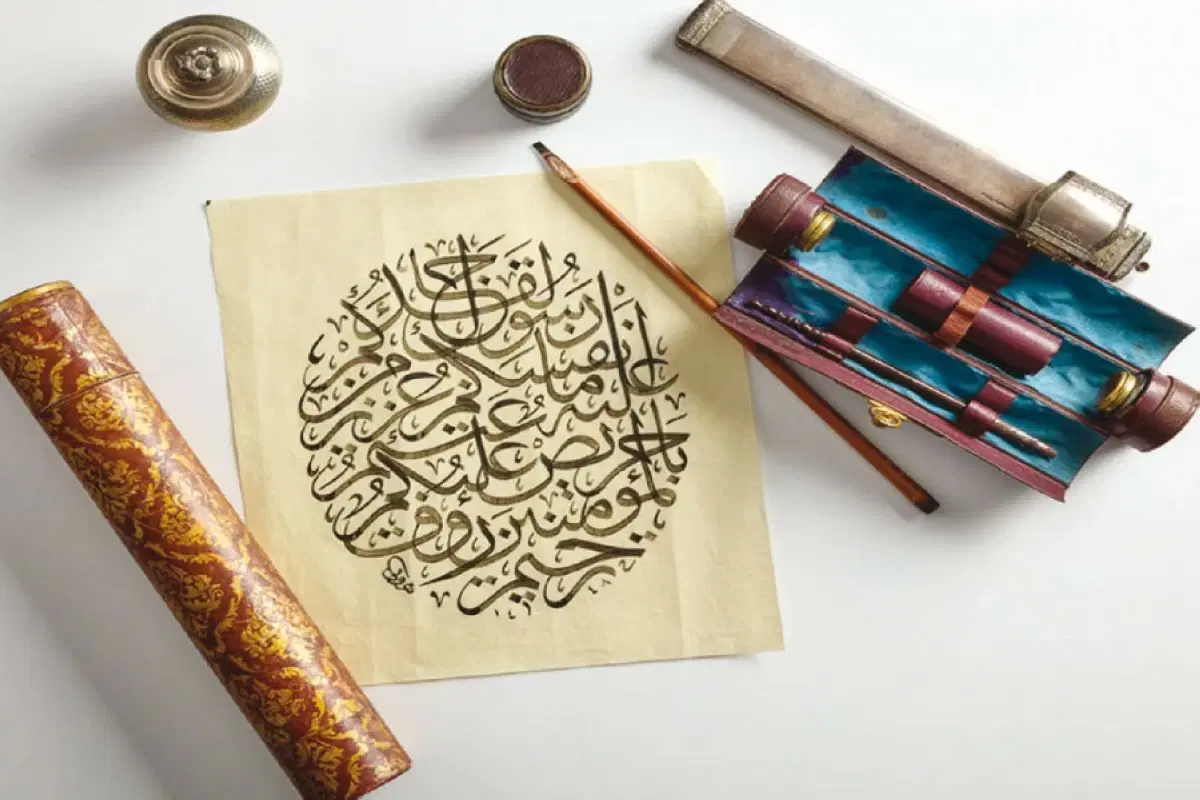
Calligrapher Mohamed Hoosain was born in the rural village of Cofimvaba in the Eastern Cape province of South Africa. He is considered a distinguished calligrapher whose works combine South African heritage with the ancient traditions of Islamic art.
Hoosain's journey in Islamic studies began after his family converted to Islam in 1991, which marked a turning point in his career. In 1994, he enrolled at the Waterfall Islamic Institute, a boys' boarding school in South Africa, where he studied Islamic sciences and completed the memorization of the Holy Quran. During that period, his interest in Arabic calligraphy began to grow, leading him to discover an artistic talent that later became the focus of his professional life.
Artist Mohamed's talent caught the attention of Turkish calligrapher Hilal Kazan, who encouraged him to pursue his studies in Turkey. There, he studied under the renowned calligrapher Hasan Çelebi, one of the most prominent names in contemporary Islamic calligraphy, in Istanbul in 2009. He continued his training for four years before receiving his Ijaza (license) in Thuluth and Naskh scripts in 2013. By obtaining the Ijaza, he joined a lineage of calligraphers who continue to preserve the traditions of Ottoman Arabic calligraphy and transmit them to new generations.
Since receiving his Ijaza, Hoosain has participated in numerous international exhibitions, workshops, and cultural programs, contributing to the dissemination of his expertise, the promotion of interest in Islamic artistic heritage, and its preservation. His works are characterized by a deep respect for the classical principles and rules of Arabic calligraphy, alongside his employment of a contemporary artistic sense.
Hoosain currently lives and works in Istanbul, where he continues to produce original calligraphic works, in addition to teaching at the Enderun Arts Center, a center specialized in traditional Islamic arts.