"Xun".. 7,000-year-old Chinese melodies passed down through generations to this day in Yumen
Amman4 min read
Share
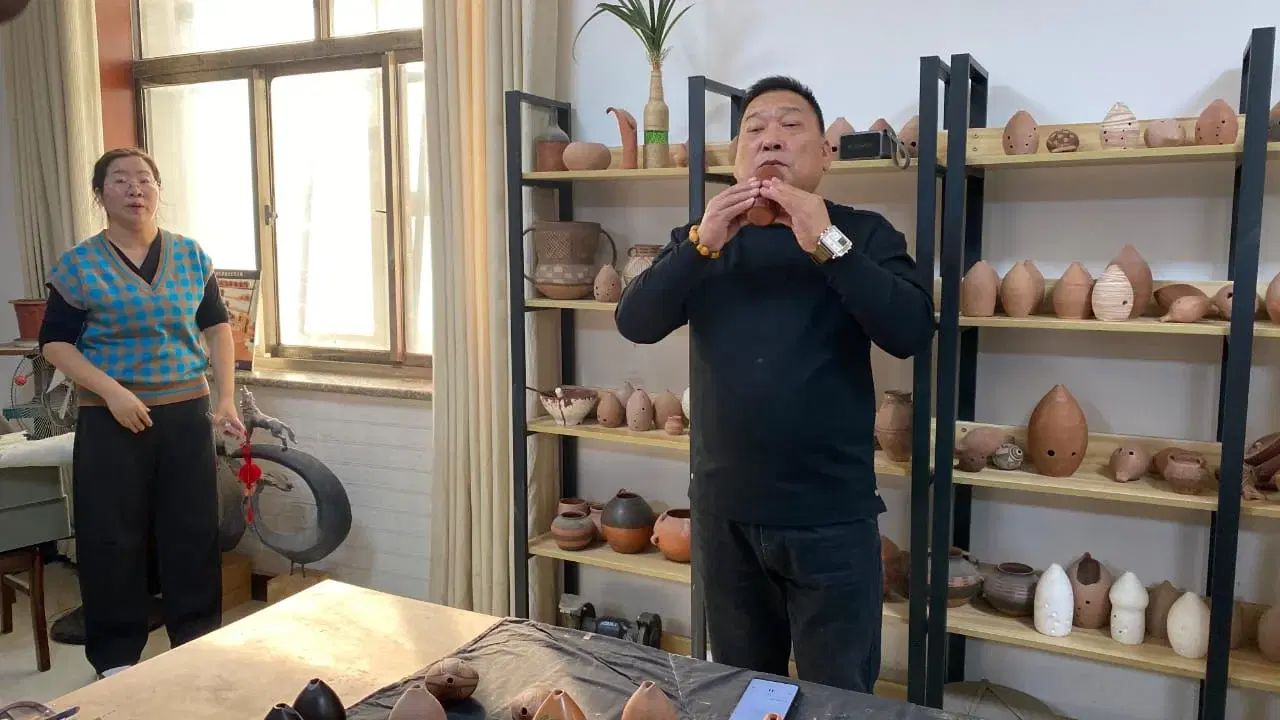
Cultural efforts continue in Yumen city, Gansu province, China, to preserve traditional arts and safeguard intangible cultural heritage by teaching artistic skills related to traditional musical instruments and encouraging new generations to learn and practice them. The Yumen Cultural Hall hosts a living example of a 7,000-year-old musical instrument called the "Xun".
During a visit by a press delegation representing media outlets from several Arab countries, including Jordan, "Al-Mamlaka" observed part of these efforts at the city's Cultural Hall through a meeting with Chinese musician Wang Zhaohui and listening to his performance on the "Xun" instrument, in a show that received positive interaction from the attendees who requested more than one musical piece related to Chinese culture.
During Wang's performance, the sound tones were characterized by depth and calmness, which reflected on the attendees due to the meditative nature that suggests antiquity.
Wang interacted with the attendees' questions and spoke in Chinese, with his answers translated into Arabic. He emphasized that the "Xun" instrument is over 7,000 years old and was initially used for communication between people when there was no spoken language among humans. It was also used militarily to identify war targets through specific tones, and musically for singing.
According to Wang, the Xun is a traditional Chinese musical instrument made of clay, characterized by its nature that allows melodies to be produced by blowing into it, while practicing it requires skills in breath and finger control to produce different tones.
The Chinese musician pointed out that the instrument has evolved throughout its stages of use in terms of the number of holes it has, which are linked to the tones produced by it.
According to the experience conducted by some attendees, the instrument requires blowing by placing it near the mouth area. After closing all its holes, playing begins by blowing and moving the fingers while continuing to blow into it, similar to wind instruments in Arab music such as the "Ney".
The performance allowed the Arab delegation to learn about this musical art up close, in an experience that combined watching and listening to one of the forms of Chinese cultural heritage.
According to the Chinese delegation accompanying the press delegation, Wang Zhaohui is one of those interested in preserving the art of playing the Xun in Yumen city, as he was classified in 2025 as a bearer of the intangible cultural heritage of this art at the city level.
Wang works as a cultural official at the Yumen Cultural Hall and heads the Performing Arts Department.
He began delving into playing the Xun in 2018, before receiving the second prize in the musical instruments category in 2024 at the 7th "Qiongxing" Arts Festival in Gansu province for his performance of the piece "Dreaming of Returning to Huashaoqu".
His efforts are not limited to playing, but extend to teaching this art and spreading it among community members, as he contributed to launching evening classes to teach Xun playing at the Yumen Cultural Hall, and participated in educational classes related to intangible cultural heritage, school trips, and related activities.
These initiatives aim to provide an opportunity for more interested people to learn to play the instrument and to introduce children and youth to one of the forms of traditional Chinese music, which enhances the chances of this art continuing and being passed down between generations.
According to what "Al-Mamlaka" observed during the tour, efforts to preserve this heritage are distributed between the skills of making the instrument and its musical practice; while Guan Zhenguo focuses on the skills of making the Xun, Wang Zhaohui devotes his efforts to playing, teaching, and spreading it.
This integration reflects the importance of combining the preservation of craft skills related to the production of traditional instruments with promoting their use in artistic and educational practice, ensuring that heritage is not limited to displayed pieces, but continues to be present through playing, learning, and community interaction.
During the visit, the delegation saw multiple models of ceramic pieces and instruments displayed inside the cultural facility, which allowed for a glimpse into some of the shapes and designs associated with this heritage.