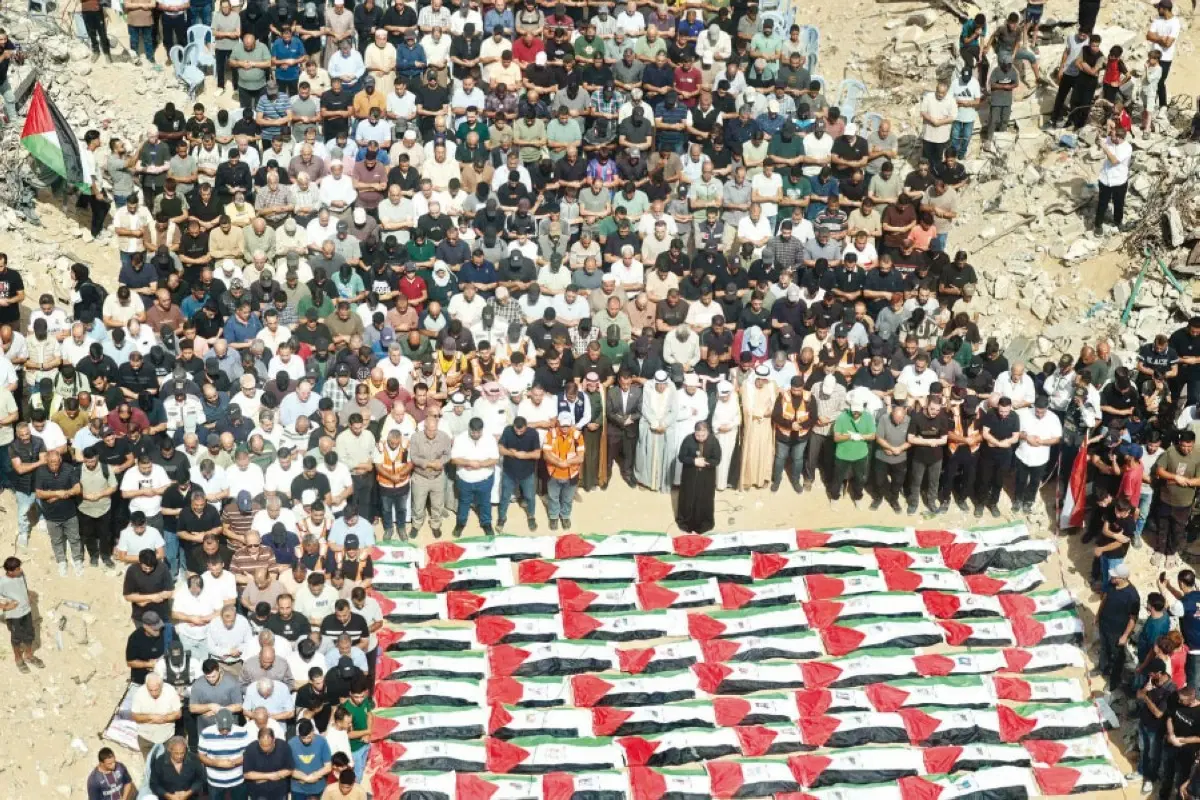
Gaza witnessed a wide Israeli military escalation on Saturday, involving aerial and artillery bombardment and demolition operations of homes and buildings, alongside an assassination attempt on a prominent Hamas leader, resulting in, according to Palestinian sources, the martyrdom and injury of several Palestinians in various areas of the Strip.
The Israeli Occupation Army said it carried out an assassination attempt targeting Ali al-Ghamoudi, a prominent Hamas leader, whom Israel describes as the current administrator of the Gaza Strip.
Al-Ghamoudi is close to Yahya Sinwar, having been arrested by the occupation in 1994 and released as part of the 'Freedom for the Prisoners' deal in 2011.
He served as Sinwar's office director between 2017 and 2021, before being elected to Hamas' Political Bureau in 2021.
After the martyrdom of Sinwar and his deputy, Rawhi Mushtaha, al-Ghamoudi, according to Israeli sources, assumed the de facto leadership of the movement in the Strip.
Israeli planes bombed the ground floor of the Asala building in western Gaza City on Friday night, with Israeli Channel 12 reporting, citing an official, that al-Ghamoudi was inside the targeted apartment, claiming his chances of survival are slim.
In contrast, informed sources reported that the assassination attempt failed, while Hamas, in a brief statement, said the final results of the operation were not yet known, noting the imposition of a security cordon around the target site and the scarcity of available information.
The airstrike on the building, according to Palestinian sources, resulted in the martyrdom of 5 Palestinians, including 4 women.
The Greek Orthodox Church in Gaza mourned the martyrs Mary Hafez Abu Daoud and her mother Misa'a Khader Abu Daoud, while local sources reported that the other martyrs were Yasmin al-Bubo and her mother Haloum al-Bubo, and the young man Bilal Ali Awda.
Palestinian medical sources reported that the death toll in the Strip had risen to 8, including the victims of the airstrike on the Asala building and others who fell in various areas.
A Palestinian was also injured by an Israeli drone in the 20th Street of Nuseirat Camp, while occupation vehicles opened heavy fire towards the eastern areas of Bureij Camp.
In southern Gaza, Israeli artillery shelled the eastern neighborhoods of Khan Younis, coinciding with Israeli occupation vehicles opening heavy fire towards the Qarara area in the northeast of the city, while Israeli naval vessels fired towards its coast.
In the Mawasi area west of Rafah, Israeli forces targeted areas previously classified by the occupation as safe zones for displaced people, resulting in the injury of a child and an elderly woman due to gunfire.
Occupation engineering units also carried out demolition operations of homes and buildings in the Tal al-Hawa neighborhood in eastern Gaza City, while other airstrikes targeted areas in the western part of the city.
In related news, the Protection Center for Human Rights documented the martyrdom of 21,745 children under the age of 18 since October 7, 2023, in addition to about 46,000 injuries among children, including 11,000 cases of lower limb amputation.
The Center warned that about 700,000 children have been deprived of basic rights, including health, education, and adequate housing, while about 300,000 children under the age of five suffer from malnutrition and starvation.
It pointed out that 123 children died as a result of malnutrition and dehydration, in addition to the death of 293 newborns and premature babies due to the deterioration of health services.
This coincided with a warning from the World Health Organization about the continued deterioration of the health situation in the Strip, affirming that the entry of humanitarian aid through Israel faces repeated delays and a chronic shortage of medical supplies. The WHO representative in the Palestinian territories, Rheinhilde van den Wildenberg, said the health situation in the Gaza Strip 'remains extremely catastrophic,' noting that none of the Strip's hospitals are operating at full capacity.
She added, in statements to journalists in Geneva from Jerusalem, that the amounts of humanitarian aid entering Gaza are insufficient and do not meet the needs necessary to expand and restore health services effectively, pointing out that the Israeli approval system for the entry of medical supplies and other humanitarian aid represents a major obstacle to their delivery.
She explained that the approval procedures are 'arduous and time-consuming with no guaranteed results,' noting, based on the latest analyses of the Organization, that large quantities of medical supplies are waiting for entry permission for an average of 74 days, before the process starts again if they are not approved.
She said the approval system is constantly changing with the introduction of new rules, while Israel justifies the prevention of some materials by the possibility of their use for military purposes, while accusing Hamas of planning new acts of violence following the attack it launched on Israel in 2023, which sparked the war in Gaza.
Van den Wildenberg pointed out that commonly used basic medical supplies globally record the lowest approval rates, noting that X-ray machines, sterilization equipment, spare parts for CT scanners, and other essential equipment are frequently rejected.
She added that a shipment of prosthetic limbs and assistive devices was rejected four separate times over the past six months, while medicines are being approved relatively better, with about 87 percent of them approved, while only one percent were rejected.
She emphasized that the problem is not limited to a single obstacle, but rather a system of procedures that lead to repeated delays, noting that behind every delay is a patient waiting for the treatment or medical supplies they need.
She called for the regular, unimpeded, and large-scale entry of humanitarian and health supplies into Gaza, and urged Israel to ease restrictions on medical supplies, and called for the opening of more crossings and the provision of clear and public guidelines on the procedures and requirements for the entry of aid.
She stressed that the success of the aid entry process should not be measured by the number of trucks crossing the border, as this does not necessarily reflect the extent to which the actual health needs of the population are being met, affirming that the arrival of non-priority supplies or the arrival of appropriate supplies too late does not contribute to saving lives.