It explained that Jordan is facing a severe and growing water crisis due to declining rainfall rates, over-exploitation of groundwater, aging infrastructure, and rapid population growth due to refugee inflows.
It added that the project will help meet 75% of Jordan's expected water deficit by 2040, in addition to reducing dependence on depleted water resources, and supporting job creation and regional stability.
The institution classified the project as "high impact" according to its Impact Quotient index.
The American Development Finance Corporation indicates that the financing includes a loan and political risk insurance, with the institution's loan for the project reaching $1 billion, while the insurance amount reaches $800 million.
It pointed out that the initial assessment showed the need to manage the project's impacts in accordance with the International Finance Corporation's environmental and social performance standards, including managing labor risks and conditions, resource efficiency and pollution prevention, community health and safety, expropriation, biodiversity protection, and cultural heritage.
The institution also identified the main risks as impacts on natural and critical habitats and internationally recognized protected areas, including the effects of highly saline water discharge on marine ecosystems, alongside risks related to cultural heritage.
The total cost of the National Carrier project is approximately $5.8 billion, with international grants of about $663 million from the United States, the European Union, Germany, the Netherlands, the United Kingdom, France, Italy, Japan, and the Green Climate Fund.
The Jordanian government's contribution to project financing is $722 million, the largest budget allocation for a capital project in the Kingdom's history, according to government data, while 29 donor agencies and international financial institutions participate in project financing, with the plan including private sector financing for Meridiam from international financial institutions worth $2.9 billion, alongside financing of up to $1.1 billion from an alliance of Jordanian commercial banks.
The Social Security Fund also participates in the financing provided through the banking alliance, in addition to its contribution to the project's capital alongside Meridiam.
Among the international financing announced for the project, the European Bank for Reconstruction and Development approved a main loan of up to $475 million for the National Carrier Project Company, with the possibility of mobilizing additional funding.
The government continues the procedures related to the project's implementation; the Council of Ministers approved on September 17 a set of facilities and exemptions necessary for starting its implementation within the Aqaba Special Economic Zone.
Last April, the government signed the final technical legal agreement for the project.
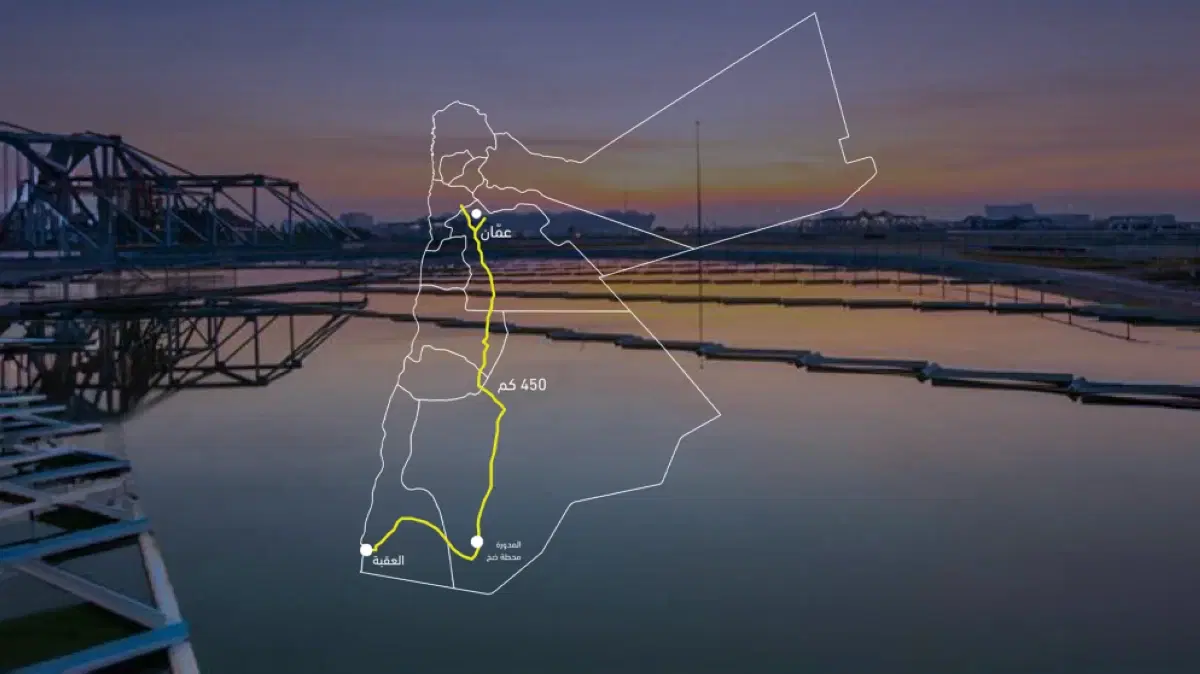
The National Carrier is one of the largest water infrastructure projects in the Kingdom, based on the desalination of 300 million cubic meters of seawater annually in Aqaba, and pumping it north through pipes extending about 450 kilometers, with pumping systems at heights of up to about 1100 meters above sea level.
The project is expected to provide about 40% of the Kingdom's drinking water needs, with the amount of water it will produce annually approaching the capacity of all the Kingdom's dams, and equivalent to about three times the production of the Disi Project.
The government expects the project to increase the annual per capita share of water from about 60 cubic meters to 110 cubic meters, increase the number of supply days from one day to three days a week, in addition to relieving pressure on traditional water sources and meeting the Kingdom's water needs until 2040.
The project includes the establishment of solar energy fields with a production capacity of about 300 megawatts to cover about 30% of its energy needs used in desalination, pumping, and transportation operations.
The project is implemented according to the Build-Operate-Transfer model, with full ownership transferring to the government 26 years after the start of operation, while the government aims to start pumping water from it in 2030.