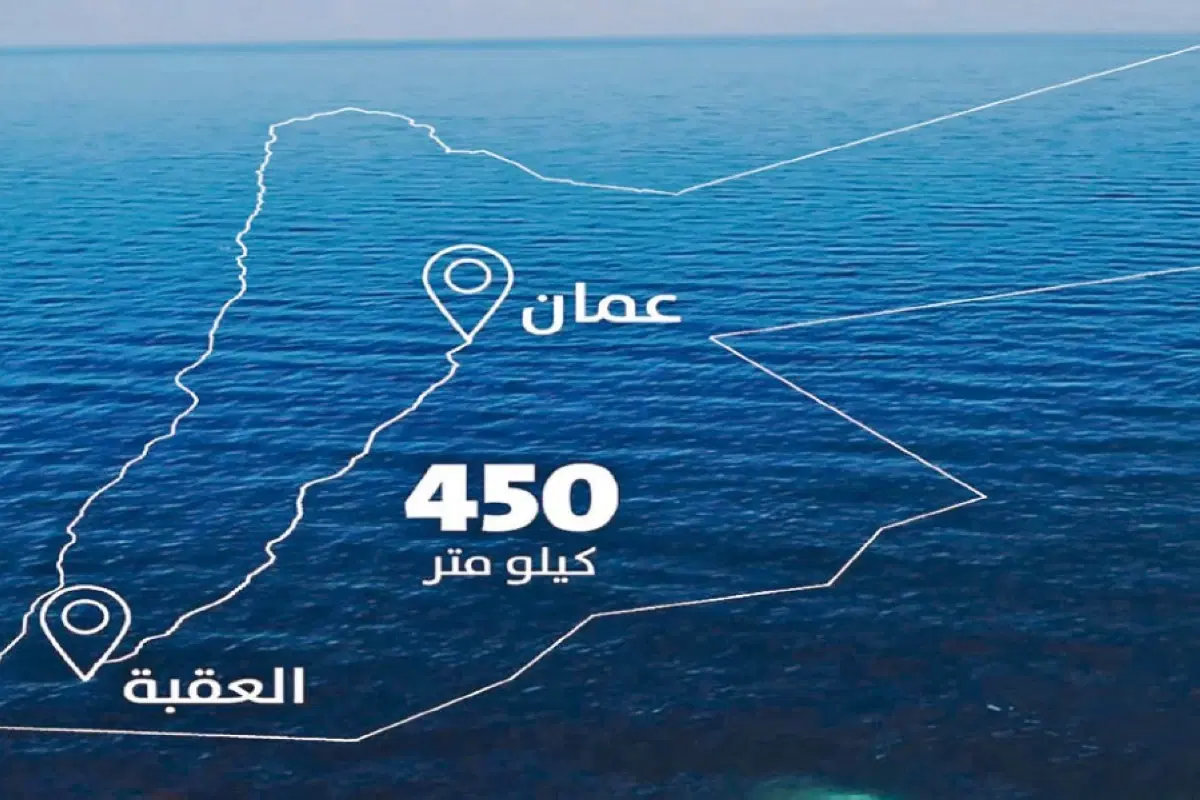
The operation of the project extends over 26 years and includes desalination of Red Sea water and transporting it for a distance of about 450 kilometers, with a height difference of about 1100 meters.
Former advisor to the Minister of Water and Irrigation, Engineer Ibrahim Hayassat, confirmed to Al-Rai that the entry of the American Development Finance Corporation reflects confidence in the project and Jordan's ability to meet its financial obligations, after subjecting the project to financial, environmental, social, and institutional studies.
He explained that the institution will provide a loan of up to one billion dollars, along with political insurance worth up to 800 million dollars for investors, which will contribute to reducing non-commercial risks and enhancing the ability to attract additional funding.
Economic and financial expert Dr. Muhammad Al-Hadab Al-Sarhan said that the amount of 800 million dollars represents insurance coverage and not additional cash funding, pointing out that this coverage can reflect on the cost of financing and its terms, and help attract long-term funding for the project.
The contribution of the Jordanian government is about 722 million dollars, or 12.4 percent of the total cost. Al-Sarhan explained that this does not necessarily mean the entire cost of the project will turn into direct debt on the treasury, as the actual burden is linked to annual payments and future obligations, including the cost of purchasing water and any support or contractual guarantees.
The project is implemented according to the public-private partnership model, where a coalition of investors undertakes the design, development, construction, operation, and maintenance, before the ownership is transferred to the government.
The financial sustainability of the project is linked to the final price per cubic meter, which is affected by the government's contribution and its ability to provide grants or concessional loans that reduce reliance on higher-cost commercial financing.
The operating cost is also affected by several factors, primarily desalination, transportation, energy, pumping, maintenance, inflation, and financing costs, while the project requires large amounts of energy, especially for transporting water over long distances and raising it to high altitudes.
Energy efficiency, the design of networks and stations capable of withstanding high pressures, are key factors in controlling the cost, while the project includes solar fields with a capacity of about 300 megawatts, to cover about 30 percent of its needs, which reduces operating costs and limits exposure to energy price fluctuations.
Dealing with the brine resulting from reverse osmosis desalination is highlighted as one of the main environmental files in the project.
Hayassat explained that the station produces approximately half the amount entering it as desalinated water, while the other amount is returned to the sea with high salinity; this means that producing 300 million cubic meters of desalinated water requires withdrawing about 600 million cubic meters of seawater.
He pointed out that the environmental impacts of discharging the brine have been studied within the requirements of funding agencies, with procedures adopted to mitigate risks and protect the marine environment.
The National Carrier is expected to provide about 300 million cubic meters annually, equivalent to about 40 percent of Jordan's drinking water needs.
Hayassat believes that the project will bring about an important transformation in water security, but it will not end the water gap permanently. According to the National Water Strategy 2023-2040, the entry of water into service around 2030 will cover the gap for a temporary period, before it widens again after 2035 due to population growth and increased demand.
Therefore, the project will remain part of a broader water system that includes reducing waste, managing demand, protecting groundwater, and developing additional water sources.
Economically, the return of the project is not limited to the production and sale of water, as it provides a basis for stability in supplies for planning and investment in the industry, tourism, health, and real estate sectors.
However, achieving this return requires efficient water management after production; losing large quantities of desalinated and long-distance transported water doubles the loss due to the high cost of its production and transportation.
Therefore, the success of the National Carrier will be measured by its ability to operate the project efficiently, maintain a sustainable cost per cubic meter, reduce waste, and decrease pressure on groundwater.
As the project approaches completing its financing structure, the real test remains in the post-financing phase: producing and transporting the targeted quantity at a sustainable cost, efficiently managing water, and transforming the project into a long-term pillar for water and economic security.