Investments of $10 billion.. The national carrier leads strategic projects
Amman4 min read
Share
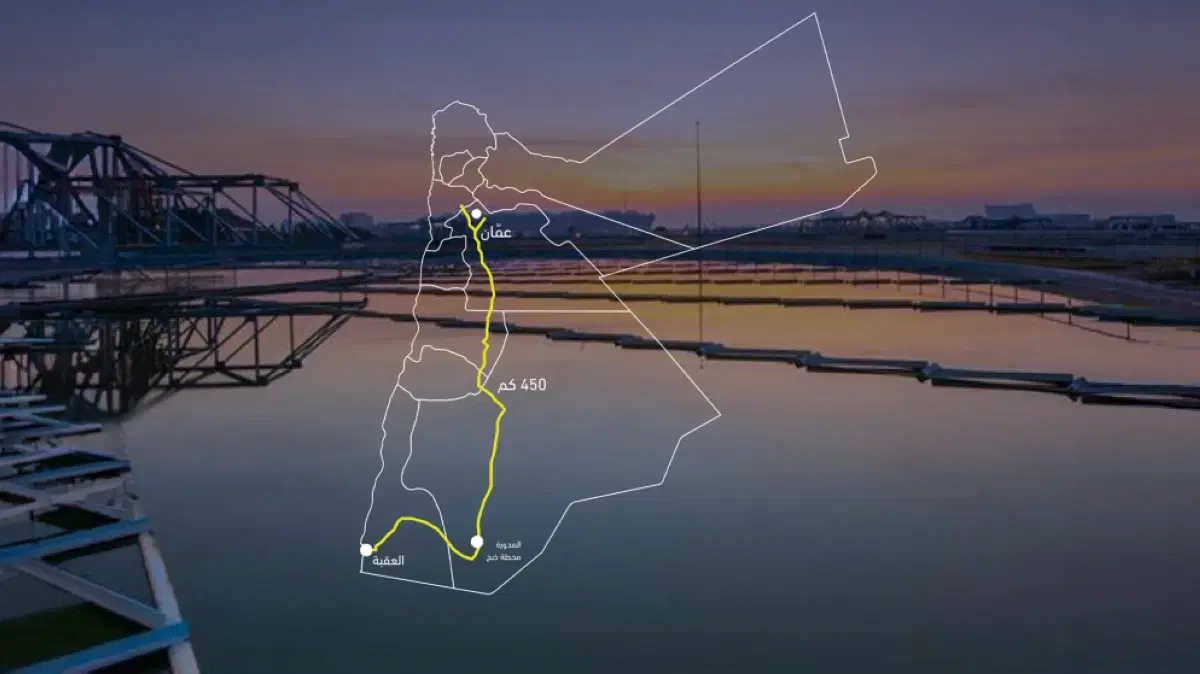
The government is moving towards implementing a package of strategic projects in partnership with the private sector, with investments estimated at about $10 billion over 3 to 4 years, while the national carrier project for desalination and water transfer stands out as one of the most prominent projects, adding about 300 million cubic meters of water annually, equivalent to about 40% of the drinking water needs in the Kingdom according to estimates of the Ministry of Water and Irrigation.
Water Ministry advisor Ibrahim Al-Hayassat said that the national carrier represents a strategic shift in the Jordanian water security system, in light of the scarcity of traditional sources and the decline in the quality of some groundwater basins and their depletion due to increased demand, population growth and economic growth.
Al-Hayassat explained that the project will rely on desalinating Red Sea water in Aqaba and transporting it to the capital and some governorates of the Kingdom, to form a new, sustainable, and non-traditional source of water supply, adding about 300 million cubic meters annually, a quantity equivalent to about three times the production of the Disi project.
He pointed out that the project is still in the stage of completing the financial closure and final procedures that precede the actual implementation, with some preparatory works being carried out, including surveying studies, while there is no official construction progress percentage reflecting significant field progress so far.
He pointed out that the direct impact of the project will be reflected in improving the regularity of water supply, but its actual impact on citizens will also depend on the readiness of distribution networks, reducing waste, and the efficiency of water demand management.
Regarding financing, Al-Hayassat explained that the financial model of the project is based on a partnership between the public and private sectors and international financing institutions according to the Build-Operate-Transfer (BOT) model, with the capital cost of the project estimated at about $4.3 billion, while the total cost with financing reaches about $5.8 billion, including direct government contribution of about $725 million, international grants of about $700 million, and financing from international institutions of about $2.9 billion, in addition to financing from a consortium of Jordanian banks led by the Housing Bank of about $1.1 billion.
He added that the developer contributes about 15% of the project value, while the Social Security Fund Investment Fund contributes a share in the project's capital.
Al-Hayassat affirmed that the national carrier will alleviate pressure on groundwater sources, dams, and traditional sources, but it will not eliminate the dependence on them, stressing the continued need to reduce waste, reuse treated water, protect groundwater, water harvesting, and rationalize consumption.
On the economic side, economic expert Hossam Aaish said that the implementation of investments worth $10 billion, if the announced figure is in dollars, can constitute a boost to economic activity and provide job opportunities and increase productivity, noting that the actual impact depends on the size of the local component, sources of financing, the volume of imports, and the level of future employment and revenues.
Aaish pointed out that water, energy, transportation, and infrastructure projects can contribute to addressing economic bottlenecks by enhancing water and energy security, reducing transportation costs, and linking markets and regions.
For his part, the Chairman of the Board of Directors of the Association of Investors in the Jordanian Housing Sector, Majed Ghosheh, said that the participation of the private sector in major projects requires a clear economic feasibility and a return commensurate with the risks, in addition to the clarity of land ownership, licenses, legislative stability, and the possibility of obtaining long-term financing.
Ghosheh pointed out that the amount of $10 billion represents the targeted investment size, and does not necessarily mean that the entire amount represents private investments or funds that have actually entered the economy, calling for clarifying the cost of each project, its financing structure, and the size of the private sector contribution.
He pointed out that the high costs of borrowing and construction, delayed financing, lengthy licensing procedures, regional developments, and the need for specialized labor, contractors, and necessary materials are among the challenges that may face the implementation of projects.
Aaish and Ghosheh stressed the importance of clarity in the stages of project implementation, sources of funding, and commitments of partnership parties, to ensure the transition of announced investments into implemented projects that achieve actual economic and water impact.