Moscow continues its intensive military strikes on Kyiv
Europe seeks to counter Russia's "multi-modal" attacks
Follow Al Rai

To ease the burden on emergency services
Moscow continues its intensive military strikes on Kyiv
Europe seeks to counter Russia's "multi-modal" attacks
Ukrainian Prime Minister Serhiy Kurytskyi called on people with disabilities and those with limited mobility in cities to consider moving to alternative accommodation before winter arrives, to ease the burden on emergency services in the event of new Russian attacks.
The capital, Kyiv, in particular, was plunged into darkness for weeks last year due to Russian strikes on Ukraine's energy sector, which led to power and heating outages amid temperatures dropping to 20 degrees Celsius below zero.
With winter approaching, many residents have begun considering the options available to them should energy facilities be targeted again, including leaving the city with their families.
Kurytskyi did not go so far as to call on all residents to leave cities during the winter, considering it an "extreme measure," but he urged people with disabilities and those with limited mobility to consider alternative options.
In an interview with the TSN television channel broadcast on Sunday evening, he said he had discussed the matter with Kyiv Mayor Vitali Klitschko.
He asked, "Why don't the relatives of these people or the city's social services take care of them?", adding, "This can be done in advance, before winter arrives."
He continued, "If a person lives, for example, on the sixteenth floor and the power goes out, why should we be forced at that moment to take care of people who need extra care, while emergency teams should be focusing on addressing the consequences of the attacks?"
He added, "It is better to find alternative accommodation for these people during the winter."
Russia has intensified its attacks on Kyiv in recent weeks, targeting the capital with drones and missiles, leading to sirens sounding day and night.
The strikes included civilian infrastructure, including transport networks and warehouses, while Ukrainian President Volodymyr Zelenskyy accused Russia of deliberately seeking to cripple his country's economy.
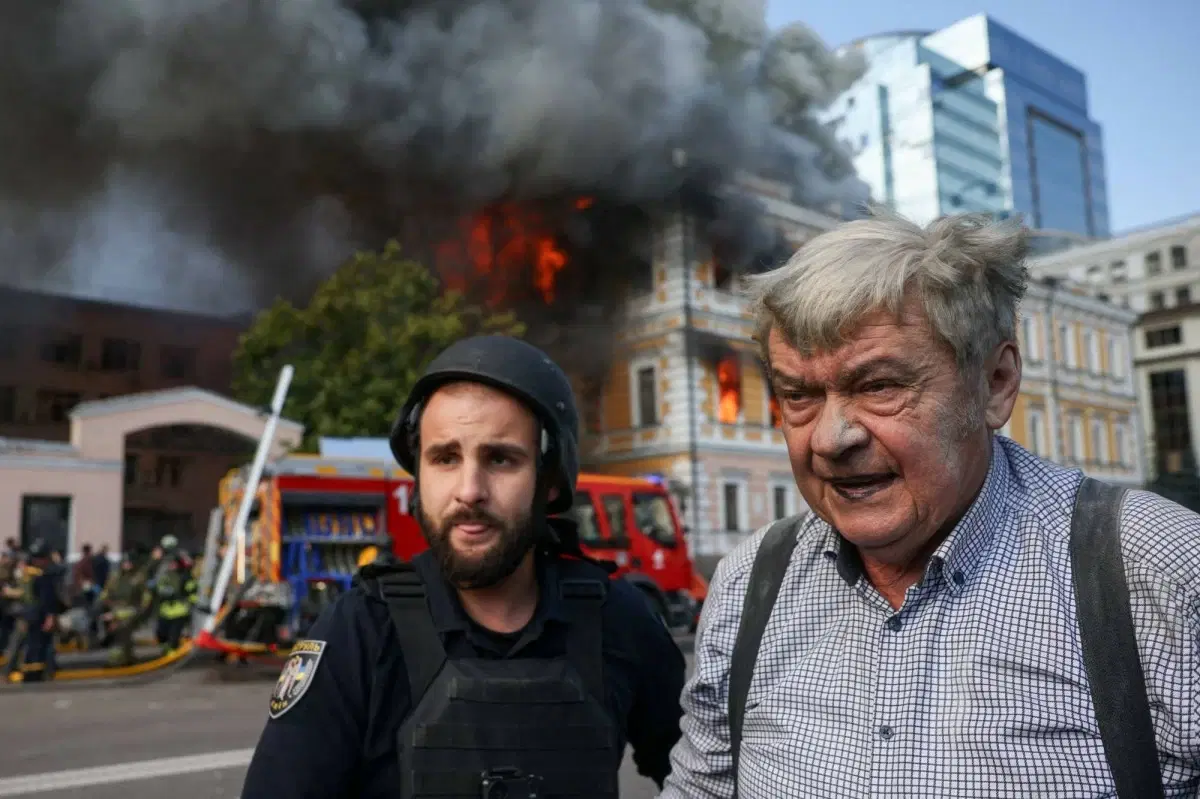
A Russian drone strike on Monday caused a fire at the Academy of Sciences in the heart of Kyiv, according to Agence France-Presse (AFP) journalists, amid escalating attacks on the Ukrainian capital.
Videos posted on social media showed people looking out of windows to catch their breath, while thick black smoke and flames engulfed part of the historic building.
The building is located in the center of Kyiv, in a neighborhood that is usually heavily protected, near embassies and government buildings.
Russia has escalated its attacks on the Ukrainian capital in the fifth year of its invasion of Ukraine, as Kyiv prepares for a new winter under war conditions.
In recent months, Russia has deployed new drones powered by Chinese jet engines, according to experts, which are faster and harder to intercept than traditional models.
Kyiv confirms that it is developing means to counter them.
Since the beginning of summer, Moscow has been targeting several civilian, logistical, and commercial facilities.
Ukrainian President Volodymyr Zelenskyy accuses Russia of seeking to cripple the economy of his country, which has also intensified its long-range strikes inside Russia.
At least four people were killed and dozens injured on Monday in a series of Russian strikes on Ukraine, according to local authorities.
Dnipropetrovsk regional governor Serhiy Lysak announced on Telegram that three people were killed in the city of Dnipro and another person in the city of Synelnykove, located in the same region in central-eastern Ukraine.
At least 38 people were also injured in a Russian attack on Kharkiv, Ukraine's second-largest city located in the northeast of the country, according to regional governor Oleh Syniehubov.
On the other hand, European Union defense ministers discussed on Monday whether the bloc needs its own emergency mechanism similar to NATO to enhance coordination in the face of Russian "multi-modal attacks."
European governments say Moscow is intensifying a campaign of sabotage and interference targeting countries supporting Ukraine, at a time when Russian forces are facing difficulties on the front there more than four years after the invasion began in February 2022.
Following notable incidents, including the discovery of an armed drone at a German airport, European Commission President Ursula von der Leyen proposed earlier this month the creation of an "emergency security protocol" to counter the growing threat.
Von der Leyen said the mechanism, similar to Article 4 of the NATO charter, would allow any EU country to call for urgent consultations in the event of a crisis, with the aim of helping to reach a consensus on responding to incidents occurring in the gray zone below the level of direct aggression.
EU foreign policy chief Kaja Kallas said at the start of the meeting on Monday that the discussions would address the "broader strategy to counter hybrid attacks."
She added, "What tools can we use at different levels?"
EU ministers generally welcomed the efforts to strengthen the bloc's response, as they look for ways to counter what they see as an increasing threat from Moscow.
Irish Minister of State for Justice Helen McEntee, whose country is one of only four EU nations that is not a member of NATO, said, "We need to be able not only to respond when incidents occur, but also to anticipate any potential escalation, and work with member states and with each other to ensure there is a strong response if something happens."
She added, "There is still some work required to define what form this mechanism might take, but there is certainly a willingness among member states."
A senior European official said that Brussels is already capable of providing "a lot" to help countries deal with this type of incident when needed.
This includes sending teams of experts to provide advice on ways to strengthen security, and increasing funding.
Finnish Defense Minister Antti Häkkänen said, "Every country must take its own measures to counter these activities, but the EU and NATO must also take much broader measures and strengthen coordination to counter them."
European officials said they intend to put forward more detailed proposals within a new security strategy document they hope to release next month.
Know more about this story?Send us a tip
Ask about this report — answers stay grounded in its text.