The King's speech draws clear boundaries between the option of peace and the protection of Jordan's security and interests
Amman12 min read
Share
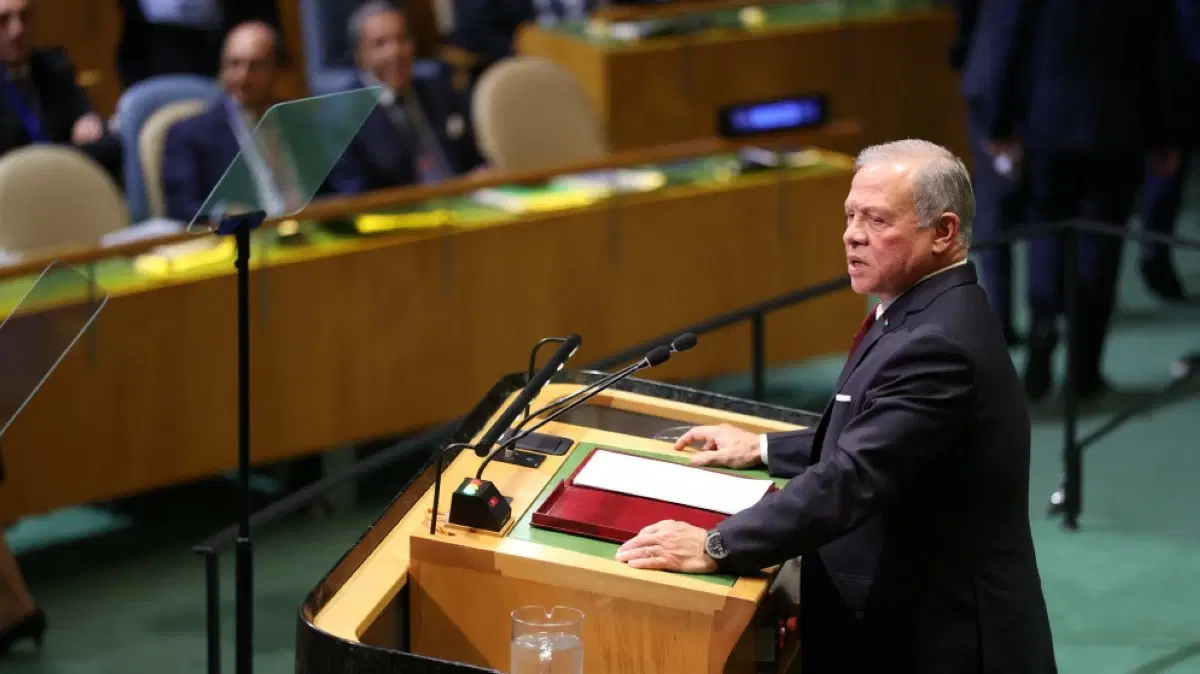
King Abdullah II's speech before the 81st session of the United Nations General Assembly was direct and firm towards Israeli practices and the inaction of the international community, placing the world before its responsibilities regarding the continuation of the occupation and violations in Gaza and the West Bank.
In his speech, His Majesty warned that the 'expansionist ambitions' of the Israeli government had become a'regional threat', and that any threat to Jordan's northern borders or its water security was a 'national security threat'.
In a speech in which the Palestinian issue occupied a major space, the King moved from warning of the risks of declining international attention to holding the world accountable for inaction.
His Majesty emphasized that 'global political inaction is not due to a lack of options', and that the international community has tools including sanctions, asset freezes, embargoes, and diplomatic isolation, but has used them in other issues, while decisions when it comes to Israel remain 'on paper'.
The King summarized the result of this inaction with a direct phrase: 'The result is a state without deterrence'.
His Majesty linked what is happening in the Gaza Strip and the occupied West Bank, refusing to treat them as separate stories, and affirming that they are 'two sides of the same Israeli strategy', aiming to make the establishment of a viable Palestinian state impossible.
The King also placed the language used to describe Israeli practices at the heart of his speech, rejecting terms that mitigate the severity of what is happening on the ground, affirming that the demolition of Palestinian homes to expand illegal settlements is 'forced relocation', that the seizure of occupied territories is 'de facto annexation', and that the system of checkpoints and suffocating barriers is a'repressive system'.
The King began his speech with the idea of 'attention', in a world where crises, tragedies, and emergencies are accelerating, considering that attention is no longer just a 'cognitive resource', but has also become a 'geopolitical resource'.
His Majesty linked what the world chooses to focus on with the conflicts that receive sustained diplomatic efforts, and those that retreat to the margins of the agenda, and the continued rejection of human suffering and its transformation over time into a familiar matter.
The King warned that what the world neglects today often shapes its future, reviewing the repercussions of conflicts extending from Lebanon to Yemen through Sudan, and the effects that crises leave beyond their geographical boundaries to energy, food, trade, investment, and people's lives.
His Majesty cited the war in Iran to show the speed with which the effects of instability are transmitted beyond the borders of the region.
But the most prominent example that the King put before the international community was the Palestinian issue.
- Choosing to contain the conflict instead of addressing it
The King reminded that he had stood for decades before the General Assembly warning of the risks of leaving the Palestinian-Israeli conflict unresolved, but the international community 'chose to contain the conflict, instead of addressing it'.
He warned that every new Israeli violation is treated as temporary, which distracts from the reality that is gradually imposed on the ground, 'until the temporary became permanent, and the permanent became a policy'.
From this point, the speech moved to question the value of international law itself in the face of the continuation of one of the longest occupations in the world, wondering about the value of international law if it can be ignored for decades, and the possibility of its application if violations are not even acknowledged.
- Gaza... The evidence is overwhelming
In Gaza, His Majesty said that 'the evidence is overwhelming', referring to the martyrdom of at least 300 Palestinian children during the first 300 days of what was called a ceasefire, and the targeting of Jordanian field hospitals there.
His Majesty pointed to the strenuous efforts made by US President Donald Trump to achieve peace and find a path to end the war, but affirmed that the current Israeli government continues to ignore the agreement, continue its attacks, and destroy civilian infrastructure in the sector, refuses to withdraw, and tightens the noose on Palestinians to confine them to barely a third of the area of Gaza.
In parallel, the King said that Israel is tightening its grip on the West Bank, where it seizes land, expands settlements, and expels Palestinians.
- It is time for the world to face the reality of what is happening
In one of the most direct statements of the speech, the King called on the world to face the reality of what is happening, affirming that 'when words do not reflect the gravity of actions, the unacceptable becomes familiar'.
His Majesty named the practices by their names, affirming that the demolition of Palestinian homes to expand illegal settlements is not 'law enforcement', but forced relocation, and that the seizure of occupied territories is not 'land registration', but de facto annexation.
He emphasized that the system of checkpoints and suffocating barriers is not 'security infrastructure', but a'repressive system', and that the systematic attacks on Palestinian population centers are not 'settler riots'.
The King stopped at criticizing the Israeli government for acts of violence in international forums, describing those responsible as 'a handful of troublemakers', and affirming that Israel is a state governed by law.
His Majesty asserted that what is happening across the West Bank is not a series of separate events, but interconnected practices that form part of 'a single policy' aimed at forcing an entire people to leave their land.
The King put the direct term for this policy saying: 'Forced relocation, which is a war crime'.
- Gaza and the West Bank are two sides of the same Israeli strategy
The King called on the world to abandon 'some illusions' if it wants to resolve the Palestinian-Israeli conflict, foremost among them the belief that Gaza and the West Bank are separate stories.
He affirmed that they are 'two sides of the same Israeli strategy', in both of which Palestinians are killed and work is being done to impose a new reality on the ground, through destruction in Gaza, and de facto annexation of territories in the West Bank.
The King directly identified the goal of this: 'Making the establishment of a viable Palestinian state impossible'.
His Majesty rejected another illusion related to considering the Israeli leadership's rejection of a Palestinian state as a position that can be changed, affirming that 'it will not change, but is being cemented on the ground'.
He pointed to the Israeli government's acceleration of settlement operations and land confiscation, explaining that these measures did not start recently, and that the map has been changing since the Oslo Accords 'little by little, settlement by settlement'.
- Arab peace in the face of illusions
In contrast, the King described the belief that Arab countries have never sought peace as 'the most dangerous illusion', recalling the Arab Peace Initiative of 2002, which offered Israel normalization of relations with 57 Arab and Muslim countries, including Iran and Iraq at the time, in exchange for peace and the establishment of a Palestinian state.
His Majesty also rejected attempts to portray the conflict as religious, affirming that the issue is not a conflict between Islam on the one hand and Christianity and Judaism on the other, but is about the rights of Palestinians, Muslims and Christians alike.
The presentation of the Arab Peace Initiative was at the heart of a speech that was very clear towards Israeli practices to affirm Jordan's commitment to the option of a just peace, while rejecting the facts imposed by force on the ground.
- Inaction is a choice
After diagnosing the reality on the ground, His Majesty turned to the question he posed to the international community: 'Will we act?', affirming that global political inaction is not due to a lack of options, saying: 'Let's call things by their names: this inaction is a choice'.
He listed the tools available to the international community, including sanctions, asset freezes, embargoes, and diplomatic isolation, affirming the existence of a record of using them 'in other issues'.
However, His Majesty said that when it comes to Israel 'decisions remain where they began: on paper', and directly stated the result: 'And the result is a state without deterrence'.
The King warned that the Israeli government's sense of impunity has reached 'terrifying levels', and that it no longer feels compelled to even question whether it can get away with its actions, 'because it knows the answer in advance'.
- Expansionist ambitions are a regional threat
The King did not confine his warnings to Palestine, but affirmed that no one should believe that the ambitions of the Israeli government will stop there.
His Majesty said that 'the expansionist ambitions of this Israeli government have become a regional threat', taking Syria as an example and a warning that the international community chooses not to heed.
He pointed to the repeated incursions and geographical expansion and the imposition of new facts on the ground in Syria, including those affecting vital water sources.
The King described the Israeli approach as proceeding "step by step," affirming that Israel is testing how far it can go, and that every time the international community looks away, it concludes that it can go further and exceed "geographical boundaries and laws."
- Jordan will not look away
When the speech moved from the regional scene to Jordan's security, the King's message was direct and decisive, as His Majesty said: "As for Jordan, the matter is as clear as the sun: any threat to our northern borders or our water security is a threat to our national security."
He added: "Jordan will not look away, but we will protect our security, our water, and the interests of our people."
The King posed a question to the international community regarding Israel's continued "aggressive approach in southern Syria" and whether the world would let it go unchecked.
Thus, the speech linked the warning about regional developments with a clear Jordanian stance on borders, water security, and national interests.
In a world where crises are multiplying, the King presented the Jordanian approach based on not having to choose between responding to crises and building the future, affirming that Jordan "is pursuing both paths simultaneously."
His Majesty pointed to strengthening ties from the Gulf to the Mediterranean through Jordan's role as a center for trade, industry, and technology, alongside addressing urgent humanitarian crises.
He also emphasized continuing to combat terrorism in the region and beyond, while developing defensive capabilities to counter threats such as drug smuggling.
The King placed the protection of Christianity, its communities, and its heritage in its original and historical homeland, alongside defending the true image of Islam against voices of hatred, within the same approach.
- No retreat from just peace and UNRWA
At the heart of these paths, the King affirmed that Jordan will not abandon its commitment to just peace.
His Majesty said that Jordan will continue to support Palestinian steadfastness and support the United Nations Relief and Works Agency for Palestine Refugees in the Near East (UNRWA), and will continue to carry the Hashemite custodianship and preserve the historical and legal status of Islamic and Christian holy sites in Jerusalem.
The King placed these constants within the model that Jordan seeks to build, "a model based on values and principles, characterized by openness and steadfastness, in a time when certainty is rare and political calculations change from one day to the next."
He emphasized that Jordan is "a country on which the world can rely," committed to its principles, committed to its positions, ready to engage in dialogue with everyone, and ready to work with all those who seek peace.
In a decisive message regarding the role of diplomacy in Jordanian policy, the King affirmed that Jordan's adherence to it does not exceed its commitment to humanitarian values.
His Majesty warned against considering this diplomacy as a given or "misinterpreting it as weakness."
Thus, the speech combined adherence to peace and dialogue on one hand, and clarity of Jordan's position in protecting its security, water, and the interests of its people on the other, while affirming positions on the Palestinian issue and Jerusalem.
The King concluded his speech by returning the discussion to the idea with which he began: the power of attention and the danger of principles becoming hostage to its fluctuation.
His Majesty affirmed that whether it is in Gaza, Sudan, Ukraine, or anywhere people are experiencing wars, displacement, and fear, whether the conflict began weeks ago or has lasted for decades, "our principles cannot change with the world's changing attention."
He also emphasized that military force cannot provide effective solutions; it does not feed the hungry, ensure the return of the displaced, or build peace.
In contrast, the King placed the need for institutions with legitimacy and for trust between countries and in agreements, and the trust that laws will be applied effectively, warning that the future is shaped not only by what the world does, "but also by what we choose to ignore."