
2.3 billion digital impressions.. and 985 million active views
6 million accounts and influencers interact.. and digital resonance exceeds the Arab world
Follow Al Rai

Alrai: The study is a monitoring and analysis of the digital lifecycle of the speech
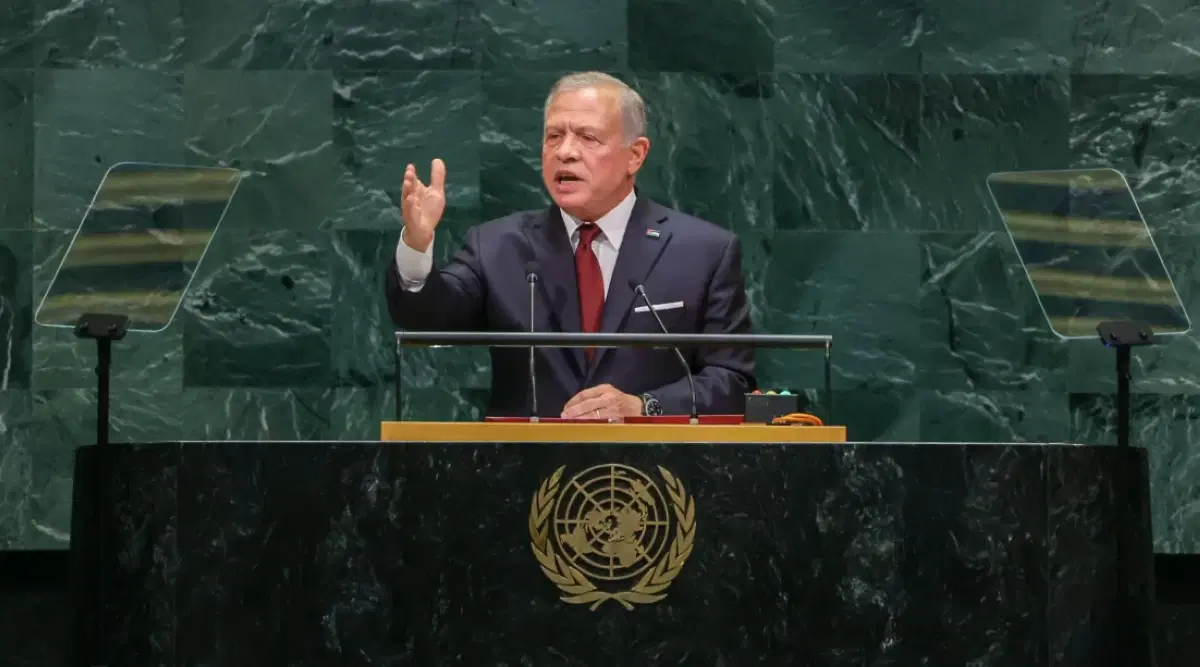
2.3 billion digital impressions.. and 985 million active views
6 million accounts and influencers interact.. and digital resonance exceeds the Arab world
A study to monitor and analyze the digital lifecycle of the speech recorded 13.9 million analyzable records and 6.05 million accounts and authors across 15 platforms and 41 languages.
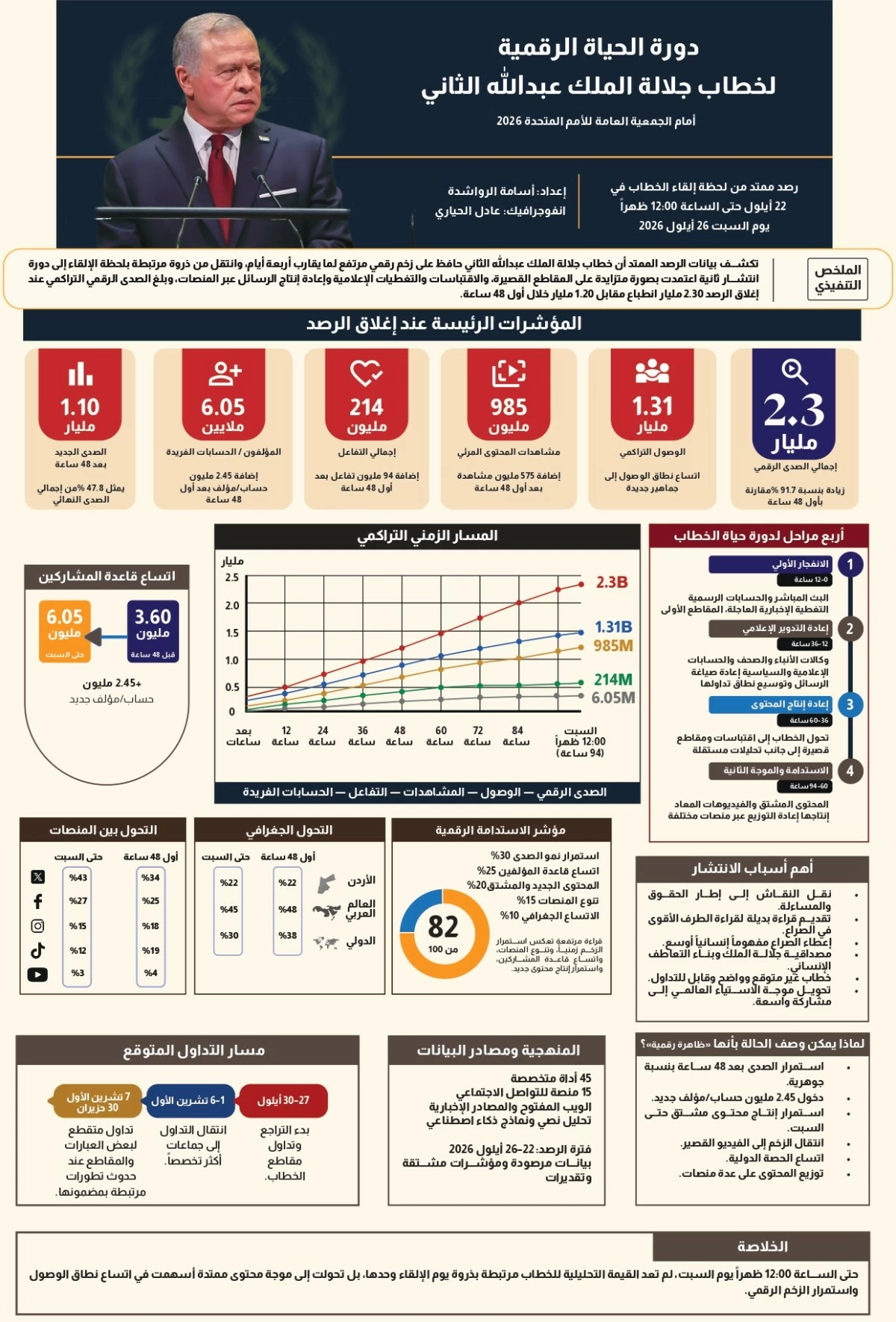
Following the previous study prepared by Alrai and published in its issue released on Thursday, September 24, 2026, and as a result of the team's continued monitoring of the public spread of His Majesty King Abdullah II's speech at the United Nations General Assembly, a specialized study in digital monitoring and analysis showed that the speech entered an extended digital spread cycle that exceeded the moment of its delivery, recording at the closure of the monitoring 2.3 billion digital impressions, 1.31 billion estimated cumulative reach, 985 million views of the visual content, and 214 million interactions, along with the participation of 6.05 million unique accounts and authors.
The study, implemented by Alrai's colleague Osama Al-Ruwaished, indicates that the speech maintained a high digital momentum for about four days, gradually transitioning from a first wave led by news coverage and official accounts to a second wave that relied more on short videos, quotes, and the reproduction of messages across multiple platforms.
18.6 million digital records in the monitoring base
The study relied on a wide system for collecting and analyzing digital data, which included 45 specialized tools in digital data and big data, including tools linked to application programming interfaces (APIs), social listening tools, and content analysis, alongside textual analysis techniques and models supported by artificial intelligence.
The monitoring scope included 15 social media platforms, in addition to the open web and digital news sources. The data collection process extended from the moment the speech was delivered on September 22, 2026, until 12:00 PM on Saturday, September 26, 2026, Amman time.
According to sample size data, the monitoring system collected in its initial phase about 18.6 million raw digital records directly or contextually linked to the speech. After verification, cleaning, deduplication, and source matching processes, the database stabilized at about 13.9 million analyzable records.
The monitored material in 41 languages included about: 5.4 million original posts and texts, 9.8 million comments and replies, 486,000 videos and visual clips, 1.34 million images, cards, and visual quotes, 64.8 thousand journalistic and news materials and web pages, 6.05 million unique accounts and authors, more than 8,700 sources, websites, digital and media domains, from more than 120 countries and regions with geographical indications.
About 7.6 million texts were also subjected to linguistic and semantic analysis, topic and narrative classification, alongside analysis and classification of about 1.83 million visual units of videos, images, and visual content.
2.3 billion impressions in 94 hours
The final indicators of the study reveal a continuous growth in the volume of interaction with the speech after the first hours of its delivery. The digital resonance during the first 48 hours reached 1.2 billion impressions, before rising to 2.3 billion impressions at the closure of the monitoring, an increase of 91.7%.
In the same period, the cumulative reach increased to 1.31 billion, while visual content views reached 985 million, total interactions amounted to 214 million, and the number of unique accounts and authors rose to 6.05 million.
The temporal data indicates a gradual and continuous growth in digital resonance, reach, views, and interaction indicators, parallel to the expansion of the base of accounts and authors participating in content circulation. In the first six hours, digital resonance reached about 250 million, content reached 160 million users, recorded 65 million views and 25 million interactions, through about 780,000 accounts and authors.
After 12 hours, digital resonance increased to 410 million, reach to 265 million, views to 120 million, and interactions to 43 million, with the number of accounts and authors rising to 1.25 million. After 24 hours, the upward trajectory continued, reaching digital resonance of 720 million, reach of 468 million, views of 246 million, and interactions of 78 million, while the number of accounts and authors increased to 2.35 million.
During the period between 36 and 48 hours, the digital presence expanded rapidly; resonance increased from 970 million after 36 hours to 1.20 billion after 48 hours, while reach increased from 622 million to 744 million, views from 337 million to 410 million, and interactions from 101 million to 120 million. At the same time, the number of participating accounts and authors increased from 3.02 million to 3.60 million.
After 60 hours, digital resonance recorded 1.46 billion, reach 875 million, views 540 million, and interactions 141 million, with the participation of about 4.18 million accounts and authors. After 72 hours, digital resonance exceeded 1.73 billion, reach 1.01 billion, views 690 million, and interactions 164 million, while the number of accounts and authors reached 4.78 million.
The growth continued in the subsequent hours, where the indicators recorded after 84 hours showed 2.02 billion digital resonance, 1.16 billion reach, 845 million views, and 189 million interactions, with the participation of 5.43 million accounts and authors. At about 94 hours, the indicators reached their highest levels in the monitoring, with digital resonance at 2.30 billion, reach at 1.31 billion, views at 985 million, and interactions at 214 million, while the number of accounts and authors increased to 6.05 million.
These data indicate that the digital spread followed a continuous upward trajectory throughout the monitoring period, with digital resonance transitioning from 250 million in the first six hours to 2.30 billion after about 94 hours, parallel to the reach exceeding one billion, views approaching one billion, and interactions rising to over 214 million. The growth in the number of accounts and authors from 780,000 to 6.05 million reflects the expansion of the circle of participation in content circulation and digital interaction.
The study shows that the period between 48 hours and the closure of the monitoring witnessed a 91.7% increase in resonance, 140.2% in views, 78.3% in interactions, and 68.1% in the base of authors. The data also indicate that 1.1 billion impressions were achieved after the first 48 hours, representing 47.8% of the total final resonance.
From breaking news to short video
The study tracks four main phases of the digital lifecycle of the speech. The first phase began within the first 12 hours, with resonance reaching 410 million impressions, led by live broadcasts, official accounts, and urgent news coverage.
In the next phase, between 12 and 36 hours, the circulation of the speech expanded through news agencies, newspapers, and media and political accounts that reframed the messages and broadened their circulation. Then, during the period between 36 and 60 hours, the speech entered the content reproduction phase, where quotes, short clips, and independent analyses emerged.
Between 60 and 94 hours, the speech entered a second wave of dissemination, associated with derivative content, reproduced videos, and redistribution across different platforms.
The figures show that video became one of the main drivers of dissemination in the subsequent phase; visual content views increased from 410 million after 48 hours to 985 million at the closure of the monitoring, an increase of 575 million views. The study explains this by the transition of the speech to shorter visual units more suitable for reposting, circulation, and recommendation through platform algorithms.
TikTok and Instagram expand their presence
The study recorded a change in the relative weight of the platforms used in circulating the speech. The share of platform X decreased from 34% in the first 48 hours to 27% at the final reading, while Instagram's share increased from 15% to 18%, TikTok's from 12% to 19%, YouTube's from 3% to 4%, and Facebook's decreased from 27% to 25%.
The study links this shift to the faster growth of visual content, especially short videos, quotes, and reproduced clips. It indicates that the change in the relative shares between platforms reflects the expansion of content circulation and distribution across multiple channels.
Expansion of spread to the international field
Geographically, the study data shows a change in the relative distribution of the spread. Jordan's share was 22% in the first 48 hours before stabilizing at 17% in the final reading, while the Arab world's share was 48% initially and 45% at the closure of the monitoring.
Conversely, the international share increased from 30% to 38%, the highest relative change among the three geographical ranges adopted by the study. The study links this growth to the expansion of coverage and re-quoting outside the Arab region.
The base of participants reinforces this trend; the number of unique authors and accounts increased from 3.6 million after 48 hours to 6.05 million at the closure of the monitoring, an increase of 2.45 million accounts and authors.
82 out of 100 on the digital sustainability index
The study developed an internal index called the “Digital Sustainability Index” to measure the ability of content to transition from a peak of immediate interaction to an extended dissemination cycle.
The index consists of five dimensions: 30% for the continued growth of resonance after the first 48 hours, 25% for the expansion of the base of new authors and accounts, 20% for the proportion of new and derivative content, 15% for the continued spread across multiple platforms, and 10% for the continued geographical expansion.
The speech scored 82 out of 100 on this index, according to the study, which confirms that the index is a private analytical tool and not an independent international standard or comparative measure.
Why did the study consider the speech a “digital phenomenon”?
The study links this description to a set of interrelated indicators, foremost of which is the continued growth of resonance after the first 48 hours, the entry of 2.45 million additional accounts and authors into the interaction cycle, the continued production of derivative content, and the shift of a growing portion of momentum towards short video, alongside the expansion of the international share and the distribution of circulation across multiple platforms.
In the analytical reading of the study, the structure of the speech's dissemination changed over time. The process began as an immediate political event led by official accounts and urgent news coverage, then transitioned into Arab and international news material, before parts of the speech's content turned into independent units that were recirculated through quotes, clips, images, headlines, and analyses.
The study identifies a set of factors linked to the expansion of dissemination, including the legal and humanitarian framework in which the speech presented the Palestinian issue, the nature of messages related to responsibility and accountability, the suitability of certain sentences and clips for quotation and recirculation, and the transition of parts of the speech into short visual formats. These points represent an analytical reading of the study and are not independent measurements of the impact size of each factor individually.
A life cycle extending beyond the monitoring days
The study presents a vision for the trajectory of the speech's circulation in subsequent periods, starting with a gradual decline in the circulation of clips from September 27 to 30, then a shift of part of the circulation to more specialized groups, such as those interested in Palestine, Jordanian politics, and speech analysis during the period from October 1 to 6, with the expectation of continued intermittent circulation of some phrases and clips when developments related to the speech's content occur from October 7, 2026, to June 30, 2027. This point represents a future analytical trajectory within the study, not completed monitoring results for those periods.
A methodology that distinguishes between monitoring and estimation
The study confirms that its figures do not all belong to the same type of measurement; it differentiates between directly monitored data, indicators derived from the data, and analytical estimates.
According to the methodology, some indicators of reach, impressions, and other estimates are calculated based on analytical models built on available data and signals, taking into account the varying levels of data availability across platforms. The results of automated classification and AI-supported analysis are subject to review and verification during the processing stages.
The study places an important limitation on the interpretation of the results, as it measures digital public opinion and observed interactive behavior on the internet during the study period, and does not present itself as a substitute for population-representative opinion polls, with varying levels of coverage across platforms according to the nature of the data, accessibility, and each platform's policies.
Summary
The figures in the study reveal a multi-stage digital trajectory for King Abdullah II's speech at the United Nations General Assembly: 2.30 billion impressions, 1.31 billion estimated cumulative reach, 985 million video views, 214 million interactions, and 6.05 million unique accounts and authors over approximately 94 hours of monitoring.
The core analytical value lies in the continued growth of indicators after the first wave ended; 47.8% of the total final resonance was achieved after the first 48 hours, coinciding with faster growth in views than impressions, an expansion of the participant base, an increase in international presence, and a shift of part of the circulation to video and derivative content.
Thus, the study paints a picture of a digital life cycle that transitioned from breaking news to media reproduction, then to quotes, short video, and multi-platform and geographical circulation, with the continued circulation of messages in new formats after the original speech moment. The study concludes that the sustained momentum was linked to reposting, rephrasing, and derivative visual content, which contributed to expanding the reach and extending the digital circulation cycle of the speech.
Know more about this story?Send us a tip
Ask about this report — answers stay grounded in its text.




