Testimonies of 24 soldiers shake the occupation's narrative about the Gaza war
Amman8 min read
Share
A narrative of the operational mechanisms underlying the mass killing of Palestinians
The screening of the Israeli documentary "Naza," which means "Collateral Damage" in Hebrew, at the 83rd Venice Film Festival, has sparked a political and media storm inside and outside Israel. The film documents the testimonies of 24 former and current officers and soldiers in Israeli military intelligence, who spoke to the filmmakers on the condition of anonymity, addressing what they described as the mechanisms for targeting and killing Palestinians in the Gaza Strip during the war.
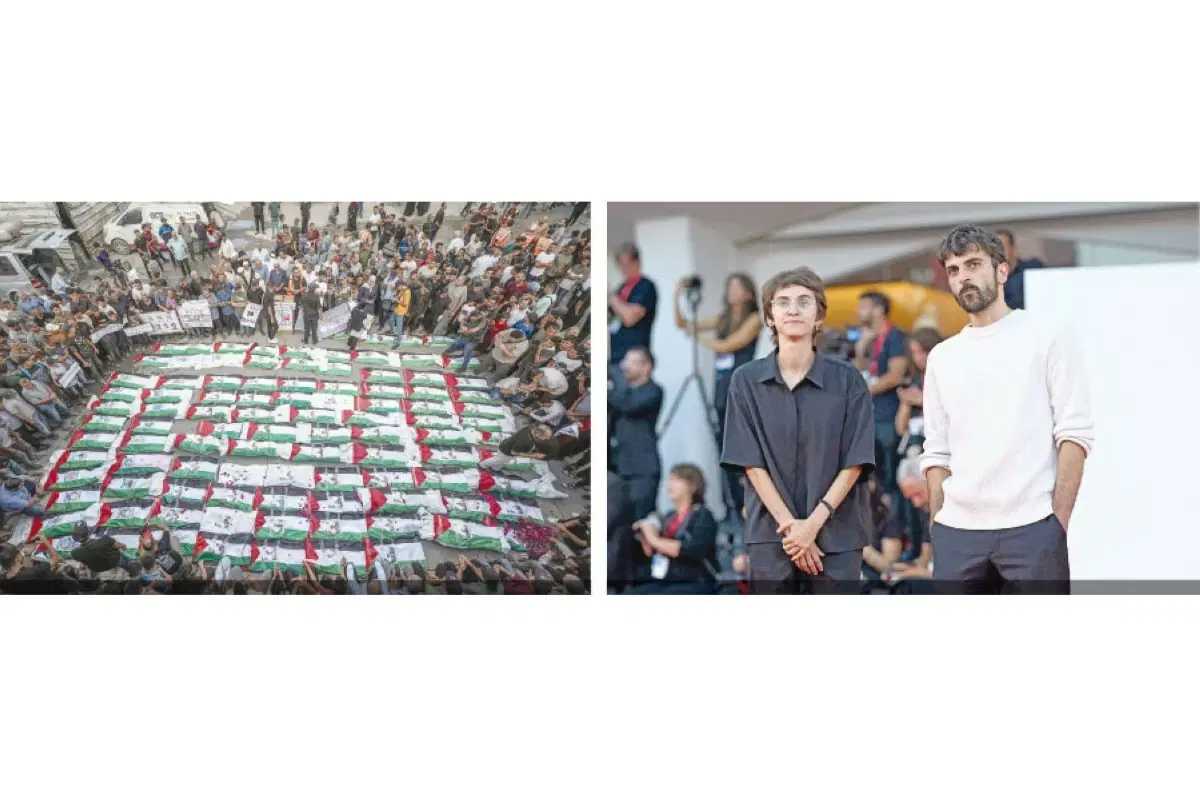
The film premiered on September 8, 2026, and is directed by Israelis Yuval Abraham and Rachel Shor, who won an Oscar in 2025 for the film "No Other Land."
The work is based on testimonies collected and filmed secretly on rooftops in Tel Aviv over three years, and, according to its official summary, it presents a narrative about the operational mechanisms underlying the mass killing of Palestinians in Gaza.
According to the film's content, the testimonies speak of the use of artificial intelligence systems and surveillance methods to identify targets, including targeting homes with prior knowledge of the presence of families inside, including children, women, and the elderly, based on monitoring and surveillance tools, including thermal imaging.
The film received a remarkable reception at the Venice Festival, where it was met with applause lasting about 25 minutes, one of the longest periods of applause recorded in the festival's history, and it also won the Special Jury Prize.
While accepting the award, Abraham said that Israel had killed a number of Palestinian children in Gaza during the first days of the festival, adding that the intelligence officers the filmmakers spoke to described the killings as "systematic" rather than incidental events.
The controversy quickly moved from the festival halls to Israel, where the official response was angry and sharp, but at the same time opened an internal debate about the effectiveness of the way the government and the military establishment dealt with the film, and whether the campaign against it had, conversely, contributed to enhancing its media and political presence. Israeli Minister of Culture and Sports Miki Zohar described the film as "despicable" and accused its makers of what he called "self-hatred" and "treason against the state," announcing his intention to work on revoking the directors' Israeli citizenship on charges of treason.
Israeli Prime Minister Benjamin Netanyahu also joined the campaign, considering the film a contributor to "antisemitic incitement on a global scale," while Minister of National Security Itamar Ben-Gvir attacked the directors, describing them as a "disgrace and shame," and called on them to leave Israel.
On the military level, Israeli Chief of Staff Eyal Zamir, during a meeting with the high command, ordered a study of the possibility of taking legal action against the film and its makers. He also directed the formation of a multidisciplinary team to develop ways to deal with what he described as "false allegations" against the army.
Zamir said that the film "is not a film that criticizes the Israeli army nor an attempt to reach the truth," accusing it of being based on a "blood libel, a deliberate distortion of reality, and dangerous false accusations against soldiers and officers of the army." He also ordered an examination of what he described as "aspects related to information security" and the identification of persons potentially involved in leaking classified materials used in the production of the film.
However, the Israeli way of dealing with the film raised questions about the extent of the official establishment's readiness to confront the content of the testimonies themselves, especially in light of Israeli reports that spoke of movements that preceded the film's screening at the Venice Festival.
According to a report published by "Yedioth Ahronoth," the Israeli embassy in Rome was aware of the film's participation in the festival about a month earlier and tried to exert pressure to prevent or postpone its screening, but the festival management rejected those pressures and insisted on organizing the screening.
More embarrassingly, according to the report, Israel was unable to obtain a copy of the film or a written transcript of its content before it was screened. The army spokesperson did not learn the details of the work until the cultural attaché at the embassy attended the screening and submitted a report on it, before the army later asked the directors to provide it with a copy of the film so that it could respond to what was stated in it.
This created a clear paradox in the official Israeli discourse, as the film was described in advance as "false" and a "deliberate distortion of reality," while the military establishment had not viewed its full content before the screening, according to the narrative reported by the Israeli newspaper.
The criticism did not stop there, as Israeli media quoted officials in the Israeli propaganda apparatus admitting that the call to revoke the directors' citizenship caused more damage to Israel's image than it weakened the film.
According to these assessments, the Minister of Culture's statements did not include a response to the allegations raised by the filmmakers, but rather allowed Israel's critics to say that the state is trying to silence criticism instead of refuting its content.
This point seems of particular importance, as it comes from Israeli circles concerned with managing media and diplomatic discourse, reflecting an awareness that emotional responses may lead to a counterproductive result by turning the film from a documentary into a political issue related to freedom of expression and the public's right to know what is happening within the military establishment.
Another question also arises regarding Israel's ability to refute the film's content. So far, official statements have focused on describing what was stated in it as "false allegations" and "blood libel," without presenting detailed evidence that refutes the testimonies provided by the work or refuting the specific facts contained therein.
In contrast, "Yedioth Ahronoth" reported a positive assessment of the film, describing its style as cold and calculated, and that it presents its narrative convincingly and without excessive reliance on emotional manipulation, while noting that the speakers' motives seem linked to what it described as a burdened conscience as a result of what they witnessed or participated in.
Directors Abraham and Shor adopt a clear political position on the war, as they used the term "genocide" in their talk about Gaza and described what happened as a "war of extermination."
This position, in itself, forces the viewer to distinguish between the testimonies provided by the film and the political interpretations and conclusions put forward by its makers.
However, the biggest controversy is not only related to the political position of the directors, but to what the testimonies of the participants in the film reveal about the nature of military operations, the mechanisms for selecting targets, and making decisions related to bombing and killing, and whether those practices represent individual cases or part of broader mechanisms within the military establishment.
In light of this, "Naza" has turned from a documentary film into a new test of the Israeli establishment's ability to confront testimonies from within itself, especially since the film's sources are officers and soldiers who served in its military and intelligence institutions, not observers or activists from outside them.
The 24 testimonies place the Israeli military establishment before a question that is difficult to ignore: If the film's narrative is fabricated or completely false, why have no detailed material evidence been presented so far to refute it, and why has the largest part of the official response focused on attacking the directors and accusing them of treason and incitement?
From this angle, the danger of "Naza" for Israel may not lie in the content of the film alone, but in the fact that it forces the military and political establishment to deal with testimonies from within its own system, and places it before a double test: refuting what was stated in the film with evidence, or facing the repercussions of continued doubts about those narratives.
While Israel insists that the film is based on misinformation and a distortion of reality, the way it chose to confront it—from attacking the directors to threatening legal action and investigating the leakage of military materials—pushed the discussion, unintentionally, to what is beyond the film itself, for the issue to become linked to the question of the extent of the Israeli establishment's willingness to allow critical testimonies from within it, and its ability to refute them in a documented manner.
While waiting for a detailed and evidence-backed response to what was stated in the film, "Naza" remains one of the most controversial documentaries regarding the war on Gaza, while it seems that the crisis it created in Israel is not only related to what the directors said, but also to what former and current soldiers and officers said in front of the camera, and the repercussions those testimonies might leave on the Israeli narrative of the war.