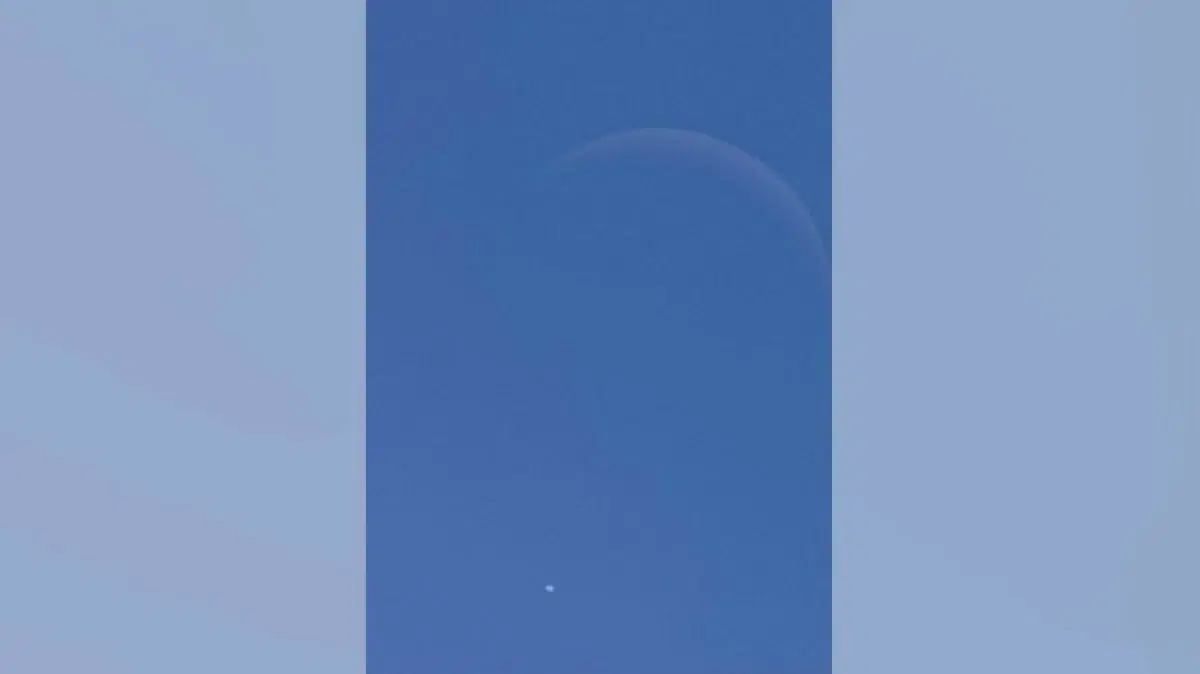
The Society had previously determined four main moments of the occultation relative to Amman and its suburbs, starting at 12:47 PM when the disk of Venus began to enter behind the moon's non-illuminated edge, before it was completely hidden at 12:49 PM.
Venus remained occulted behind the moon until 2:13 PM, when it began to appear from the moon's illuminated edge, before it completely emerged at around 2:15 PM.
According to the Society, the total occultation duration, between the complete disappearance of Venus and the beginning of its reappearance, was about an hour and 24 minutes, while the entire phenomenon, from the start of the planet's disk entering behind the moon until its complete emergence, took about an hour and 28 minutes.
The Society explained that the moon and Venus appeared during the observation in the crescent phase, pointing out that the transition of the Venus disk from the beginning of its entry behind the moon to its complete disappearance took about two minutes, a duration associated with the appearance of Venus as a disk with a perceptible angular diameter, unlike distant stars that appear as points of light.
The observational recordings, according to the Society, showed a great consistency between the actual times of disappearance and appearance and the timings determined by the theoretical calculations in advance.
It pointed out that the timing of the occultation of celestial bodies is affected by the observer's geographical location, in addition to the movement of the moon and the planet, and slight differences in the moments of contact may appear due to the terrain on the moon's edge, making the recording of times and comparing them with theoretical calculations part of the scientific documentation of the phenomenon.
The occultation occurred in broad daylight, making it more difficult to observe with the naked eye, while the Society said that the phenomenon was observed with the naked eye and binoculars, in addition to computerized telescopes and astronomical cameras.
It explained that lunar occultations are not observed from all regions of the world at the same time due to the moon's relative proximity to the Earth and the difference in its apparent location relative to celestial bodies depending on the observer's location.
According to the Society's calculations, the next occultation of the planet Venus behind the moon, which will be visible from Jordan, will occur on January 10, 2032, and it will cross the visibility range of parts of Asia, Africa, and Europe, with Jordan within the visibility area.