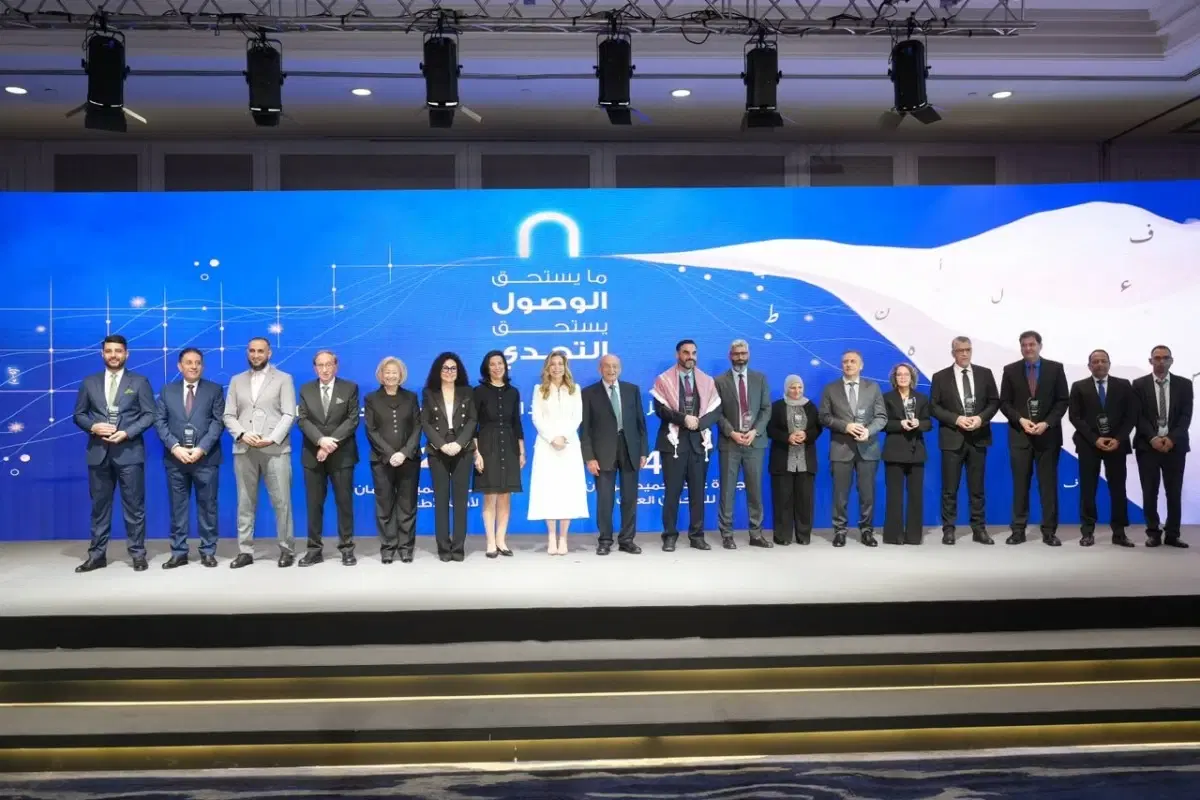
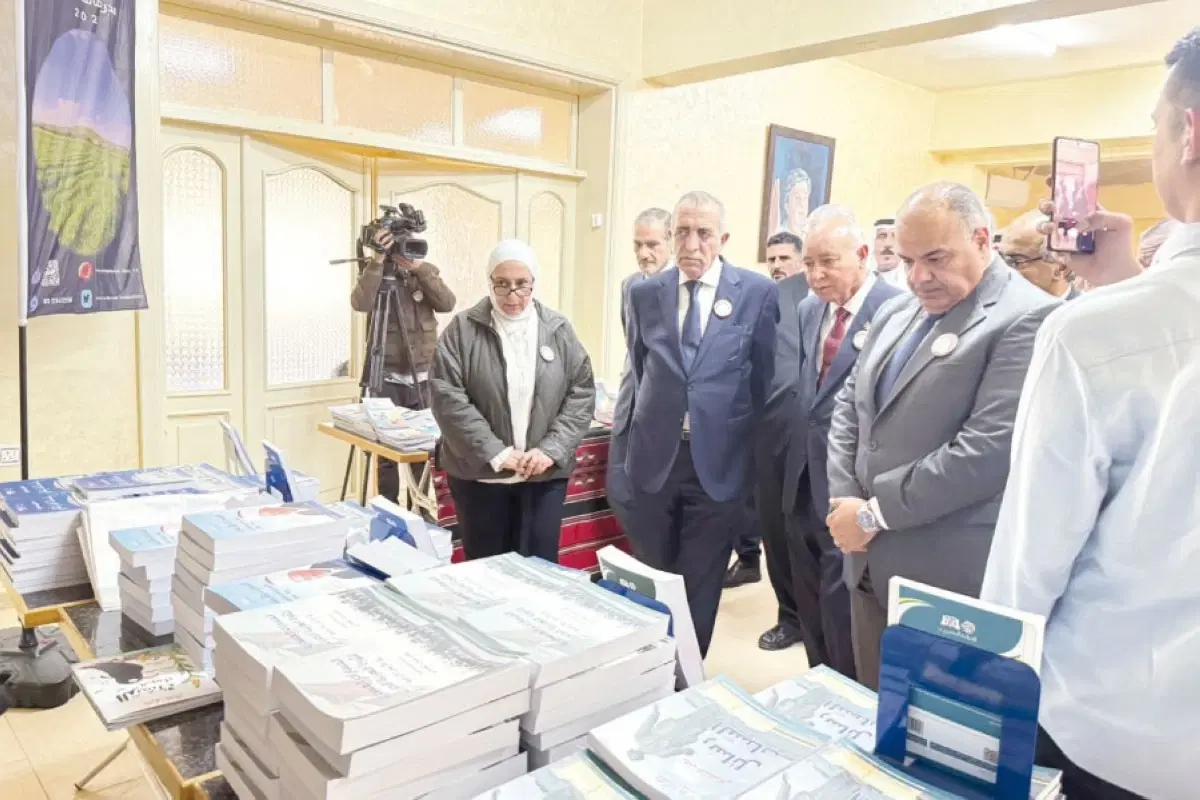
In her speech during the ceremony, HRH Princess Ghida Talal emphasized the importance of providing a supportive environment for scientists and researchers, including the necessary resources and sufficient time for scientific research, and strengthening scientific partnerships at both regional and international levels, noting the role played by the Abdul Hameed Shoman Foundation in supporting Arab scientific research and acknowledging the achievements of researchers.
Her Highness noted that since the launch of its award forty-four years ago, the Foundation has believed in the importance of investing in the Arab mind and its ability to contribute to the production of knowledge, stressing the need for the success of an Arab scientist to become a firm rule rather than an exceptional case worthy of celebration.
For her part, the Foundation's CEO, Valentina Qussisiya, emphasized that scientific and creative achievements often begin with a question that opens new horizons for knowledge, pointing out that scientific curiosity alone is not enough unless an environment exists that believes in the owners of ideas and grants them the opportunities to experiment, try, and persist.
She stated that the Foundation seeks to enhance the presence of science and creativity in the lives of Arab societies and to prepare opportunities for scientists, researchers, and writers to realize their potential, noting that Arab talents have proven their ability to add to human knowledge despite the persistent gap between available capacities and the opportunities granted to them.
She added that bridging this gap requires a shared responsibility starting from education based on developing curiosity and thinking, extending to universities, research centers, and institutions that invest in ideas and transform them into tangible achievements that positively reflect on people's lives.
Qussisiya explained that investment in knowledge is a long and cumulative path that requires time and continuity for its results to emerge, affirming that a small idea might transform into an achievement whose impact extends to future generations.
She clarified that the Arab Bank's establishment of the Abdul Hameed Shoman Foundation in 1978 stemmed from a belief in the importance of investing in humans and knowledge, while the Foundation's awards, since their launch in 1982, have continued their role in appreciating Arab scientific and creative excellence and encouraging new generations to continue the journey of research and innovation.
A new award for international scientific excellence
In a new move to enhance the presence of Arab scientific achievements at the global level, the Foundation announced the launch of the Abdul Hameed Shoman Award for International Scientific Excellence, aimed at celebrating Arab scientific achievements that have transcended geographical borders and contributed to the advancement of human knowledge.
The Chair of the Scientific Committee for the Abdul Hameed Shoman Award for Arab Researchers, Dr. Labib Khadra, announced that the Lebanese scientist Dr. Huda Zoghbi won the first cycle of the International Scientific Excellence Award for 2026, in recognition of her prominent contributions in the fields of neuroscience and genetics.
Zoghbi is considered one of the most prominent scientists in these two fields globally, and her scientific discoveries, most notably identifying the genetic cause of Rett syndrome, have contributed to a shift in understanding neurological disorders and opened new horizons for studying their causes and treatment possibilities.
Khadra affirmed that honoring Zoghbi represents recognition of an exceptional research career whose impact has reached scientists and researchers around the world, noting that the award carries a message affirming that science is not limited by geography, and that major discoveries may begin with a question in a laboratory to cause a shift in humanity's understanding of the world.
Three winners of the Children’s Literature Award
Regarding the results of the Abdul Hameed Shoman Children’s Literature Award for 2026, which was dedicated to stories aimed at children aged six and older under the title "Childhood: A World of Challenges," the Syrian writer Mirna Alloush won first place for her story "My Cake is Crooked... But It’s Tall."
Jordanian writer Haneen Abu Taleb came in second place for the story "My White and Gold Scarf," while Egyptian writer Minnatallah Al-Sayed came in third place for the story "Anxiety on Planet Ruqan."
The award falls within the framework of the Foundation's efforts aimed at supporting Arab children’s literature and encouraging writers to provide creative works that contribute to developing children's imagination and enhancing their abilities to express, think, and deal with challenges.
12 researchers win the Arab Researchers Award
In the 44th cycle of the Abdul Hameed Shoman Award for Arab Researchers for 2026, 12 researchers of various Arab nationalities won across six scientific fields and 12 research topics.
The awards were distributed by nationality as follows: five winners from Palestine, four from Egypt, two from Jordan, and one from Tunisia, in various scientific and research fields that reflect the breadth of Arab researchers' interests and their diverse knowledge contributions.
In the field of Medical and Health Sciences, Prof. Dr. Muwaffaq Househ from Jordan won for the topic "Telemedicine and Digital Health," while Prof. Dr. Ahmed Abu Tayoun from Palestine won for the topic "Genomics and Precision Medicine."
In the field of Engineering and Technological Sciences, Dr. Inas Al-Sayed Ali from Egypt won for the topic "Applications of Green Hydrogen and its Derivatives," while Prof. Dr. Haitham Abu Al-Rub from Palestine won for the topic "Smart Electrical Power Grid Technology."
As for the field of Water, Energy, and Food Sciences, Prof. Dr. Khawla Khwaldieh from Tunisia won for the topic "Circular Economy and Energy Efficiency in Sustainable Agriculture," while Prof. Dr. Mamdouh Issa from Egypt won for the topic "Soil Health and Fertility Management."
In the field of Basic Sciences, Prof. Dr. Bassem Shihada from Palestine won for the topic "Smart Mathematical Modeling and its Applications," while Dr. Mohamed Mohamed from Egypt won for the topic "Artificial Intelligence and Smart Earth Monitoring."
In the field of Economic and Administrative Sciences, Dr. Mohamed Al-Ghababsheh from Jordan won for the topic "Supply Chain Management," while Dr. Moez Aliya from Palestine won for the topic "Financial and Administrative Disclosure."
In the field of Humanities, Social, and Educational Sciences, Dr. Ahmed Qabha from Palestine won for the topic "Memory Studies," while Prof. Dr. Alaa El-Din Mohamed from Egypt won for the topic "Emotional and Social Intelligence in the Educational System."