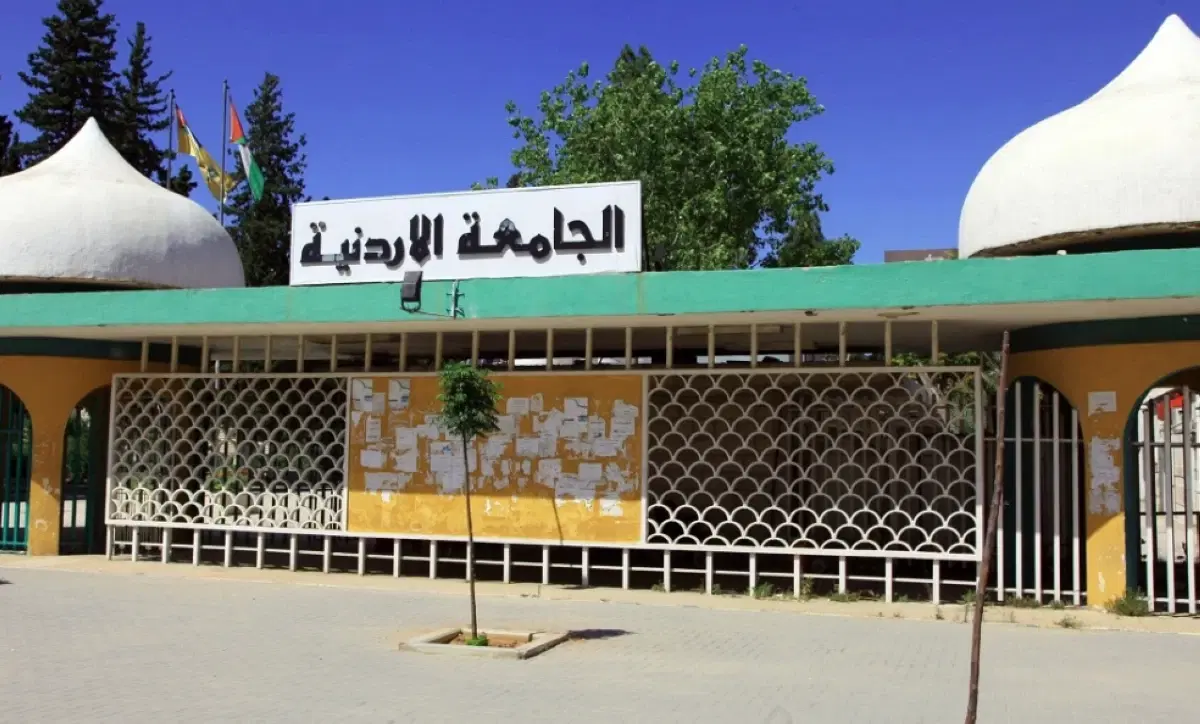
"University of Jordan" ranks seventh in the Arab world for research impact and third for the impact of its scientific journals
Amman5 min read
Share
The University of Jordan ranked seventh among Arab universities and institutions in terms of "research impact" for its affiliated authors, and third in terms of the impact of its scientific journals, according to the 11th annual report of the Impact Factor and Citation Report for Arab Scientific Journals "Arcif" for 2026.
The total number of citations achieved by authors affiliated with the university reached 10,870 from 2,301 cited articles, while its scientific journals achieved 20,722 citations from 3,555 articles, with an average of 5.83 citations per article.
Jordan achieved the seventh and eighth positions in the first index, as Yarmouk University came in eighth place with 10,692 citations from 2,073 cited articles.
The report, which is one of the initiatives of the "E-Marefa" database for Arab scientific production and content, showed that the top ten universities and research institutions in terms of the number of citations belong to six Arab countries: Egypt, Iraq, Saudi Arabia, Jordan, Algeria, and Palestine.
The report's results are based on two main indicators: the first measures the volume of production and impact achieved by authors affiliated with universities and research institutions in terms of citations of their research published in Arabic, covering 1,448 universities and institutions.
The second indicator includes the ranking of universities and institutions as publishers of scientific and research production in Arabic through their journals, based on the number of citations of articles published in these journals, totaling 519 universities and institutions.
In the results of the first index, Ain Shams University in Egypt topped the list with 20,653 citations from 3,926 articles, followed by the University of Baghdad in Iraq with 18,980 citations from 6,456 articles, then King Saud University in Saudi Arabia with 14,752 citations from 2,787 articles.
Capital University (formerly Helwan) came in fourth place with 13,936 citations from 3,588 articles, Cairo University fifth with 12,643 citations from 3,119 articles, and Al-Azhar University sixth with 12,384 citations from 3,174 articles, all of which are in Egypt.
Assiut University ranked ninth with 10,328 citations from 2,351 articles, and Benha University ranked tenth with 10,122 citations from 1,867 articles.
In the results of the second index, Ain Shams University maintained the first position with 30,799 citations from 5,453 articles, with an average of 5.65 citations per article, followed by Cairo University with 20,919 citations from 4,196 articles, with an average of 4.99.
The University of Baghdad came fourth with 20,159 citations from 6,670 articles, Kasdi Merbah University of Ouargla in Algeria fifth with 18,149 citations from 3,329 articles, and Assiut University sixth with 17,903 citations from 3,543 articles.
Sohag University ranked seventh with 16,552 citations from 2,156 articles, with an average of 7.68 citations per article, and the Islamic University of Gaza in Palestine eighth with 14,147 citations from 1,955 articles, with an average of 7.24.
The University of Echahid Hamma Lakhdar in El Oued, Algeria, came ninth with 14,099 citations from 4,190
articles, and Ziane Achour University in Djelfa, Algeria, tenth with 13,613 citations from 5,238 articles.
On the other hand, the report's results showed a remarkable growth in the "research impact" of Arab universities and scientific and research institutions.
The "Arcif" scientific teams examined more than 5,600 scientific and research journals published in Arabic by more than 2,600 scientific and research bodies, and 1,303 journals succeeded in meeting the 32 criteria adopted by "Arcif," which are compatible with international standards for international impact factors.
These journals are published by 19 Arab countries, excluding Somalia, Djibouti, and the Comoros, in addition to 9 foreign countries: Britain, Turkey, America, Malaysia, India, the Netherlands, Iran, Pakistan, and South Africa.
Citation data is based on a review of more than 1,070,000 scientific articles published in Arab scientific journals, in addition to data on 413,000 Arab authors, and the results showed that more than 135,000 of them had their scientific and academic production cited.
The head of the "Arcif" impact factor initiative, Professor Dr. Sami Al-Khasawneh, said that "Arcif" is an Arab scientific project that constitutes a civilized alternative to Western indicators and contributes to highlighting Arab scientific production and measuring its research impact.
He explained that the project moves this production from the circle of the "invisible" or "absent" and the marginalization placed upon it by foreign indicators, to the circle of "visible existence" and "recognized" status that can be measured and shown to Arab and international scientific and research communities.
A digital version of the report will be issued in PDF format and made available to researchers, academics, experts, and decision and policy makers in the field of Arab scientific research and publishing before the end of the current year.
"Arcif" is subject to a supervisory and coordination council consisting of representatives from the UNESCO Regional Bureau for Education in the Arab States in Beirut, the United Nations Economic and Social Commission for Western Asia (ESCWA), and the "E-Marefa" database, in addition to a scientific committee of experts and academics from several Arab and foreign countries. It provides its data through various reports for countries, institutions, researchers, disciplines, and others through an advanced digital platform on the website http://emarefa.net/arcif.