President of the Senate inaugurates the conference "Community Security and Peace is Our Responsibility" in Al-Mazar Al-Janoubi
Amman8 min read
Share
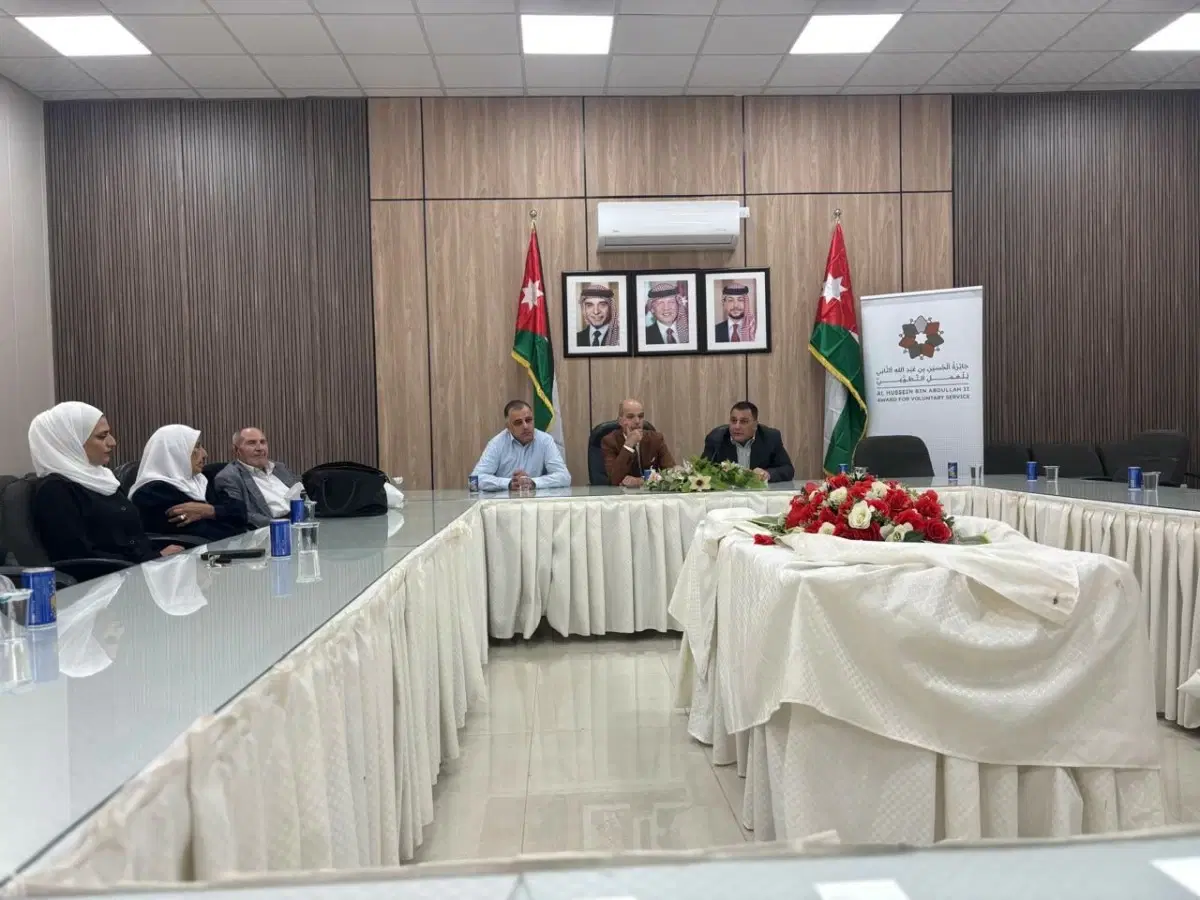
The President of the Senate, Faisal Al-Fayez, inaugurated the National Educational Conference titled "Community Security and Peace is Our Responsibility" organized by Al-Thawabit Private Educational Schools in the presence of official figures, directors, sheikhs, notables, academics, educators, and a crowd of ladies and members of the local community.
Al-Fayez said during his patronage of the opening events that community security and peace are not a gift, a marginal issue, or built solely by laws and security measures, but by a cohesive society; community peace is not just a slogan we raise, but a daily practice and national behavior, every responsible word, and every initiative that brings together and does not divide is a new brick in building a more secure and stable society, and one that has the ability to shape the future.
He added that Jordan, due to its geopolitical location, has faced significant challenges since its establishment and has been the most affected by regional events, but it has remained a resilient state, due to the wisdom of the Hashemite leadership, the sacrifices of the fathers and grandfathers, the awareness of its people, and the vigilance of its security and military agencies, proving that Jordan, throughout its history, has been an oasis of security and stability in a region swept by conflicts and political crises, therefore everyone must realize, especially the youth of the nation, that national security and the social peace we enjoy are the real guarantee for the future of our generations and the future of our nation.
Al-Fayez explained that the challenges have increased in our time due to political and security instability in many Arab countries, the spread of terrorism and extremism, the scourge of drugs, the repercussions of October 7, the Iranian-American-Israeli war, and its impact on the stability of the region, and today the drums of war are beating strongly in the region, but the most dangerous challenge is the continuation of the aggressive and expansionist policies of the Israeli occupation state, its pursuit of annexing the West Bank and liquidating the Palestinian cause, forcibly displacing the Palestinian people, and making Jordan an alternative homeland for the Palestinians, in addition to its futile attempts to tamper with the Hashemite custodianship, and the danger of the illegitimate Israeli policies in Jerusalem, aimed at consecrating the occupation in all the occupied Palestinian territories, in addition to the Iranian ambitions in the region, stressing that these challenges are confronted by Jordan with strength, as it confronts suspicious plots, and rejects any solutions at the expense of its national constants, or tampering with its sovereignty, security, and stability, in addition to the fact that Jordan's positions are firm towards the Arab-Palestinian conflict, empowering the Palestinian people to achieve their rights, and establishing an independent Palestinian state, and Jordan also rejects Iranian attacks on the Kingdom and the Arab Gulf States, and will continue to confront them, and will not allow it to be a battlefield for the conflicting parties.
Al-Fayez expressed his pride in the position of His Majesty King Abdullah II, as he warns from various international platforms against harming Jordan and its deep-rooted national constants, and strongly defends Arab issues. His Majesty, in his recent speech before the United Nations General Assembly, warned the international community against the aggressive Israeli policies in the region, affirming that Jordan will confront any attempts to harm its security and stability, and that Jordan's security, northern borders, and water security are an integral part of its national security, and this firm and strong royal position reflects the constants of the Jordanian state in protecting its supreme interests, and dealing with any threat to its security and stability as something that cannot be ignored. And thus, His Majesty revealed to the international community the reality of the extremist Zionist entity, and the war crimes it commits in the occupied West Bank and the Gaza Strip, and called on the international community to hold it accountable for its crimes, and that this entity should not remain outside the umbrella of international law.
Al-Fayez pointed out that His Majesty affirmed that while Jordan is committed to just peace, supporting the steadfastness of the Palestinian people, and continuing to carry the Hashemite custodianship, and preserving the historical and legal status quo of the Islamic and Christian holy sites in Jerusalem, he affirmed that Jordan's adherence to diplomacy does not exceed its commitment to humanitarian values, and should not be misinterpreted as weakness.
Al-Fayez emphasized that community peace has become a real criterion for the strength of the state and the cohesion of society, and the ability to face crises and challenges, as community security and peace do not mean that we all agree, but that we differ without turning into enemies, and that we resort to the law instead of force, and to dialogue instead of exclusion, and to national interest instead of narrow interests, therefore we must believe in the culture of dialogue, and reject the language of defamation, suspicion, and hate speech, and reject violence, sectarianism, and regionalism, as a cohesive society whose members are linked by relationships of trust, respect, national belonging, and loyalty to its political leadership, is more capable of preserving its security and stability.
The founder of Al-Thawabit Schools, lawyer Muhammad Saleh Al-Trawneh, said that peace is not a word we say, but a value we live, and tolerance is not weakness, but the courage of great souls. Under the Hashemite banner, Jordan, led by His Majesty King Abdullah II, is committed to its identity and constants, and believes in dialogue, moderation, and coexistence. In Jordan, the Hashemite leadership is not just a name in history, but a presence in the consciousness, and a banner that brings together and a homeland we meet out of love for it; thus, the meanings of loyalty and belonging remain rooted in the hearts of Jordanians.
He added that we believe that community security and peace are not made by one party, but by a kind word, an aware family, a teacher who educates, a reformer who brings hearts together, and youth who carry the homeland in their conscience, indicating that this is why the role of Al-Thawabit Schools goes beyond the limits of education to the realm of society; it held the National Forum for Parents, affirming that the family and the school are partners in raising the human being and building the future.
Dr. Ali Al-Faqra, Director of Education for the Southern Mazar Governorate, said: "From building the learner to building the human being, a vision for building a secure and balanced society is formed." When we talk about community security and peace, we are not just talking about the absence of crime or violence, or about the measures taken when the problem occurs, but we are talking about a culture of society, and human awareness, and a system of values that is built early, and grows with the human being until it becomes part of his behavior and decisions.
He added that from my position as an educational expert, I see that education has a role that goes beyond the limits of education in its traditional sense; education is one of the most important preventive tools through which we can build a human being capable of managing his differences, controlling his behavior, respecting others, and taking responsibility for his homeland and society, indicating that in educational work, it is not enough to deal with the problem after it occurs, but we must ask how we can prevent it from happening in the first place? And here lies the strength of education. The child who learns from a young age that dialogue is a means of resolving conflict, that violence is not a means of proving oneself, that difference does not mean enmity, and that the other has rights that must be respected; he is more prepared in the future to be a citizen who contributes to the stability of his society. Therefore, education in security and peace is not an additional lesson that we put in the curriculum, but a culture that should be shaded in the entire educational environment.
The celebration included many speeches that emphasized the importance of community peace in expressing the strength of the state and the cohesion of society, and the ability to face crises and challenges of all kinds and forms.