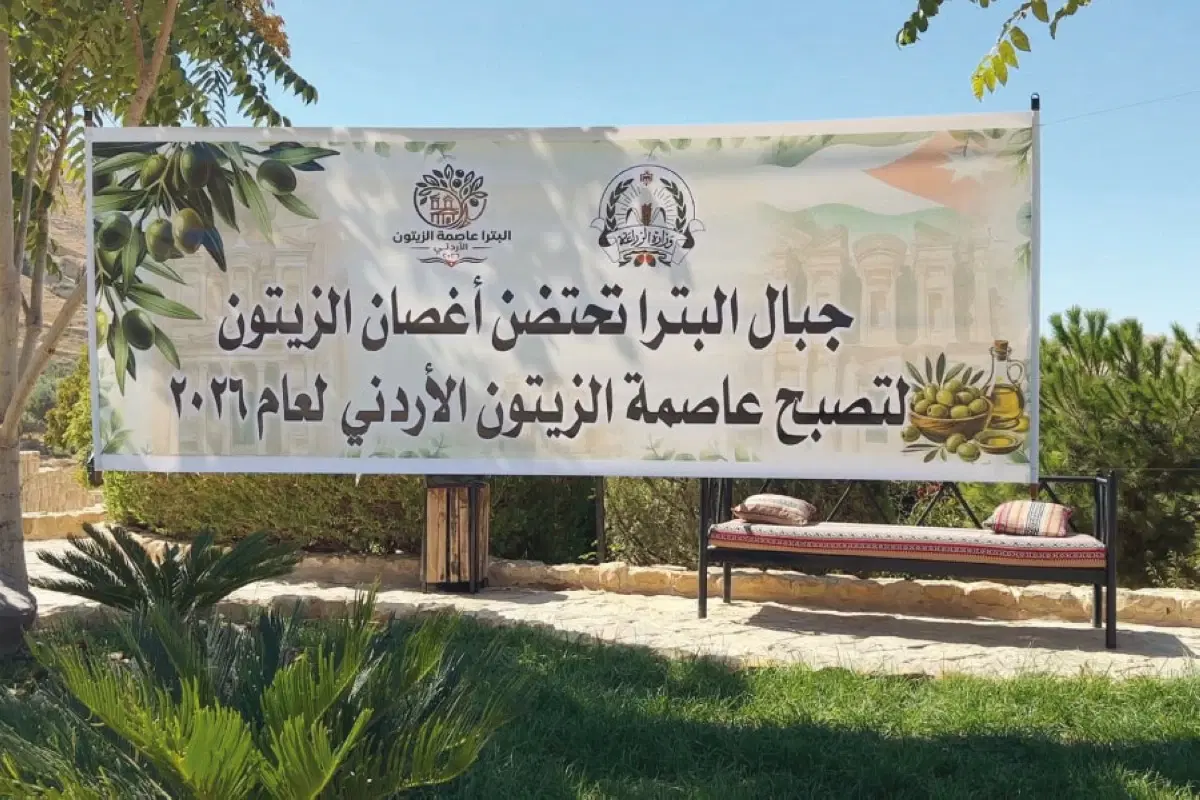
Al-Hayari added that the launch of Petra's activities as the capital of olives comes within the efforts to support agricultural and tourism development in the region, pointing to the Ministry's intention to sign a memorandum of understanding with the Petra Development and Tourism Authority, as part of efforts to support the agricultural sector.
Al-Hayari renewed the Ministry's keenness to support the agricultural sector's endeavors in Petra, which contributes to preserving green spaces and making this sector also a source of income and economy in the city.
For his part, the Director of Petra Agriculture, Engineer Akef Al-Dhunebat, confirmed that the announcement of Petra as the capital of olives for 2026 comes to link the agricultural heritage with the tourist heritage, and emphasizes the importance of the status of olives as one of the most important components of the agricultural wealth in the region.
Al-Dhunebat explained that the Petra Agriculture Directorate strives with all its capabilities, in cooperation with farmers, to enhance the preservation of cultivated areas and increase them, alongside spreading awareness among generations about the importance of expanding olive cultivation and various types of fruit trees.
The Head of the Plant Production Section at the Petra Agriculture Directorate, Engineer Sabah Al-Alaya, presented the importance of olives, which are one of the most important economic and agricultural trees in the Petra Governorate, as its cultivation extends over an area estimated at about 6,700 dunums, and its roots in the history of the region date back to ancient times, until its presence was linked to the land of Petra and its agricultural heritage inherited through generations.
According to Al-Alaya, the varieties of olives cultivated in the governorate vary, and the most prominent are the Arabic or Roman variety, Nabali, Nabali Al-Muhassan, and Nabali Al-Baladi, reflecting the agricultural diversity and specificity of the local environment.
The President of the Rajef Association, Salem Al-Ruwaijfah, considered the announcement of Petra as the capital of olives as an event that encourages agriculture, alongside linking olive groves to tourist routes, calling for the importance of giving the agricultural sector more support and attention.
The launch ceremony, which was attended by the Governor of Ma'an, Khalid Al-Hajjaj, and a wide number of those concerned, included a bazaar of folk heritage and local products, alongside a visit to one of the oldest popular olive presses in Wadi Musa.