Palestine Committee in the Senate meets the German Ambassador
Amman6 min read
Share
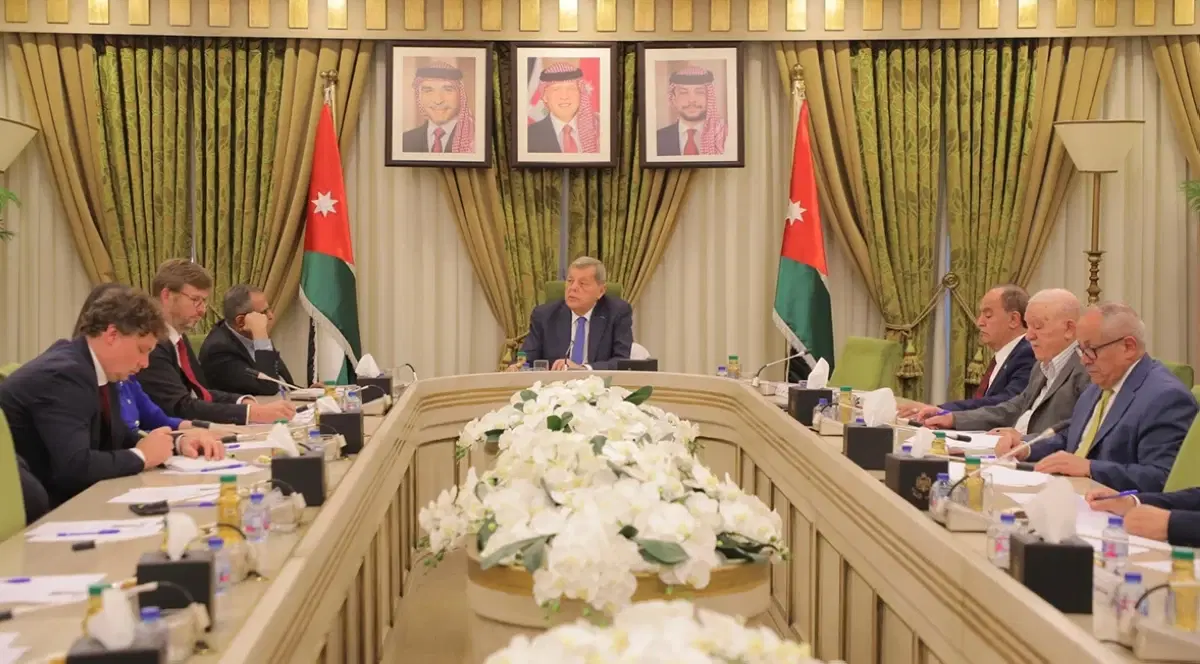
The Palestine Committee in the Senate, chaired by Senator Mazen Darwazeh, met today, Thursday, with the Ambassador of the Federal Republic of Germany to the Kingdom, Dr. Bertram von Moltke, to discuss the latest developments related to the Palestinian cause, political and humanitarian developments in the Palestinian territories, and the international efforts required to protect civilians and achieve a just and comprehensive peace.
Senator Darwazeh emphasized the depth of Jordanian-German relations, which span more than seven decades, appreciating German support for Jordan in the water, development, and education sectors, and the Kingdom's efforts in hosting refugees and dealing with the humanitarian and economic burdens resulting from regional crises, in addition to the educational and cultural partnership embodied by the German Jordanian University.
He pointed to the historical relations based on cooperation between the two countries, including the educational legacy of the Schneller Institute and the Theodor Schneller School in Jordan, stressing that Jordan's security and stability constitute a regional and international strategic interest, and that continued Jordanian-German coordination gains double importance in light of the challenges facing the region.
Darwazeh stressed that the Palestinian cause remains the core of the conflict in the region, emphasizing the necessity of ending the occupation and enabling the Palestinian people to determine their own destiny and establish their independent and viable state on the June 4, 1967 lines, with East Jerusalem as its capital, based on the two-state solution. He also valued the German position supporting this solution, stressing the importance of translating it into effective political and diplomatic steps.
He pointed to what His Majesty King Abdullah II emphasized in his speech before the United Nations General Assembly regarding the necessity of accountability for violations and the rejection of continuing to manage the conflict instead of working to resolve it, warning of the repercussions of land confiscation, entrenching settlements, and imposing new facts on the ground.
Darwazeh stressed the importance of preserving the Hashemite Custodianship of Islamic and Christian holy sites in Jerusalem, safeguarding the historical and legal status quo there, and confronting escalating Israeli practices in Jerusalem and the West Bank, including storming and attacking holy sites, settlement expansion, and settler attacks, as they pose a threat to peace opportunities and undermine the two-state solution.
Regarding the Gaza Strip, he stressed the necessity of intensifying international efforts to ensure the sustainable and sufficient delivery of humanitarian, medical, and relief aid, opening crossings for it without obstacles, securing the basic needs of the population, protecting civilians, especially children and the most vulnerable groups, establishing a ceasefire, and moving to serious efforts to reconstruct the Strip and rehabilitate its infrastructure and health facilities.
Darwazeh valued the German aid provided to the Gaza Strip and the Jordanian-German cooperation in delivering it, including airdrop operations, stressing that these efforts should be accompanied by ensuring the regular and sufficient flow of aid through land crossings.
He also emphasized the importance of strengthening Jordanian-German cooperation to support the recovery of the health sector in Gaza, through the rehabilitation of hospitals and medical facilities, providing necessary medicines and equipment, and training health personnel in coordination with the competent Palestinian authorities and relevant international institutions, in addition to continuing support for the United Nations Relief and Works Agency for Palestine Refugees (UNRWA), and enabling it to continue providing its humanitarian, educational, and health services to Palestinian refugees.
He also stressed the necessity of protecting journalists, medical crews, and humanitarian workers, ensuring their ability to perform their duties in the Strip without being targeted or restricted, respecting international law, supporting relevant international mechanisms and their independence, and enhancing accountability and ending impunity.
Senator Darwazeh pointed to the danger of the continuation of Israeli violations in the Palestinian territories, and the worrying developments witnessed in the Jordan Valley and southern Syria, stressing Jordan's rejection of unilateral measures and the violation of the sovereignty of states, and the necessity of taking a clear international position that supports respect for international law, protects the legitimate rights of the Palestinian people, and preserves the security of Jordan and the stability of the region.
He noted that the current stage requires moving from emphasizing principles to practical steps that contribute to protecting civilians, alleviating humanitarian suffering, supporting the steadfastness of the Palestinian people, and preserving the opportunities for achieving the two-state solution, stressing the importance of continuing Jordanian-German dialogue, consultation, and coordination in political, humanitarian, and development fields, in a way that contributes to achieving a just and lasting peace.
For his part, the German Ambassador, Dr. Bertram von Moltke, confirmed that the Palestinian cause concerns everyone, including Germany, stressing that there are no differences in the Jordanian and German positions towards fundamental issues, especially the Palestinian cause, and that both positions are clear regarding the necessity of ending the occupation and enabling the Palestinian people to obtain their legitimate rights.
He confirmed that Germany's position supports the establishment of an independent Palestinian state on the June 4, 1967 borders, ending the conflict, and achieving peace, noting that the speech of His Majesty King Abdullah II before the United Nations General Assembly was one of the strongest speeches that addressed the Palestinian cause and developments in the region.
He pointed to the clarity of the German position regarding the attacks on the historical and legal status quo in Jerusalem, confirming the alignment of the German position in this regard with the Jordanian position, and the necessity of respecting the status quo and protecting the holy sites.
Regarding the Gaza Strip, the German Ambassador confirmed that his country opposes the war and the destruction it is witnessing, stressing the necessity of delivering humanitarian aid and opening crossings for it to ensure it reaches the needy population.
He pointed to Germany's participation in airdrop operations of aid to the Gaza Strip, stressing the need to intensify these efforts and increase the aid provided to alleviate the suffering of the population.
He also confirmed Germany's support for His Majesty King Abdullah II's initiative regarding the evacuation of sick children from the Gaza Strip and their treatment in Jordan, in cooperation with the Kingdom, appreciating Jordanian efforts in the humanitarian field, and stressing the importance of continuing to support the United Nations Relief and Works Agency for Palestine Refugees (UNRWA), and enabling it to continue providing its services to Palestinian refugees.
The Ambassador reiterated Germany's support for the establishment of an independent Palestinian state and ending the conflict, leading to the achievement of a just and lasting peace in the region.